
MLA 'shocked' by no-jail sentence given to serial criminal who crashed stolen car in a high-speed chase
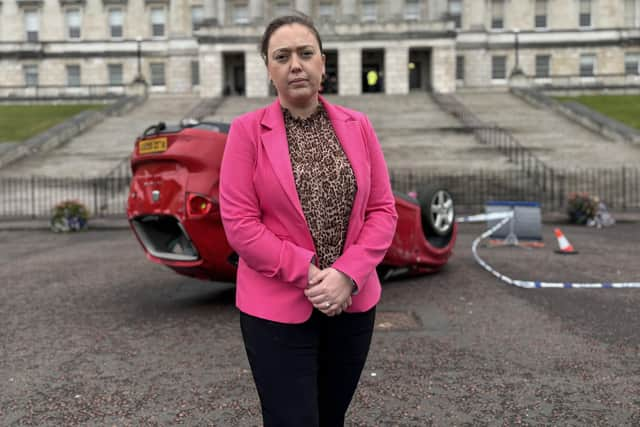
The chairwoman of Stormont's transport committee has declared herself "shocked" at the sentence handed down to a serious motoring offender.
DUP MLA Deborah Erskine said that the case shows a need for "tougher sentences for repeat offenders".
She was adding her voice to that of UUP MLA Doug Beattie, who had voiced similar dismay over the sentencing a day earlier.
It is the latest in a string of sentences for serious rule-breaking by drivers which has been featured in the News Letter.

This case in question involves Thomas James Coleman, 32, of no fixed abode.
He was caught in a stolen Dacia Sandero filled with £400-worth of shoplifted goods in Antrim last May.
When police tried to pull him over he fled at speed, reaching over 100mph and causing other vehicles to swerve off theroad to avoid being hit.
While carrying a passenger, he then lost control on a roundabout and crashed into a barrier.
When he was extracted from the car his pupils were dilated and he was unsteady on his feet.
He admitted a suite of offences including dangerous driving and driving while unfit when he appeared before Ballymena Magistrates' Court, sitting in Antrim, on Tuesday.
He was given one year of probation and a two-year driving ban.
He had 107 previous convictions.
During the hearing, the judge was told that probation would be harder for Coleman than jail, because he was used to prison and probation would force him to "fix his life".
The sentence cannot be appealed because it was handed down in a magistrates' court, not a crown court.
Mrs Erskine, chairwoman of the Infrastructure Committee, said: "This case highlights the urgent need for reform in our prisons and tougher sentences for repeat offenders who show blatant disregard for public safety.
"Driving a stolen vehicle at over 100mph, endangering countless lives, and committing multiple crimes should not be met with probation alone.
"With more than 100 prior convictions, the defendant has repeatedly demonstrated an unwillingness to reform, making a lenient sentence not just ineffective but a direct threat to the public.
"Justice must serve as both a deterrent and a means of protecting law-abiding citizens.
"Soft sentencing only fuels the cycle of reoffending. The courts must take a firmer stance before tragedy strikes."
The Lady Chief Justice's office, representing the judiciary, has said: "The sentencing framework within which all judges must act is set in legislation.
"In cases where the prosecution is brought in the Magistrates’ Court, the sentencing powers are lower than they are if the case was prosecuted in the Crown Court…
"In general terms, the sentence imposed in an individual case will depend on the specific circumstances of that case.
"In calculating the appropriate sentence for a particular offence, the judge will consider the maximum sentence which the court can impose (as set out in legislation), all of the evidence provided to the court, any sentencing guideline judgments relevant to the offence committed, whether the offender pleaded guilty and when, the level of culpability, the offender’s previous convictions, and any other aggravating or mitigating factors presented to the court by the prosecution and defence."
A day earlier, Doug Beattie had said: "It's time the minister acted and swerving questions with 'the judiciary is independent' is simply not good enough. She should legislate and give guidance and direction now.”
The Department of Justice spokesperson responded: “Sentencing in individual cases is a matter for the independent judiciary as are sentencing guidelines. This is not a matter of the minister avoiding issues.
"The minister has no power to direct the judiciary: to do would fundamentally undermine the independence of the judiciary and amount to political interference in due process.
"Where an offence may be tried in the magistrates’ courts or the Crown Court, it is a matter for the independent PPS to decide which court is appropriate, taking into consideration all the facts of the case.
"In such cases, the choice of court determines the maximum sentence available for the offence.
"A range of sentences imposed in the Crown Court, where higher sentences can be imposed, may be referred by the DPP to the Court of Appeal as being unduly lenient.
"The department’s forthcoming Sentencing Bill will extend these arrangements to all sentences imposed in the Crown Court."