
Only seven people charged with supporting terrorism across whole of Northern Ireland in 10 years, figures reveal
Just seven people have been prosecuted in 10 years across all of Northern Ireland for supporting or encouraging terrorism, the News Letter can reveal.
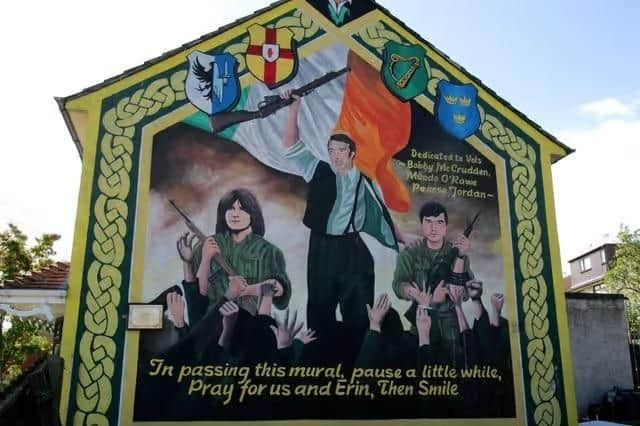
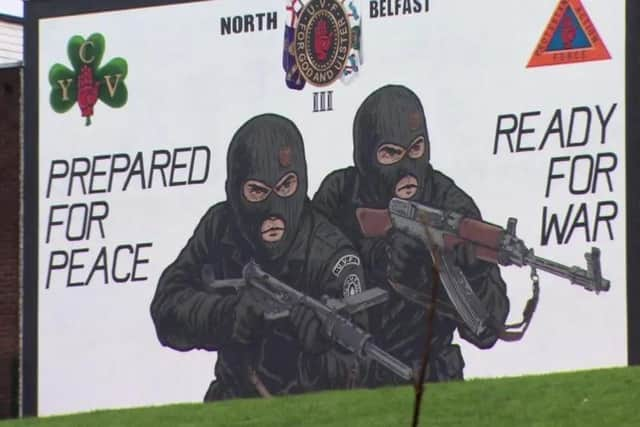
The DUP has said in response to the figures that there is "a perception that a blind eye is turned" to terror displays.
The PSNI has responded by saying it "would never ignore paramilitary or terrorist activity".
The news comes just as the PSNI faces questions over the absence of arrests of protestors in Belfast and Londonderry who held up signs which stated "I oppose genocide, I support Palestine Action".

Palestine Action is a proscribed group, and in London protestors who did the same thing faced mass arrest.
The figures have come to light thanks to the Freedom of Information Act.
The News Letter asked the PSNI about the number of people arrested and charged under different sections of the Terrorism Act 2000 from 2014/15 to 2023/24.
It did not have pure arrest figures, but did have figures for those who were arrested under Section 41 of the Terrorism Act and then subsequently charged under the following sections:
Section 11 (membership of a proscribed organisation);
Section 12 (inviting support for a proscribed organisation);
And Section 13 (displaying an article that arouses suspicion that you are a supporter of a proscribed organisation).
The number charged under Section 11 (membership) over that decade was 46: of which 39 were republican, and seven were loyalist.
The number charged under Section 12 (inviting support) was three: all republican.
And the number charged under Section 13 (displaying articles in support) was four: three republican, one loyalist.
The single-digit charges for people under Sections 12 and 13 came despite the law being beefed up in 2019 to cover more pro-paramilitary actions.
Since 2019, Section 12 has been widened beyond just "inviting support for a proscribed organisation" to cover anyone who "expresses an opinion or belief that is supportive of a proscribed organisation, and in doing so is reckless as to whether a person to whom the expression is directed will be encouraged to support a proscribed organisation".
Meanwhile Section 13 was expanded to cover not just anybody who "wears, carries or displays an article in such a way or in such circumstances as to arouse reasonable suspicion that he is a member or supporter of a proscribed organisation", but anybody who publishes an image of someone doing so.
Section 13 is the piece of law which was used in the failed prosecution in London of Kneecap rapper Liam O'Hanna for displaying a Hezbollah flag.
It has also been used to take prosecutions in Great Britain against hundreds of supporters of Palestine Action, a group which – unlike Northern Ireland's paramilitaries – was only proscribed five months ago and has never killed anyone.
‘THERE MUST BE NO NO-GO AREAS FOR THE LAW': DUP
When the figures were put to him, Paul Frew, DUP chairman of Stormont's justice committee, said: “The public rightly expect that anyone engaged in criminality linked to proscribed organisations – whether through membership, promoting support, or displaying material – should face the full rigour of the law.
"Too often there is a perception that a blind eye is turned to paramilitary or terrorist-linked activity, particularly when it comes from those with a political or community platform.
"That undermines confidence in the rule of law and sends the wrong message to victims and to wider society.
"There can be no hierarchy or no-go areas when it comes to law enforcement.“
‘IF WE SUSPECT AN OFFENCE, WE FULLY INVESTIGATE’
It was put to the PSNI that the number of membership charges – averaging fewer than five per year – was low.
It was also put to police that the numbers charged with showing and inviting support for terror are negligible, given how awash Northern Ireland's streets and social media are with pro-paramilitary displays and sentiments.
In response to this, and to Mr Frew's comments, the PSNI released a statement from Assistant Chief Constable Davy Beck.
In it, he said: "The PSNI investigates, and will continue to investigate, those individuals and groups – namely organised crime, paramilitary and terrorist groups – who would seek to cause harm within our communities.
“The circumstances of each incident will determine what action is taken, including commencement of an investigation.
“When officers suspect an offence has been committed, a full investigation is carried out and all available evidence presented to the Public Prosecution Service.
“In terms of terrorism-related offences, it’s extremely important to see the wider picture.
"For example, the offence of publishing images in support of a proscribed organisation is just one of a number of offences covered by the Terrorism Act.
“From October 2024 to September 2025, there were 19 security-related arrests under Section 41 the Terrorism Act, with five people subsequently charged.
"This is a result of, not only the proactive efforts of police, but also the support of local communities.
“When it comes to paramilitarism, please be assured that, working with our partners on the Paramilitary Crime Task Force (PCTF), we will continue to disrupt the activities of those who use a regime of fear and violence to exercise their control over communities…
“Please be assured that we would never ignore paramilitary or terrorist activity, or indeed any criminality.
“Working with our partners, and with the support of local people, our investigations will continue.
"And I am keen to take every opportunity to encourage anyone with information, or indeed concerns, to speak to us.”
He provided figures showing that, from its inception in 2017 until 31 October 2025, the PCTF has:
Carried out 1,313 searches;
Recovered over £12.1m of controlled drugs;
Seized 450 weapons and firearms;
Made 548 arrests;
Charged/reported for prosecution 585 people;
And "prevented over £98m in revenue loss".
The PCTF investigates "criminality" linked to the east Belfast UVF, west Belfast, north Antrim, and south-east Antrim UDA, and the Belfast and north-west wings of the INLA specifically.
Meanwhile the PSNI said its Serious Crime Branch investigates "homicide, kidnap incidents, terrorist related offences, intelligence led operations and other serious crime incidents".