
Police officer who covered up a phone call to the home of a murder suspect within hours of Robert Hamill attack is jailed for a year
A former police officer, labelled a “disgrace to the uniform,” was jailed for a year today after admitting conspiring to cover up a phone call he made to the home of a murder suspect within hours of Robert Hamill being fatally beaten by a loyalist mob.
Jailing 70-year-old retired RUC Reserve Const. Robert Cecil Atkinson at Craigavon Crown Court, Judge Patrick Lynch KC told the pensioner “it’s a disgrace that you as a serving police officer should stoop so low as to deliberately mislead an investigation which you knew concerned a serious assault you had witnessed.”
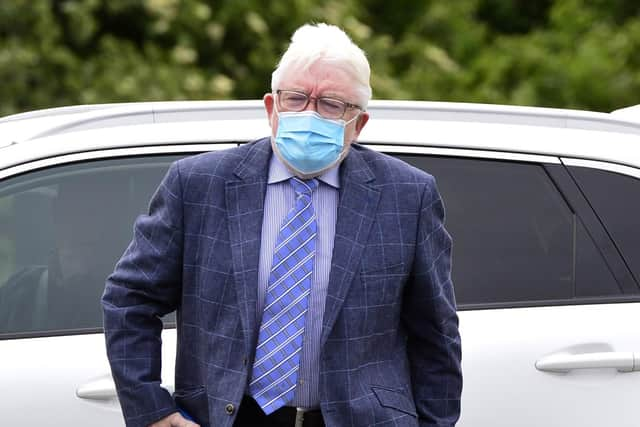

“Ultimately it turned into a murder enquiry where the son of the household you contacted was a suspect,” the judge told Atkinson, highlighting that the pensioner “is the only person in this courtroom” who could shed light on the contents of that call.Judge Lynch added however that Atkinson has never shown any co-operation and “even now will not shed light on the fateful phone call.”
“The public are entitled to expect the highest degree of probity from those entrusted to police and enforce the law,” the judge said and declared: “You have been a disgrace to the uniform.”
“You continued to serve as a police officer for years afterwards as a criminal because there’s no other description for you. It would seem to me and the wider general public to be an affront if you, the pro-generator and the beneficiary of the wider conspiracy, should escape the fate of Mr McKee who ended up in prison serving a sentence of six months,” the judge concluded.
On the second day of his trial last April Atkinson, from the Brownstone Road in Portadown, admitted that he had conspired with Andrea and Michael McKee to pervert the course of justice.
Following Atkinson’s admission, the PPS offered no further evidence against either defendant’s wife Eleanor Atkinson, 70, or against 72-year-old Kenneth Hanvey, from the Derryanvil Road in Portadown and accordingly, not guilty verdicts were recorded in their cases.
The charges arose after Robert Hamill was beaten by a loyalist mob in the early hours of 27 April 1997 and his serious assault, and later murder when he died on 8 May, was the subject of a public inquiry because it was alleged that four police officers were positioned in a police vehicle near the scene of the attack but did not intervene.Mr Atkinson was one of the officers in the police vehicle on the night Mr Hamill was attacked.
A total of six individuals, including Allister Hanvey, were charged with the murder but the charges against five of them, including Hanvey, were subsequently withdrawn due to insufficient evidence to prosecute while the sixth person, Paul Rodney Marc Hobson, was acquitted following a trial where Const. Atkinson gave evidence.
The charge against Atkinson arose because despite the fact that he rang the Hanvey household while Robert Hamill lay fatally injured in hospital, he concocted a story with the McKees that it had been Michael McKee who made the call.
Atkinson was first questioned about the phone call in September 1997 and although he initially denied it, police later obtained evidence establishing that a call lasting 95 seconds had been made at 08.37 and also that another call had been made a week later.
Interviewed again in October 1997 Atkinson claimed the McKees were staying at his house that night and that Michael McKee rang the Hanvey household to check whether Allister Hanvey’s girlfriend, Mr McKee’s niece, had gotten home safely “as he had heard there had been a commotion in Portadown town centre.”
The second phone call, Atkinson claimed, was to “discuss matters about martial arts.”Judge Lynch told the court the PPS were not seeking to rely on allegations made by Andrea McKee that Atkinson had “warned Allister Harvey to dispose of his clothing…in anticipation that the police would inevitably regard him as a suspect which indeed they did.”
“At that stage it was an enquiry into a serious assault” rather than murder and the judge said that with “no credible evidence” as to the content of the call, “it cannot be established that the call frustrated or was an attempt to frustrate a proper line of enquiry into the assault of Mr Hamill.”“It was however an attempt to frustrate an enquiry into a phone call that the accused was aware was connected to the investigation into the serious assault on Mr Hamill,” said Judge Lynch, adding that Atkinson “has never sought to provide an explanation for the call, he being the only person in this court who can from first hand knowledge tell us it’s contents.”He said while the specific contents of the call are not known “the court is entitled to come to a common sense conclusion” in circumstances where Atkinson “as a serving police officer must have been well aware of the gravity of deliberately misleading the investigators into a serious criminal offence which had it been discovered, would have ended his career in the police and may well end in a sentence of imprisonment.”
Turning to the appropriate sentence, Judge Lynch said he accepted there had been delay in bringing the case to a conclusion given that Atkinson was first questioned in 1997.
That delay, said the judge, would be reflected in a decrease of the sentence as would the defendant’s significant health difficulties.
He told Atkinson that if he had been convicted after a trial he would have been given a three years jail sentence but taking all maters into account, Judge Lynch jailed him for a year.