
PSNI speaks out on 'IRA army council' assessment in a statement that is near-identical to government one
The PSNI has issued a statement, seeking to clarify its position on the ongoing existence of the IRA.
The PSNI had told the BBC earlier this month that a 2015 security report which said that IRA structures remain intact “has not changed”.
That 2015 report had found that “the structures of PIRA remain in existence in a much reduced form” including “a senior leadership, the ‘Provisional Army Council’ and some ‘departments’”.
The PSNI’s comments that this analysis “has not changed” prompted anger from unionists, who took it to mean that the 2015 report was just as valid today as it was back then.
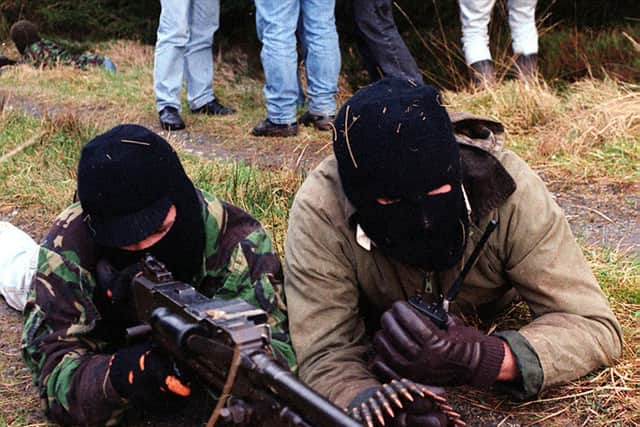

The issue has now been raised in Parliament by Tory peer Lord Caine, who asked the government today whether the security forces still consider that the 2015 report applies.
Labour peer Baroness Anderson replied: “The ‘Paramilitary Groups in Northern Ireland’ report was published in 2015 by the UK Government in order to provide a one-off factual assessment from the UK security agencies and the PSNI on the structure, role and purpose of paramilitary organisations in Northern Ireland.
"This public assessment, which was intended to inform the then ongoing cross-party talks, has not been repeated.
“Although it is acknowledged that some individuals engaged in serious criminality may also have ties to former paramilitary republican organisations, such activity does not present a threat to national security.
“The PSNI and UK security agencies continually assess the threat, risk and harm posed by paramilitary, terrorist and organised crime groups to inform the most appropriate operational response.
"The threat from Northern Ireland Related Terrorism (NIRT) is assessed by the Joint Terrorism Analysis Centre (JTAC), after MI5 passed over responsibility earlier this year.
"JTAC keeps the threat level in from NIRT under constant review and formally reviews it twice a year.
"However, the threat is wholly driven by violent dissident republicans who reject the Good Friday Agreement (GFA) and not by groups that support the GFA.
“Where any criminality exists, the Government is clear that it should be dealt with fully by the police.”
A statement was then issued by PSNI chief constable Jon Boutcher containing near-identical wording.
It claimed that the PSNI both does and does not assess terrorist threats.
In full, Mr Boutcher said: “The Government has today told Parliament the ‘Paramilitary Groups in Northern Ireland’ report published in 2015 provided a one-off factual assessment from the UK security agencies and the PSNI on the structure, role and purpose of paramilitary organisations in Northern Ireland.
"This public assessment, which was intended to inform the then ongoing cross-party talks, has not been repeated.
“I want the public to be reassured that we, alongside our security partners, continually assess the threat, risk and harm posed by paramilitary, terrorist and organised crime groups to inform the most appropriate operational response.
“Any criminality or threat – by individuals or groups, loyalist or republican will be investigated and those responsible will be brought before the courts.
“The threat from Northern Ireland Related Terrorism (NIRT) in Northern Ireland is assessed by our security partners, not PSNI.
"This threat is wholly driven by violent dissident republicans and not by any group which supports the Belfast Good Friday Agreement.
"This threat is an ever-present reality for our officers, staff and their families as shown by the cowardly attempted murder last year of our colleague John Caldwell. The threat from NIRT remains substantial meaning at any time an attack is likely.”