
Testimony about the IRA's campaign against border Protestants aired as new 'landmark study of the Troubles' is officially launched
Harrowing tales of violence meted out to Protestants living close to the border have been recounted at a book launch tonight.
The book, titled ‘The Northern Ireland Conflict on the Margins of History’, was written by Dr Ken Funston (formerly of Troubles victims’ group the South East Fermanagh Foundation) and Dr Cillian McGrattan (a lecturer in politics at Ulster University).
It was officially unveiled at Ulster University’s new Belfast campus, at a gathering attended by around 60 people.
Among those in attendance was David Davis, the Tory former minister in charge of Brexit.
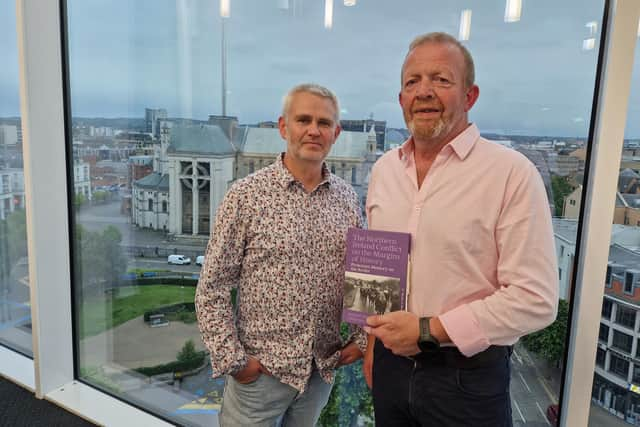

Liam Kennedy, a professor of history at Queen’s University Belfast, was the introductory speaker at the event.
Prof Kennedy called the new book a “landmark study of the Troubles”.
"Do we need to remind ourselves that in the beautiful lakeland landscape of County Fermanagh, of the 116 Troubles-related deaths, 90% of those killed were of Protestants?” he said.
He noted that “republican candidates have been returned to Stormont in election after election in that very area,” adding: “I come from a nationalist background and I have to say: ‘We are a very forgiving people’. We are particularly good at forgiving ourselves.”
He cited the statistic that “almost 70% of northern nationalists believe that there was no other way to achieve reform in NI, except by resort to political violence”.
"The ethno-centrism and myopia involved in this is truly astonishing,” he said, adding that “no serious student of the Troubles would accept this narrative”.
Prof Kennedy added: “Among the lessons I take away from this book are: we must not forget; we must acknowledge the suffering inflicted on others; we must assign responsibility to the perpetrators of violence; and we must not take the easy way out by conflating the status of perpetrators and victims…
"This is a book for the times we are in and the years to come. At a more personal level, it is a triumph for Ken and Cillian. I congratulate them.”
Dr Funston’s brother Ronnie was shot in the back while driving a tractor on their border farm at Pettigo in 1984, and when it came his turn to speak he told the gathering: “Forty-one years after Ronnie's murder, people are not being murdered for the sake of a political ideology.
"But those innocent victims are being airbrushed from history.”
His work is an attempt “to redress the situation,” he said.
He gave a sample of testimony from one individual in the Rosslea area of Fermanagh, who were “the only Protestant family in the area, with no connection whatsoever to the security forces”.
They had been attacked repeatedly, and “it came to a head one night”.
"Roughly 12 IRA gunmen came to the house, a rural farm, took the family out of their beds – the children were in their vests and pyjamas – and lined them up outside."
The IRA team then torched the farm with petrol bombs, with a number of animals “burned alive”. The family left afterwards.
He cited another case, of a family who owned a petrol station near Newtownbutler, with “no connections again to the security forces”.
"An IRA gun team entered the house, beat her husband in front of her until he was almost unconscious, then grabbed her son Peter and said he would be driving a human bomb into a checkpoint at the border.
"Peter said: ‘I’m not driving any bomb’.
"They said: ‘If you don’t, we’ll shoot your father, and you – but we won’t shoot her. We’ll leave her to bury both of you’.
"He then actually had to go ahead and drive the bomb.”
When he reached the checkpoint, the detonator for the 3,500lb bomb went off – but he and the soldiers survived because the main charge failed to explode.
Still another story was that of a girl whose father was murdered (on the third attempt).
Many other children in her Protestant high school in Lisnaskea had seen their parents suffer a similar fate.
"When the tannoy system, the loudspeaker, went off in the school, and they said a name – for example, ‘Ken Funston, please go to the principal’s office’ – it was the black spot. Everybody knew what that meant.
"It meant that somebody had been murdered in their family, that somebody had been attacked in the family, something in particular had happened.
"She tried to portray the fear and dread that had affected the children as soon as they heard a name being announced… until the day they called out her own name.”
He added: "Conducting these interviews in the book… was not particularly easy.
"I recognise the trauma and pain and suffering many had to endure. It was something they carried for years in silence.
"There were these recurring themes: totally let down by successive Republic of Ireland governments, and to a lesser extent by British governments.
"The total erosion of a British way of life in border areas. The sense of abandonment.
"And the never-acknowledged plan by the IRA to ethnically cleanse the border areas of Protestants and unionists, thereby giving those republicans a free rein to act [with] impunity in a so-called ‘free zone’ – or as some people talk about it, border creep."
When he came to speak, Dr McGrattan told the audience that, despite an absence of admissions and documentation from the IRA, “intentionality can nonetheless be argued or attributed… through repeated actions”.
He continued: “Republicans repeatedly targeted Protestants around the border. This was offset by denialism: particularly the denial of sectarianism.
"Nonetheless, as we try to stress in the book, the outcome was clear: repeated targeted killings, often directed by close neighbours.
"They involved people, whole families, being displaced. They involved things like school closures. We go into detail on those in the book.”
Speaking to the News Letter afterwards, Dr Funston said: “I think it was marvellous to see so many people from across a cross-section of the community who’ve shown an interest in the book, and who’ll hopefully tell other people.”
During his talk he had referenced Michelle O’Neill’s famous statement that there had been “no alternative” to the IRA’s campaign.
He concluded: “This is the real story: there was an alternative.”
More to follow on this in the days to come.