
British military leaders hear case for canonising priest in British Army who died trying to save Ulster soldiers
British military figures have heard the case for Canonising a Catholic priest in the British army who died while trying to help two Ulster soldiers on the front line.
Fr Willie Doyle served as a British Army chaplain during some of the most devastating battles of WWI, including the Somme, Messines and Passchendaele.
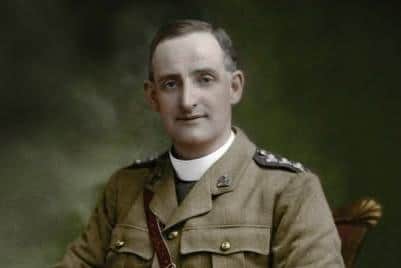

The Dubliner was renowned for his courage under fire, persistently running into battle to rescue wounded troops or pray with those who were dying.
Today The Bishop of Meath Tom Deenihan led a special service in Mullingar Cathedral before sending thousands of documents to the Vatican to support the case for his canonisation.
Opening the service he welcomed bishops and clergy, the Defence Attaché to the British Ambassador, representatives of the Irish and British armies and members of Father Doyle’s family.
He told them: "Throughout Ireland and beyond, despite the passing of over one hundred years since his death, many have felt that Father Doyle was another of those who, by his life and example, displayed heroic virtue: an Irish, Catholic and Jesuit priest, sacrificing his life on the battlefield as a British Army Chaplain, to bring comfort to soldiers of all denominations."
A member of the Orange Order, he said, had affirmed that, "we could not possibly agree with his religious opinions, but we simply worshipped him for other things. He did not know the meaning of fear. He was as ready to risk his life to take a drop of water to a wounded Ulsterman as to assist men of his own faith and regiment".
There were many testimonies from the time to his courage.
"Father Doyle never rests’, wrote one Ulster Protestant officer. "Night and day he is with us. He finds a dying or dead man, does all, comes back smiling, makes a little cross and goes out to bury him and then begins all over again."
Another a Belfast Presbyterian soldier, wrote of him, "He didn’t know the meaning of fear and he didn't know what bigotry was. He was as ready to risk his life to take a drop of water to a wounded Protestant as to assist men of his own faith". The book also cited a piece written by Doyle himself. He said: "I have long had the feeling that since the world is growing rapidly worse and worse and God has lost His hold, as it were, upon the hearts of men, He is looking all the more earnestly and anxiously for big things from those who are faithful to Him still."
The bishop said his example is more relevant in today's polarised world than ever.
"Nationality, creed and political belief were to him secondary and subservient to being a child of God,” he said.
He is reported to have died on 16 August 1917 at the Battle of Passchendaele. At some time in the late afternoon a group of soldiers lead by Lieutenants Marlow and Green – Protestant soldiers from NI - got into trouble beyond the front line, and Fr Doyle ran to assist them. It seems they were hit by a German shell and killed. His body was never recovered.
Bishop Deenihan said the Diocesan Inquiry into Doyle’s Cause for official canonisation is now also complete, thanking those who researched the historical and theological nature of his life.
His files will now be sent to the Dicastery for the Causes of Saints in Rome, "and I firmly believe that it will succeed" he added.