
Belfast to get unique robot tree as part of environmental trial
Belfast is to get a special ‘robot’ or ‘city’ tree as part of an important environmental trial involving analysis of 44 normal trees.
City trees, also known as Robot Trees and Moss Walls, are large structures that increase air quality in cities using moss and plants.
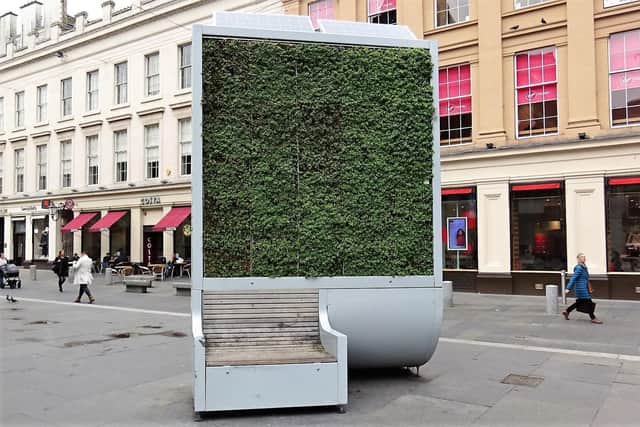

They capture dust and nitrogen dioxide from the air, reducing air pollution and greenhouse gas emissions, and can help to reduce urban heat, and the impact of heavy rainfall.
Belfast is one of 11 pilot cities across Europe, and the only one from the UK and the island of Ireland, chosen for the Horizon Europe’s Urban Planning 2030 (UP2030) scheme, a three year programme that aims “to guide cities through the transitions required to meet their climate neutrality ambitions.”
The geographic area involved covers the Linen Quarter and surrounding city centre communities of Barrack Street, Sandy Row, Donegall Pass and the Market.
The programme involves a cost benefit exercise on the planting and maintenance of 44 trees on the air quality management area of Cromac Street in comparison to the installation of a city tree.
A council officer explained: “They say it has the equivalent of the absorption of 44 trees. Trees do other things besides absorb carbon dioxide, they create environment, biodiversity, habitat etc.
“But it is (connected) to our thinking about how to improve air quality in an area, and what it takes to actually plant 44 trees in an urban setting.
“It will be a cost benefit analysis of a city tree versus 44 trees, (asking) what is the maintenance and lifetime cost (of both).”
Green Councillor Anthony Flynn said: “I am aware of the technology of city trees, but there is a bigger discussion – that is around doing something like the city trees and actually planting trees where they are needed.
“We have a tree strategy, and tree equity is a big part of that. My fear is we will do this instead of actually giving people trees in those areas where they don’t have them. Working class areas for example.
“So I will be very interested to see what you come up with. I do think there is a need for (city trees), this technology could be very useful in certain parts of the city. But obviously it shouldn’t take away from giving people green spaces.”
The council officer said: “We are in an urban environment, and that is a huge challenge, and they are the very conversations we need to grapple with. But city trees are quite costly, and you have to manage and maintain the moss inside of it, and work out what is the lifespan of that versus the right tree in the right place.”