
'Once-in-a-lifetime' encounter as rare bird which has all-but vanished from Northern Ireland turns up behind Belfast bin
A rare bird which was thought to have all-but vanished from Northern Ireland has turned up... behind a bin on Belfast's Lisburn Road.
The creature, a nightjar, was found by a member of the public who contacted animal rescuer Debbie Nelson, more widely known as Debbie Doolittle.
She told the News Letter that the last confirmed breeding of the birds in the Province was "in the early 1900s", and that there have been only around a dozen sightings since the 1950s.
The ground-nesting bird has since been released into the wild in the scrub-covered Belfast hills.
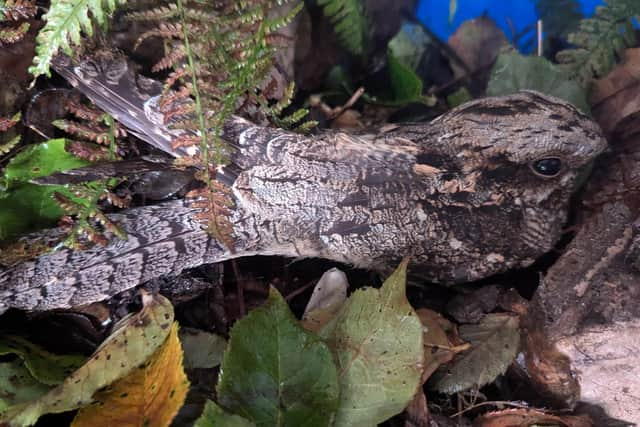

Initially the woman who discovered the bird thought it was a bird of prey, as the species looks a little like a kestrel.
But when Miss Nelson saw it she realised what it was, and was in "a wee bit of shock" because "something like a nightjar is very, very special".
"There were no injuries to the bird - it was just a bit tired and was just trying to find somewhere to rest," she said.
Common in the 19th century, nightjars were largely killed off in the 20th century by loss of habitat.
The birds are mostly nocturnal, and she believes this one may have been flying during the night and become confused by the bright city lights of Belfast.
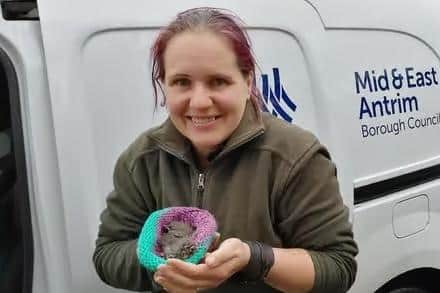
Miss Nelson cared for the juvenile female for about 24 hours, feeding her lots of insects to build up her energy levels, before releasing her.
This all happened back in September, but Miss Nelson has only just announced it because she knew it would attract the attention of bird enthusiasts who would end up combing the Belfast hills for the bird and making her stressed.
She also held off until the new year to see if she encountered any more interesting or exotic creatures throughout 2025 - but she didn't, so the nightjar is her "top bird of the year... it was the highlight of 2025, definitely".
Miss Nelson hopes the bird has now migrated to southern Africa for the winter.
"They're pretty unusual, rare migrant birds," she said.
"They were confirmed breeding in the south-east of Ireland in 2024, though they obviously haven't released the location.
"There is a chance this chick may well have come from breeding birds from last year... that's always a possibility."
She was ringed before she was released, so that if she is found again in decades to come she can be identified.
Miss Nelson has a facility at her home in Nutt's Corner in south Antrim, and she and her 10 volunteers take care of roughly 2,000 creatures a year (they deal with native wildlife, rather than domestic pets).
She said she has been rescuing animals for about 38 years (she describes herself as "a few years off 50").
Doolittle's Wildlife Rescue is a charity, and she does not get paid for the rescues.
Instead she makes a living from her educational work, doing things like delivering talks to schools about Northern Ireland's indigenous animals.
Of the nightjar, she said: "I'd say that'd be a one-off. We do get very odd, unusual birds here-and-there, but I'd say the chances of ever even seeing one again to be honest, it'd be a once-in-a-lifetime thing."
A paper last year in the journal Molecular Ecology (titled 'The Genomic Signature of Demographic Decline in a Long-Distance Migrant in a Range-Extreme Population') stated: "As recently as the 1800s, nightjars were a widespread breeding species across the entirety of the British Isles.
"The species underwent a population decline throughout the 20th century, undergoing a greater than 50% population reduction between 1966 and 1981.
"Range loss was most pronounced in the central and western aspects of the species' British range, with nightjar declared extinct in Northern Ireland and near-extinct in the Republic of Ireland in the late 20th century."
A 2007 paper published by the British Trust for Ornithology ('Status and distribution of European Nightjars, caprimulgus europaeus, in the UK in 2004') stated: "Since the 1950s, large-scale losses of heathland to agriculture, construction and afforestation have led to both a contraction of range and a strong population decline…
"In Northern Ireland, where occupied habitats included ‘cut-over’ raised bogs, it is probably now extinct as a breeding species, having formerly had a widespread distribution.
"The last suspected breeding record for Northern Ireland was in 1987, when a pair was noted in Tyrone."