
Gordon Lucy: Professor Frank Pantridge had no time for politicians … except for Harry S Truman
Professor Frank Pantridge, who died on Boxing Day 2004, was recognised internationally for transforming the treatment of heart attacks with his invention, the portable cardiac defibrillator. Pantridge is still regarded as ‘the father of emergency medicine’. He also did much to develop pre-hospital coronary care.
Pantridge was born in Hillsborough in 1916, into an Ulster-Scots farming family. His father died when he was 10. Problems with authority, which were to dog his life, started at an early age and he was expelled from several schools before completing his education at Friends' School, Lisburn.
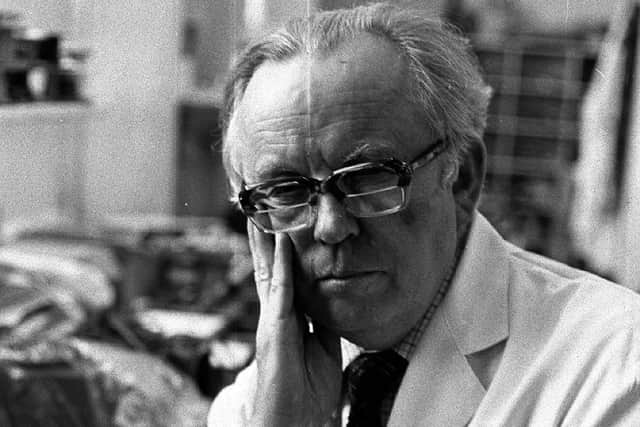

Despite further clashes with authority, he graduated in medicine near the top of his year and qualified as a doctor at Queen's University, Belfast, in 1939. He was given a coveted house job at the Royal Victoria Infirmary but on the outbreak of the Second World War, he immediately volunteered for the Royal Army Medical Corps.
Eighteen months later, he was posted to Singapore, where he was assigned as medical officer to the Gordon Highlanders.
He was awarded the Military Cross in 1942 with the citation: ‘This officer worked unceasingly under the most adverse conditions of continuous bombing and shelling and was an inspiring example to all with whom he came into contact. He was absolutely cool under the heaviest fire.’
Singapore fell to the Japanese on February 15 1942.
As a prisoner of war, Pantridge was transported to Thailand to join thousands of other PoWs in the slave labour camps of the Thai-Burma railway, including some months in the Tanbaya death camp, where few survived.
Pantridge suffered badly from beriberi and in August 1943, he became very ill. Determined that he would not die, he told himself every day: ‘I will not leave my bloody bones in Burma.’ Thus, he survived cardiac beriberi, which is usually fatal. This ignited his life-long interest in heart disease.
His experience in the prison camps left him both mentally and physically scarred. He was appalled at the cruelty of the Japanese guards.
Throughout his life, Pantridge famously had little time for politicians of any hue. He reserved a special antipathy for Winston Churchill who he held responsible for the fall of Singapore. Although Churchill pledged to defend Singapore to the last, the naval base had no proper landward defences. Fifteen-inch guns pointing out to sea were no form of defence. Singapore was far from the impregnable fortress of Churchill’s imagination. He was ignorant of its lack of landward defences. It had never occurred to him that ‘no circle of detached forts of a permanent character protected the rear of the famous fortress’.
In ‘The Hinge of Fate’, Churchill later wrote: ‘I cannot understand how it was I did not know this … my advisers ought to have known and I ought to have been told, and I ought to have asked.’
As chancellor of the exchequer in the 1920s Churchill was responsible for slashing defence expenditure on the new naval base from £12 million to £8 million.
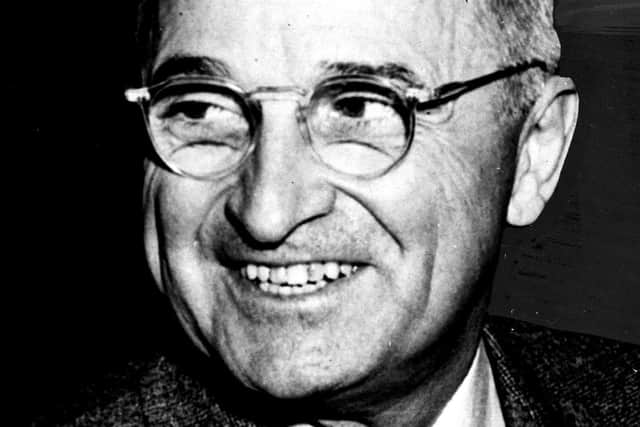
In his antipathy towards politicians, Pantridge made an exception for Harry S Truman, a fellow Ulster Scot. He applauded President Truman’s decision to drop the first atomic bombs on Hiroshima and Nagasaki in August 1945 to bring the Second World War to an end.
It was a decision about which Truman spoke about with great reluctance. A speech in Milwaukee on October 14 during the US Presidential election of 1948 was a rare exception. He only did so because his Republican opponent had raised the subject.
The decision caused Truman far more agony and soul searching than he was ever publicly prepared to admit. Privately, he wrote to his sister that it was ‘a terrible decision’. In his journal he reflected on whether the Japanese, even if they were ‘savages, ruthless, merciless and fanatic,’ deserved such a fate.
Like a great many other PoWs, Pantridge credited Truman with saving his life. (In 1948, Pantridge took up a research fellowship at Ann Arbor University in Michigan and was delighted to be in the United States to see Truman unexpectedly win that year’s presidential election.)
The atomic bomb may also have had profound significance for the future of western Europe.
In July 1945, in small talk during a break during the Potsdam conference, Averill Harriman, the US ambassador to Moscow, said to Stalin: ‘It must be very pleasant for you to be in Berlin now after all your country has suffered.’ Stalin responded that Tsar Alexander I had (after the Napoleonic wars) gone all the way to Paris in 1815. Was Stalin’s observation simply evidence of his familiarity with 19th-century Russian and European history or did it have a more profound and sinister significance?
Evidence points to the latter because in 1944 and 1945 Stalin was already relishing the extension of Soviet power across not only eastern but western Europe.
In 1944, according to General S M Shtemenko, a senior Soviet strategist, the Politburo gave instructions to the Stavka (the HQ of the ‘Main Command of the Armed Forces of the USSR’) to prepare for the invasion of Italy and France, choreographed with the seizure of power by the local Communist parties. Norway and Denmark also featured in Stalin’s plans.
Stalin calculated that the Americans would withdraw from Europe at the end of the war (which is exactly what Churchill feared) and he anticipated that the UK and France would find themselves fully preoccupied with colonial unrest in their overseas possessions.
Furthermore, Stalin was confident he had the manpower (400 battle-hardened divisions) and resources to realise his goals within a month.
These plans were only shelved when the Russians learned of the successful test explosion of the atomic bomb at Los Alamos in New Mexico.
So although the development of the atomic bomb is thought of primarily in terms of hastening the end of the war against Japan (which it did), it had immense consequences too for the people of western Europe. Without it, ‘the iron curtain’ might have been pushed as far west as the English Channel.