
Gordon Lucy: Ronald Reagan's 'tear down this wall' speech in Berlin in 1987 encapsulated his gifts as US president
When Ronald Reagan left the White House in 1989 he did so as the most popular US president since Eisenhower and the most influential president since F D Roosevelt.
During his presidency Reagan rehabilitated conservatism, revived faith in the presidency, restored American self-respect, and his vision made a significant contribution to ending the Cold War.
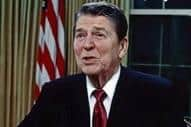

A famous campaign advert from the 1984 presidential election captured the heady optimism of the Reagan era: ‘Today more men and women will go to work than ever before in our country's history. With interest rates at about half the record highs of 1980, nearly 2,000 families today will buy new homes, more than at any time in the past four years. This afternoon, 6,500 young men and women will be married, and with inflation at less than half of what it was just four years ago, they can look forward with confidence to the future. It's morning again in America, and under the leadership of President Reagan, our country is prouder and stronger and better. Why would we ever want to return to where we were less than four short years ago?’
Tip O’Neill, the Democratic Speaker of the House of Representatives, once observed: ‘I have known every president since Harry Truman and there is no question that Ronald Reagan was the worst. He wasn’t without leadership ability, but he lacked most of the management skills that a president needs.’
Yet he conceded that ‘with a prepared text he’s the best public speaker I have ever seen’ – perhaps even better than FDR or JFK.
Reagan’s modus operandi was the perfect riposte to O’Neill’s harsh assessment that he was the worst president since Truman: ‘Surround yourself with the best people you can find, delegate authority, and don't interfere as long as the policy you've decided upon is being carried out.’ (As this retort could have been lifted straight out of ‘The Prince’, Machiavelli would surely have graded it α++.)
O’Neill was guilty of seriously underestimating Reagan’s masterly command of language both spoken and written. (Reagan’s letters demonstrate that he was a beautiful writer.) Indisputably ‘the Great Communicator’, he professed to believe that it was not his style nor the words he used that made a difference but the content.
His contention was that he communicated ‘great things’ derived ‘from the heart of a great nation – from our experience, our wisdom, and our belief in the principles that have guided us for two centuries’.
Reagan might be legitimately criticised for paying too little attention to detail but he was no lightweight, was genuinely interested in the big picture and possessed a coherent worldview.
Like the early-17th-century Puritan John Winthrop, he aspired to America being a ‘City upon a hill’ and a ‘beacon of hope’ for the world. He believed passionately in freedom and democracy and was pro-free trade, pro-immigration, pro-Nato and opposed to Russian expansionism.
In January 1967 he addressed one of the leitmotifs of his political faith at his inauguration as governor of California: ‘Freedom is never more than one generation away from extinction. We didn't pass it to our children in the bloodstream. It must be fought for, protected, and handed on for them to do the same.’
It was Reagan’s conviction that ‘to hold and grasp a vision … is the very essence of successful leadership’.
The consensus is that Reagan’s most memorable speech was the one delivered on June 12 1987 at the Brandenberg Gate in Berlin.
In the middle section of the speech, drafted by the White House speech writer Peter Robinson, Reagan said: ‘We welcome change and openness; for we believe that freedom and security go together, that the advance of human liberty can only strengthen the cause of world peace. There is one sign the Soviets can make that would be unmistakable, that would advance dramatically the cause of freedom and peace. General Secretary Gorbachev, if you seek peace, if you seek prosperity for the Soviet Union and Eastern Europe, if you seek liberalisation: Come here to this gate! Mr Gorbachev, open this gate! Mr Gorbachev, tear down this wall!’
White House Chief of Staff Howard Baker objected to the words ‘tear down this wall’ because he thought that they were outlandish, provocative and unpresidential. More importantly, he feared the four words might damage the developing rapport between Reagan and Gorbachev.
Deputy US National Security Advisor Colin Powell and senior White House staffers and aides concurred.
Convinced after only a day-and-a-half in Berlin that the majority of West Berliners were opposed the wall, Robinson kept the phrase in successive drafts while the State Department and National Security Council kept removing it. Reagan sided with Robinson and overruled their objections.
According to Robinson, the words were prompted by a conversation with Ingeborg Elz, his West Berlin hostess, who observed: ‘If this man Gorbachev is serious with his talk of Glasnost and perestroika he can prove it by getting rid of this wall.’
Although the story made the front page of the New York Times, the speech had very little immediate impact.
The East German regime dismissed the speech as ‘an absurd demonstration by a cold warrior’ and the Russians accused Reagan of delivering an ‘openly provocative, war-mongering speech’.
It only became widely known after the fall of the Berlin Wall in November 1989. Once the wall fell, the speech seemed to have summed up and even predicted the final phase of the Cold War.
In November 2019, a bronze statue of Reagan was unveiled at the US embassy, near the venue for the speech, after the cowardly Berlin authorities had refused to site one in the city.
During his six-year career as a White House speech writer, Peter Robinson wrote some 300 speeches for Reagan and Vice-President Bush.
Since 1993, Robinson has been a research fellow at the Hoover Institution at Stanford and since 2008 he has hosted Uncommon Knowledge for the institution, a current affairs TV programme which sets the gold standard for all current affairs programmes.