
John Coulter: Jim Molyneaux's face was etched with a sense of betrayal when he visited our home at Christmas 40 years ago, weeks after the Anglo Irish Agreement
In all the years I knew Jim Molyneaux, I have never witnessed him being so depressed as at our North Antrim home forty years ago, shortly before Christmas 1985.


The Ulster Unionist Party leader was dejected by the signing of the notorious Anglo-Irish Agreement four weeks before, on November 15 1985, between Dublin and London which gave southern Ireland its first major say in the running of Northern Ireland since partition in the 1920s.
For unionism, it was yet another betrayal of the pro-Union community, this time by a person most unionists once regarded as a hero – then Tory Prime Minister Maggie Thatcher. It was to mobilise unionists in a way not witnessed since the Ulster Workers’ Council strike of 1974 which collapsed the then Sunningdale power-sharing executive.
The signing came just over a year after the Provos’ bid to kill Thatcher the year before in the October 1984 in the Brighton hotel bombing.
Did Thatcher think that by signing the agreement, also known as the Hillsborough accord and to many unionists, the Dublin Diktat, that the Dail would agree to some magic cross-border security arrangement to defeat IRA terror?
Perhaps Thatcher, her advisors and supporters wanted some official security ‘hot pursuit’ agreement whereby the then RUC, Ulster Defence Regiment, other British Army regiments and even the SAS could chase IRA and INLA terrorists deep into southern Ireland.
Many republican terror gangs were using the political and geographical safety of the Irish Republic to plan, launch and especially escape when they carried out atrocities in NI.
Did Thatcher seriously think she could trust the Dublin establishment to reciprocate a say in the running of the province by cancelling out southern Ireland being a safe haven for republican terror gangs? She was misinformed, even deluded if so.

The Anglo-Irish Agreement spawned the notorious Maryfield Secretariat, near Belfast, from where Dublin’s say in interfering in NI affairs was administered.
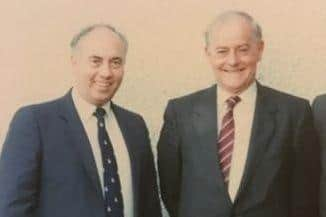
The real depth of the betrayal of unionism by Thatcher was etched on the face of Mr Molyneaux (later Sir James), during one of his frequent visits to our family home. Molyneaux, or ‘Gentleman Jim’ as he was affectionately known in some unionist circles, viewed my late dad, Rev Dr Robert Coulter MBE, as a political confidant; someone he could talk to and it would not end up in the media.
I was a staff journalist at the Belfast News Letter in 1985 and I was allowed to sit in on their meetings provided I did not repeat what was discussed in the media, too.
Molyneaux was close to tears as he admitted he did not think Thatcher would sign such an agreement. He felt totally snubbed by her attitude. Put bluntly, he gave the strong vibe ‘I didn’t see that one coming!’
Molyneaux had often talked about his ‘special relationship’ with Thatcher and the Tory Right-wing. In 1985, the UUP was by far the ‘Big Dog’ of unionism as the lead party and even within the UUP, the Right-wing Ulster Monday Club pressure group was the most influential of all the factions within the party.
The agreement, signed on British soil between Thatcher and then Taoiseach Dr Garret FitzGerald, was to spark the unionist protest movements, the Ulster Says No and Ulster Still Says No campaigns.
It saw unionists getting involved in politics who had previously been inactive or uninterested. The first major Ulster Says No rally at Belfast City Hall saw an estimated 250,000 attend.
One of the poignant images that day was the crowd’s reaction to then DUP leader Rev Ian Paisley’s famous ‘Never, never, never, never’ remark. But whilst people can remember that remark from Paisley senior, can anyone – including myself – remember a single quote from Molyneaux’s speech?
Looking back on that rally, Molyneaux was very muted. Was it a sign that his ‘special relationship’ with Thatcher was in political tatters, or did he come to realise that the seeds of his demise of his leadership of the UUP had been sown at Hillsborough? While it would be another decade before he would relinquish the leadership to David Trimble in 1995, the grassroots mumblings within the UUP about the need to replace him had already started. The Hillsborough accord shifted them up a notch.
Organisations were launched or mobilised. The Ulster Clubs was formed, a mirror image of the Unionist Clubs which had existed in the early 20th century in opposition to Home Rule for Ireland.
On the paramilitary front, Ulster Resistance was launched with its distinctive red berets. Both the UDA and UVF saw an increase in membership.
Politically, the concept of Ulster independence came on the agenda with the formation of fringe pressure groups such as the Ulster Movement for Self-Determination (MSD). Even the far right National Front capitalised on unionist mobilisation by appointing one of its ruling directorate members to oversee recruitment in Northern Ireland.
Politically, it was to see Unionist Unity between the parties with agreed candidates at the January 1986 protest Westminster by-elections and the 1987 Westminster general election. ironically, unionism was to lose an MP in each of those two elections.
On the 40th anniversary of the signing of the Dublin Diktat, unionism needs to ask itself – how can this seemingly long-lost spirit of mobilisation and unity be reinvigorated for the 2027 Stormont elections? The seeds which spawned the pan nationalist front were sown in November 1985. That front is in full bloom in 2025. Unionism needs to find the political weed killer to spray on it by the time of the next NI assembly poll.
• Dr John Coulter has been a journalist since 1978