
Labour’s 1945 general election win over Winston Churchill was a shock, but not really a surprise
On July 5 1945 the United Kingdom went to the polls. To include the votes of servicemen serving overseas, the result was not declared until three weeks later. Labour won 393 seats.
For the first time in British history Labour was able to form a government with an absolute majority – a majority of 146. In the words of Winston Churchill, the wartime prime minister and Conservative leader, ‘the verdict of the electorate had been overwhelmingly expressed’.
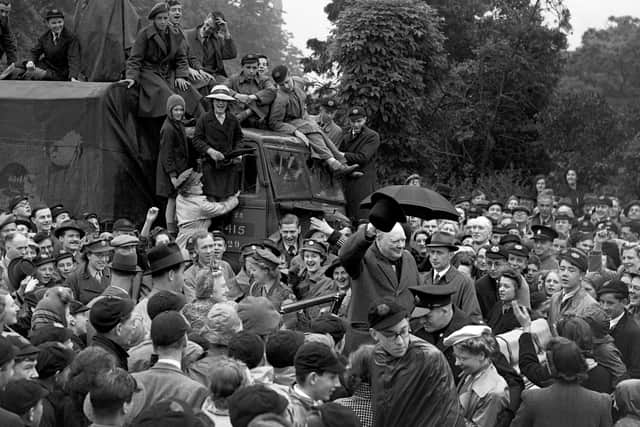

Churchill generously interpreted the result as the electorate ‘voting against all the discomforts they have had’. Privately, Churchill was hurt by the outcome. His wife tried to console him with the observation, ‘It may well be a blessing in disguise.’ Churchill’s riposte was, ‘At the moment it seems quite effectively disguised.’
The general election of 1945 was one of the three great electoral catastrophes to overtake the Conservative Party during the course of the 20th century, otherwise aptly described as ‘The Conservative Century’.

The Labour landslide of 1945 reduced the Conservative Party to 213 seats in the House of Commons, better admittedly than 157 seats won in the year of the Liberal landslide of 1906 or the 165 won in the election of 1997 which swept Tony Blair into 10 Downing Street.
Overall, the result of the election was unexpected. Clement Attlee, the Labour leader, expected to lose by a margin of between 40 and 60 seats. Encouraged by cheering crowds, bunting and flowers, Churchill expected to win. Only towards the end of the campaign was he booed at Walthamstow and Ladbroke Grove.
Conservative Central Office and Lord Beaverbrook, whose intransigent attitude towards Labour is often viewed as a major cause of the Tories’ defeat, both forecast a majority of at least a hundred seats for the Conservatives. On May 23 1945 Sir John Colville, Churchill’s private secretary, supposed ‘many will vote for the Conservatives merely out of personal loyalty to W.S.C.’ However, Colville was subsequently to record, ‘It was surprising to find myself on July 27th, 1945, Private Secretary to Mr Attlee’.
Comparatively few politicians anticipated the result. Aneurin Bevan, Emmanuel Shinwell and George Strauss were the only prominent politicians on the Labour side credited with predicting the outcome accurately. On the Conservative side R A Butler, the architect of the 1944 Education Act, and Sir William Anstruther-Grey, commanding officer of the Guards Armoured Division, a sitting Conservative MP and a future chairman of the 1922 Committee, got the result right.
At the beginning of May 1945 Anstruther-Grey told Ernie Teal, one of his sergeants, ‘We have fired our last shot in anger. I’m going back to be a pot-bellied politician. We [the Conservatives] shall get kicked out, but we’ll be back’. During the campaign Beaverbrook’s confidence slowly ebbed away. Ralph Assherton, chairman of the Tory Party, even warned Churchill that defeat was possible.
In retrospect, it is exceedingly difficult to explain the extent of the surprise to which the result of the election gave rise. Attitudes surveys, opinion polls and parliamentary by-elections all consistently pointed towards a Labour victory but few read the runes correctly.
The war created a climate favourable to a more collectivist and a more egalitarian society, a development charted by Mass Observation. After the war people expected less class distinction, more state control, a levelling of incomes and increased social services. Unsurprisingly, 86% of the electorate supported the Beveridge Report, the basis for the post-war welfare state. Only 6% opposed the report. Significantly, more people described themselves as ‘anti-Conservative’ than ‘anti-Labour’. By 1943 25% of interviewees were declaring that their views had shifted to the left. Crucially, a majority was convinced that Labour would win when an election was called.
Even before the war there was a pronounced drift to the left in parliamentary by-elections. During the war there was a party truce but it was only observed by the three main parties. This meant that by-elections did not go uncontested. The Conservatives lost no less than 12 by-elections – many of them quite spectacularly – between February 1940 and April 1945, all but two of them to left-wing candidates and three of them to the ultra-left-wing Commonwealth Party.
Voting intention as measured by the British Institute of Public Opinion – usually referred to as Gallup after 1952 – confirmed the striking strength of left-wing sentiment during the war. For example, in June 1943 Labour was seven percentage points ahead of the Tories. By December 1943 Labour had extended its lead to 13 percentage points and by April 1944 to 17 percentage points.
From 1942 onwards Labour usually had a lead over the Conservatives in double figures. Few people then took opinion polls seriously. Yet an opinion poll published on June 11 1945 gave Labour 47% of the vote, the Tories 41% and the Liberals 10%. It proved to be astonishingly accurate: the only poll which mattered – the general election – gave Labour 47.8% of the vote, the Tories 39.8% and the Liberals 9%.
A sea-change – evidenced by Mass Observation’s attitudes surveys, the British Institute of Public Opinion’s polls and parliamentary by-elections – had taken place in British politics. The Conservative Party’s seemingly tired and stale values (and programme) no longer chimed with the new aspirations of the electorate, whereas the Labour Party’s did.
The electorate rejected the Conservative Party of the 1930s – perceived to be the party of high unemployment, the means test and appeasement – rather than the party leader of 1945 who had been marginalised and sidelined by the Conservative Party throughout that disagreeable decade. These were points which Attlee touched upon in a television interview in 1965, two years before his death.
Interviewer: Why do you think that the nation turned against Churchill?
Attlee: Well, they didn’t turn against him; they turned against the Tories. They remembered what happened in the 1930s.
Interviewer: Do you think that Munich had played a great part in this?
Attlee: A good deal.
Interviewer: Or was it more a matter of unemployment?
Attlee: I think the general feeling was that they wanted a new start. We were looking towards the future. The Tories were looking towards the past.
Labour’s victory owed nothing to its leader’s charisma because Attlee did not possess charisma. He was short, bald and taciturn. As Douglas Jay, wittily remarked, ‘He never used one syllable where none would do.’
In 1947 the diarist Harold Nicolson observed, ‘Attlee is a charming and intelligent man, but as a public speaker he is, compared to Winston [Churchill], like a village fiddler after Paganini’. In 1945 the British electorate preferred ‘a village fiddler’ to Paganini because they preferred Attlee’s policies and his vision of society to Churchill’s.