
Austen Morgan: The Irish government continues to cheerlead on legacy for northern nationalists, as they progress from one grievance to the next
It is unclear why the UK thinks it needs to jointly rule Northern Ireland with an opportunist neighbouring state – but this month that is what Labour confirmed it does think.
With the party sinking fast into the electoral depths, Hilary Benn, with his new best friend Simon Harris, the Irish tánaiste, has added another weight to the decline of the government … on legacy. It is a matter has bedevilled successive UK governments since 1998.
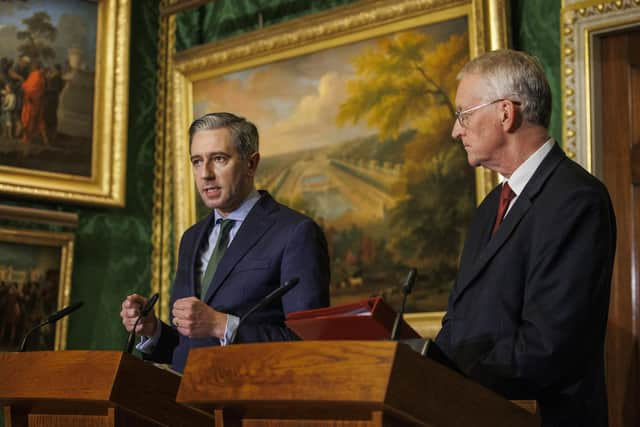

On September 19, Benn and Harris unveiled their joint framework, The Legacy of the Troubles, at Hillsborough castle, Sir Keir Starmer having played his hand of re-setting relationships with the Republic of Ireland a week earlier.
The background to this is important. In January 2024, the Irish government took the UK to the human rights court in Strasbourg over London's legacy plan for conditional amnesties - this was despite the fact that Ireland has operated a flagrant amnesty, albeit undeclared, for the IRA since 1994.
In the 1998 Belfast agreement, the two governments promised relatives recognition at best (not prosecutions all round), while Tony Blair and Jonathan Powell conducted a secret process with the IRA premised on incremental amnesty.
In March 2020, when London broke with Dublin, having belatedly recognised its obligations to the Northern Ireland veterans, the Conservatives introduced what between the so-called Legacy Act 2023. It led to Sir Declan Morgan, the former lord chief justice, heading up a commission which went live in Belfast in May 2024.
Brandon Lewis was the first, and only, secretary of state (of the 25 we have had) to address legacy seriously. It was, under the Belfast agreement, part of strand one (and for Stormont), and not a subject for joint sovereignty or authority (or even frameworks) by London and Dublin. Labour, as the then parliamentary opposition, had promised to repeal and replace the hated Tories’ 2023 legislation.
The takeaway which should have been reported from Hillsborough is that Sir Declan Morgan and his commission – to be rebranded the legacy commission – have survived as the focus of UK legacy policy. The commission, of course, is to be reformed despite its tender age: the existing commissioners will go in time, to be replaced (?); Peter Sheridan, the ex RUC officer in charge of investigations, is to be marked by yet another English (?) police officer; there will be an oversight board (sounding like Jon Boutcher), but with commission officials – like Whitehall civil servants – perhaps governing the commission.
The Eames/Bradley idea from 2009 of five years survives, but expect mission creep towards institutionalisation and even (perish the thought!) permanence. All this, of course, was dressed up by Hilary Benn in nationalist colours (designed no doubt to provoke unionist reaction – the best way to get through to republicans).
The new joint framework reads like a quasi-treaty, with the following recitals: London and Dublin as ‘co-guarantors’ of the Belfast Agreement (which is legally meaningless); the European convention on human rights (that secular tablet of stone); ‘truth, accountability and, where possible [my emphasis], justice’; and the 2014 Stormont House agreement on legacy of course.
Hilary Benn – in his year plus of consulting on this new policy (including not meeting the Malone House Group with which I am associated) – told a number of ministerial whoppers.
First, that the relatives had opposed the Conservatives, and he was now – by implication – going to do their bidding (this is in spite of 85% of such families not belonging to victims’ groups).
Some 3,750 people died in the troubles, most unlawfully at the hands of republicans and loyalists, and some 10% – most lawfully – killed by police but mainly soldiers.
Ninety per cent of relatives therefore have no access to human rights, and article 2 – which is cited to justify the disproportionate legacy focus on state killings - of the European Convention of Human Rights applies now only to state killings from 1988 to 1998 (not the 1970s and 1980s when most of the atrocities occurred).
Hilary Benn is not going to flood the courts with prosecutions, because that would undermine the at least 187 comfort letters (of 228 applications), issued to the supporters of Gerry Adams and Martin McGuinness between 2000 and 2014 and held by Gerry Kelly MLA in a Sinn Féin office.
The second whopper is that all the parties in NI opposed the evil Tories. True, but what does that mean? Legacy has been the responsibility of Stormont since 1999. In the 2010s, the involuntary coalition could not agree its legislation. It passed the poisoned chalice to Westminster.
Nationalists and unionists act like clientelist politicians, championing respective victims’ groups – to little particular effect generally. Secretary of state, how many of the Stormont five parties support your new joint framework?
Third, more a silent whopper! The Irish legal case was stayed, probably by agreement. Neither of the principals at Hillsborough castle (who was asked) would say whether the application will be withdrawn by the Irish and when. Nor did they address News Letter queries about Irish hypocrisy over amnesties.
Fourth, another silent whopper. The Conservatives, in their legislation, took away Gerry Adams’ right to compensation for being interned by the wrong UK minister in the early 1970s. The high court in Belfast reversed this in February 2024, opening the way to a flood of claims.
In July the same year, after Sir Keir Starmer became prime minister, the secretary of state abandoned his human rights appeal. Then, in January 2025, the prime minister said they would find another – presumably lawful – means of denying all internees compensation. This is not included in the joint framework.
Simon Harris, from the land of the cute hoors, even mentioned – surrounded by the portraits of our rulers – that, on the Sean Brown case, in which the order of a public inquiry by the Belfast courts is on its way to our supreme court in London, Dublin would continue to act as champion and cheerleader for northern nationalists progressing from one grievance to the next. Plus ça change.
• Austen Morgan is a barrister