
Ben Lowry: Northern Ireland should not expect much from Donald Trump or Kamala Harris
We now know that it will be an election contest in America between the former president Donald Trump and the current vice-president Kamala Harris.

The Obamas, Barack and Michelle, effectively helped to anoint Ms Harris as the Democratic Party nominee yesterday when they endorsed her. The previous endorsements of Bill and Hilary Clinton, President Joe Biden and the former US House Speaker Nancy Pelosi had almost secured her the nomination, the Obamas ensured it (although Ms Harris is yet to be ratified).
What does all this mean for Northern Ireland, and for unionism?
NI will not be on the radar and barely ever has been in American politics. None of the White House incumbents showed much interest in the province, despite more than a dozen of the 45 men who have been president (there have been 46 presidents) having had some traceable Ulster descent.
Bill Clinton, who had a very distant ancestral connection to Fermanagh but who never (to my knowledge) called himself Scots Irish, was the first US commander-in-chief to take much of an interest in NI. His visit here in 1995 was an electric moment for a society that was then emerging from a quarter of a century of violence.
The Democrats in the 1970s and 80s had generally sympathised with nationalist Ireland, but President Clinton broke with that tradition, just as Tony Blair at the same time broke with the 1980s Labour policy of advocating a united Ireland by consent.
While both of Mr Clinton’s successors George Bush Junior and Mr Obama visited NI while in office, they never displayed his level of interest in what was going on here.
Donald Trump, who has one of the closest ever connections to the UK of an American president (his mum was born in Scotland), showed almost no interest in NI during his four years in the Oval Office.
Many unionists wanted him to win in 2016, then again in 2020 and want him to win now.
There are two broad reasons for this.
First, many unionists think that a Republican Party president will be more likely to value its friendship with the UK over its friendship with Ireland.
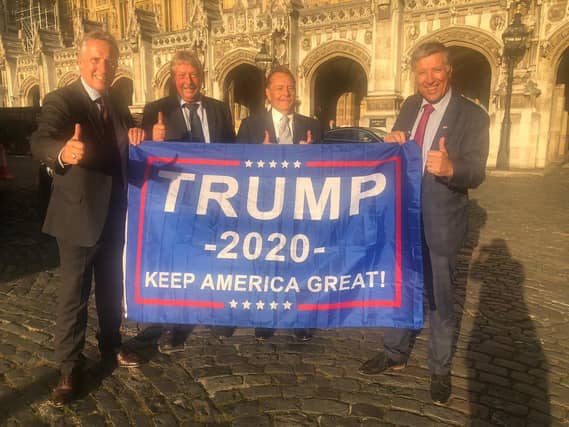
Second, a smaller but significant number of unionists are all-round Trump supporters. Look at the picture above of the then DUP MPs Ian Paisley Junior, Sammy Wilson and Paul Girvan endorsing him in 2020. Mr Paisley vanquisher, Jim Allister, is a supporter too.
The first point is true in the sense that Mr Trump as president put none of the pressure on the UK over the Irish Sea border that the Irish American Joe Biden did.
My own concerns about this line of argument in favour of Mr Trump is that in that narrow sense he was far preferable to Mr Biden. But when looked at on a wider level he turned out to be less interested in the UK as an ally than any other president I can think of since World War Two. He simply wasn’t interested in us. He wanted to get invites from the Queen, and that was about it.
Worse than that, he has had no interest in the vital Nato western alliance, in which Britain is such an important partner. True, he demanded (rightly) that Europe contribute more to defence but he had core sympathy with it.
John Bolton, his one-time National Security Advisor, thinks that he might well pull America out of Nato. Mr Bolton, incidentally, is unusual in that he has held very high office in the US government and foreign policy establishment yet is a specific defender of unionism and our place in the UK.
When I have written about President Trump before I have referred to his almost surreal narcissism and his outrageous personal behaviour: constantly boasting, constantly insulting people to their face about their physical appearance and other factors over which they have no control, constantly saying that he is the best (there is an amusing video on Twitter that has clips of him claiming, quite seriously, to know more than anyone else on earth about a range of areas about which he knows nothing).
This shocking conduct now does him no harm at all. When the Democrats in 2016 put out an ad of his vile and abusive public appearances, and showed kids observing it all on TV, with the slogan ‘Our children are watching’, I thought it would damage of him. And probably, to an extent, it did but it is now widely accepted as just a matter of ‘Trump being Trump’.
There has never been an American president remotely like this in my lifetime and I am not aware of any presidents of the pre television era being like that either, not even the wild Ulsterman Andrew Jackson (he was born not long after his parents sailed from Carrick in the 1760s), who, while uncouth, is not described as having been so openly and relentlessly nasty.
These Trump traits, while they debase the presidency to an alarming degree, might not matter so much if he governed in a stable way. But he didn’t. He governed in a chaotic way and was easily flattered by the West’s most mortal enemies. China and Russia will be delighted with an isolationist Trump presidency. What happens if Beijing invades Taiwan?
Kamala Harris will be little better. She has not been an impressive politician at any stage in her career, and has failed utterly to impress people as vice-president. She will be badly out of her depth in an international crisis. She flopped in her handling of one of the great crises of our time, the surge in immigration. Like many Democrats the overwhelming of America by people of alien cultures might even be something of which she approves.
And like a liberal wing of the Democratic Party she has little empathy with Britain, and none at all with unionism or Northern Ireland. Thus she will lean on advisors for those issues, and those advisors are likely to be pro nationalist Ireland.