
Ben Lowry: The huge delay in approving the vast gold mine in the Sperrins - one of the best untouched deposits in the world - is a farcical reflection on Northern Ireland
On Monday week, the public inquiry will – probably – get under way into plans for a gold mine in the Sperrins.
The hearings at the Strule Arts Centre in Omagh, if indeed they do happen (they have been stalled twice before), will examine one of the most important business proposals in the history of Northern Ireland – indeed this island.
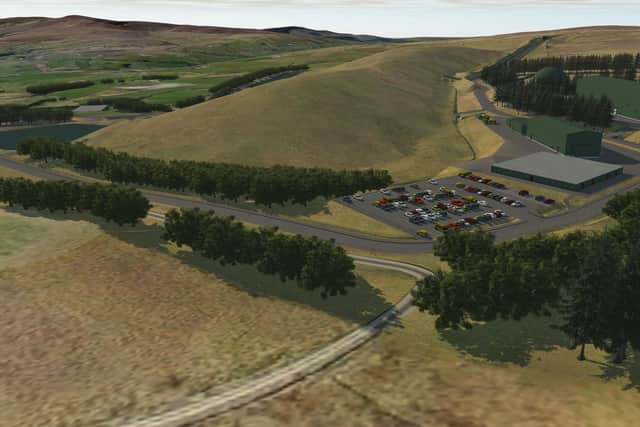

In fact, the plan relates to one the best untouched sites in the world of one of the most precious metals known to man, gold.
Gold has been treasured by humans since the first civilisations, thousands of years before the birth of Jesus Christ, whom we remember this weekend.
It is currently at sky-high value globally because gold’s scarcity and immunity to corrosion is seen as a safe haven in times of turbulence, as we are experiencing now with the Iraq war. It is selling at approaching £4,000 an ounce, having been a mere £800 or so a decade ago. As recently as three years back, the price was still only £1,600.
The estimated deposit in the Co Tyrone hills is around six million ounces (almost 200 tonnes). At today’s values, that puts it in the staggering £22 to £24 billion range. But, at this time of international economic crisis, we are not benefitting from a penny of these booming prices. We might never do so.
It is not clear how the Planning Appeals Commission will assess the request to extract the gold, as well as silver and copper, from a site in the Co Tyrone hills called Curraghnihalt, or when they will report. Above all it is unclear if political and legal approval will be given by the Stormont executive, particularly given that some of the key decision makers will be Sinn Fein ministers – a party that has been at best cool towards any such mine in the Sperrins.
This is because the main opposition to the mine proposal is local to the site, in what is a largely republican area.
The big question under consideration is whether or not a company called Dalradian will be allowed to extract the metals from Curraghnihalt. The coming resolution to that question has enormous implications for Northern Ireland. It goes to the question of whether or not we are open for business, flagged up recently by the mystery around why the American financial firm Cantor Fitzgerald abandoned plans for a 300-job investment in Belfast during a meeting in New York with the Sinn Fein economy minister, Caoimhe Archibald MLA.
You could even say that the outcome in this application – as to whether or not the mine gets built – will be a barometer on whether the province might ultimately become almost ungovernable.
The approval process for getting access to this vast resource has been slow to the point of farce – or “total disgrace” (as the DUP leader Gavin Robinson MP recently described it). It is set to take 12 years for approval to be granted, if indeed it is. Dalradian began seeking approval in 2015.
The United States ambassador to the UK, Warren Stephens, perhaps America’s most important diplomat, said the delay was harming Northern Ireland’s reputation. "You cannot expect a US company to make a major investment here if they cannot be certain when they will get an answer from planning authorities," he said at Queen’s University in November.
And Dalradian has made one heck of an investment. They told me that they have spent $400 million (£300m) since they picked up the exploration licences in 2009 at the existing site in the Sperrins (exploration that government bodies had encouraged).
The stalemate in the gold mine proposal also sheds light, I would argue, on how pampered we have become in Northern Ireland. Other nations such as China, Russia, Brazil, South Africa, the US, Sweden, Canada and Congo are blessed with vast mineral riches that they develop and sell to make their societies more prosperous, yet we – a part of the UK that is heavily dependent on taxpayer subsidies from London, which never seem to be enough – have no almost such natural resources and are nonetheless sitting on this gold with no sense of urgency. Many people in NI are not even aware of this immensely valuable find.
In early 2018 I travelled to Canada with other journalists as a guest of Dalradian.
I had an open mind on the matter because for more than two decades I have written articles in favour of major infrastructure projects such as airports, but I have also written strongly against environmental degradation and short-sightedness, such as NI’s lax, scattergun approach to giving planning approval for bungalows all over the countryside (I see France as a model nation that has fantastic infrastructure – rail and motorway – carbon-free nuclear power, but also extremely tight planning that protects rural spaces).
It soon became clear to me that the gold mine is essential. Later that year I travelled to Curraghinalt, to go into those exploratory tunnels.
For this article, I asked Brian Kelly, managing director of Dalradian, about the claim that the mine represented the industrialisation of the Sperrins. He said there will be no surface impact beyond modest infrastructure covering 150 acres: “Our site is no bigger than some farming operations and certainly smaller than many quarries.”
I also asked him about his comment that this is the worst experience Orion – owner of Dalradian – has had in running 80 mines in more than 50 countries. He stood by that assessment.
“Dalradian’s project is to develop one of Europe’s most modern mines and will be one of the largest-ever US investments in Northern Ireland,” Mr Kelly said. “We will create 1,000 jobs, including 350 direct jobs with an average salary 56% higher than the Northern Ireland average.”
The UK government aims to make decisions on critical infrastructure within 12 months, not 12 years.
West Tyrone should be crying out for the gold mine.
I would not be surprised if a mine is ultimately refused. But if common sense prevails I predict that the local community and its politicians will soon become its most staunch supporters.
• Ben Lowry (@Benlowry2) is News Letter editor