
Alf McCreary: Trump's mastery of TV presentation and sound bites evokes memories of late Ian Paisley
The remarkable victory by Donald Trump in the US presidential election may seem far away from our own small patch of earth where all politics boil down to Orange versus Green, but it will have important consequences for nations and individuals everywhere, including here.
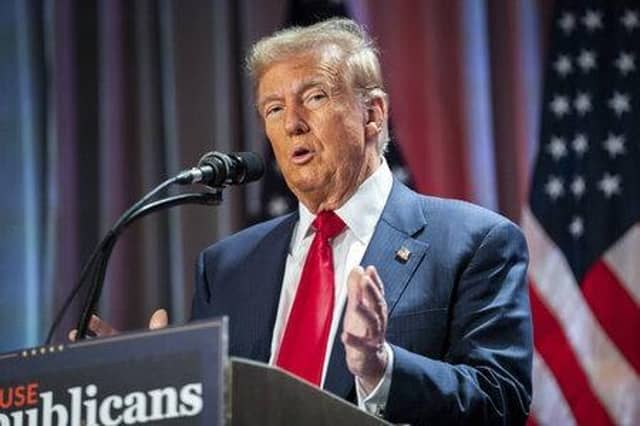

Perhaps one of the great puzzles is how such a flawed figure as Trump, a convicted felon with a long list of sexual and other scandals behind him, was able to rise above this to win such a decisive victory over Kamala Harris and the Democrats.
Trump had a 49.9 per cent share of the vote, compared to 48.3 per cent for Harris. Even more strikingly, Trump won the popular vote by 76,916,868 to 74,391,639 for Harris.
Overall, for better or worse, it was a stunning victory for Trump, and an embarrassment for the American pollsters who predicated wrongly that this would be one of the tightest elections in recent US history and that it would takes days or even months to find out the final verdict. Not a bit of it – Trump made gains everywhere and he was able to claim his decisive victory only hours after the polls closed.
In contrast, the US pollsters did badly again, as they did years earlier when they predicted wrongly that Hillary Clinton had a four-point lead over Trump, who became president. The recent experience of this election means the people everywhere will take American pollsters even less seriously the next time around.
One of the most significant questions arising from this election is why so many people voted for Trump despite his outrageous record. He made inroads among ethnic and other communities, and apparently among a significant section of white women who deserted Harris despite her powerful advocacy of women’s rights on abortion and other issues.
Perhaps America is not ready for a non-white woman in the White House. It seems also that major sections of the US working class from all cultural backgrounds were more concerned with the cost of living than with the alleged erosion of democracy by Trump, and a number of left-wing issues dear to the Democrats. Not for the first time, the old slogan coined by Bill Clinton proved to be true - “It’s the economy, stupid!”
What has all this to do with us? Well, there will be some anxiety as to whether or not Trump will appoint an economic ambassador to help us drum up new inward investment. There is also anxiety about Trump’s proposed high tariffs on exports to America, and how this will affect world trade in general, and UK trade in particular.
The Labour Party already has to build fences with the notoriously thin-skinned Trump, after the historic and full-blooded comments about the president from current foreign secretary David Lammy, and the Labour activists who went to the US to help the Democrats fight the election. A Trump coolness to the UK would affect us as well, if the Donald chooses to seek revenge against his bitterest critics.
However the biggest conundrum remains, namely why did millions and millions of people vote for a candidate with such a flawed character, and why do they still buy the optimistic promise of a man who claims that he will make America great again, but who so singularly failed to do so during his first term in the White House?
Perhaps part of the answer is that Trump was able to focus on their deepest fears about immigration and the economy and was able to allay these fears with a long series of brilliant sound bites and his showman’s mastery of television presentation. In that sense he reminds me of the late Reverend Ian Paisley who was also a remarkable orator with a consummate mastery of the sound bite and of television.
Paisley’s rise to power in the 1960s was impressive because he too was able to play on the fears of unionists who believed that the only policy was “Not an inch” and that any concessions to civil rights supporters and to nationalists and Catholics would seriously endanger the Union.
Paisley also had the ability to make people snigger, with derogatory sound bites such as calling the pope “old red socks”, or disrupting the opening might of the 1966 Presbyterian General Assembly by amassing his supporters outside Church House where they verbally abused the then Northern Ireland Governor Lord Erskine, his wife and others as “pope heads” and “Romanists”.
The supreme irony of this, however, is the fact that Paisley, having bitterly opposed armed republicanism, eventually surprised everyone by doing a political deal with Sinn Fein. Was this because he genuinely wanted in his old age to rebuild many of the bridges he had so vociferously destroyed in his younger days, or was it simply his naked ambition to become first minister at Stormont? Many people feel that it may have been the latter, as I note in my new book ‘Keeping the Faith’.
The same kind of question can be asked of Donald Trump today. Does he genuinely want to unify his country which remains so bitterly divided, or is he just in it for himself? This remains to be seen, as the world - and many people in the USA particularly - nervously wait to see what might happen.
The Donald may continue to surprise us all, but his re-emergence like a phoenix from the ashes reminds me of a quote from the late Franklin D Roosevelt, who was an outstanding US president, statesman and war leader.
He once predicted that in time there would arise a politician who will claim to save America but that very same man in the end would ruin the country.
Does that sound familiar?
Alf McCreary’s latest book Keeping the Faith is published by Messenger at £12.95 and is available in local bookshops and on Amazon