
Ben Lowry: A huge victory for Reform UK but I don't expect Nigel Farage to show much interest in Northern Ireland
Shock by election and council results are notoriously unreliable in telling you what is happening in UK politics.

Governments have often suffered dramatic defeats and then gone on to win re-election.
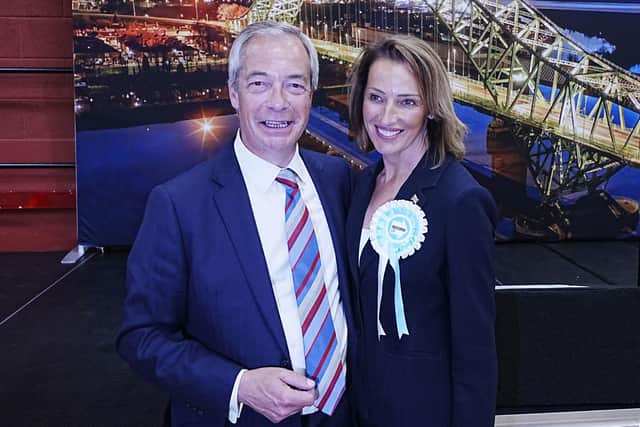
Even so, the Reform UK victory at Westminster – scraping an MP in a formerly safe Labour seat – and winning in councils is an immense moment, and it confirms opinion polls about the rise of Reform.
How will this impact on Northern Ireland, and the whole nation?
The impact locally depends upon Nigel Farage, just as the fate of the entire party does. The party would probably plunge in popularity without him, as Ukip did. If something extraordinary happens, and he becomes prime minister, then unionism will be at his whim.
My fear is that he has shown little empathy with unionism.
A striking thing happened after the 2016 Brexit vote. Most of unionism, or certainly the DUP and numerous other unionist politicians, took a firm position in support of the decision to leave the UK. It was partly principle, given that a clear majority of unionists backed Brexit, but it was also – I believe – a not unreasonable attempt to show the new political consensus (which, even in the Labour Party, was to push ahead with an EU departure) that Northern Ireland unionists were pro Brexit too.
But the leading Brexiteers, including Nigel Farage and Boris Johnson, just bagged that support and didn’t help unionists in return. In a choice between the hardest Brexit, quitting the single market and customs union, and protecting the Union there was no debate for them – going for the former. The EU and Irish government saw this UK weak point almost at once.
Mr Farage has also said alarming things, such as that an all Ireland is inevitable and that Mary Lou McDonald of Sinn Fein was (in effect) a friend (he said he had been misquoted but this web version of this essay links below to an article in which the journalist who spoke to him insists he was correctly quoted – click here: ‘Nigel Farage was not misquoted on an all Ireland, says Irish Times’).
It is often said that Brexiteers are English nationalists. I do not sneer at such politicians when I say that there is some truth in that – England is a country with a remarkable history and it gets such abuse from the Celtic fringe that it is surprising that it is not more nationalistic than it is. But I think it striking that Nigel Farage is a politician whom you would expect to be closely aligned with Jim Allister MP, yet he betrayed the latter’s political agreement with Reform when he took over as leader.
The immediate impact of a Reform surge is on the UK as a whole, but in a few respects I expect an impact here. I have written before about what I think is this government’s weakness when it comes to the legacy of the Troubles, but I think that is less likely with Reform in the ascendant – for example, it took the bold step of legally challenging the Clonoe inquest verdict in which a judge decided that the SAS had been unjustified when it killed some of a heavily armed IRA murder gang during a terror ambush in 1992. I think the Tories and Reform could make much more of such outrageous legacy findings against elderly ex security forces who prevented civil war.
Nationally, however, there is no issue on which Reform will have more immediate impact than immigration. He has softened markedly on the topic, for example saying at times that he opposes mass deportations. Such deportations sound vicious but in fact the loss of control of the borders has been on such a scale (almost two million net migration increase in under three years), and most of it into one of the world’s most densely populated countries (England), that the UK faces huge cultural tensions and ruinous pressure on infrastructure without radical action to stem and reverse it.
I think Mr Farage has modified his stance because he really know thinks he has a chance of being prime minister, perhaps in alliance with a panicked Tories, and thus – in effect – a Conservative premier.
This electoral convulsion will dominate our politics for months if not years, but a last thought for now: The failure to reform our first-past-the-post electoral system in 2011 was disastrous. We have been electing governments with huge majorities on sometimes shockingly small vote shares (Labour got a mere 33% in last year’s election). Major parties like Reform UK have been massively under-represented.
Yet there is no chance of electoral reform and I fear ever more wild electoral swings and abnormal results. Reform was massively under represented in Westminster in 2024. It might in the next general election be grossly over-represented and have few MPs of government calibre. Meanwhile, the current electoral system is slowly beginning to work against unionists at Westminster, just as in the 1970s and 80s it worked against nationalists.
This is all very bad for stability.
Ben Lowry (@Benlowry2) is News Letter editor