
Ben Lowry: Andrew will not cause the end of the monarchy but a king like him would do so
Twenty-five years ago as a young reporter I covered Prince Andrew, as he then was, on a north coast visit.
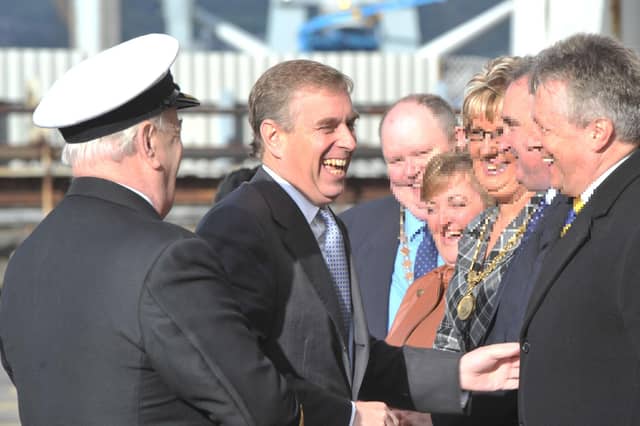

The then Duke of York was himself relatively youthful, in his early 40s. I remember being disarmed by his cheerfulness the whole way through an event to open the new council headquarters in Coleraine.
He shared jokes with the then first nationalist mayor of the borough John Dallat, who presented Andrew with a blackthorn walking stick. The duke pretended not to know what the gift was for, and tapped Mr Dallat on both shoulders as if knighting him, which delighted onlookers. The visiting royal was also charming with the dozens of primary school pupils present.
Days later I was, by chance, at a reception in London after a military and ceremonial function on which I had reported and somehow ended up making small talk to a very senior official in the royal household, whose name I will not cite here. I mentioned that I had covered Andrew on a recent visit to Northern Ireland and had been expecting a somewhat foolish figure (he was known as Randy Andy) but had instead been struck by his warmth and social skills. This person said that the queen would be delighted to hear that, and he would relay it.
I was certainly not expecting that response – perhaps it was only said to flatter a lowly reporter from the provinces. I will never know. Andrew was said to be a favourite son of the late monarch.
I had not been impressed by Andrew and his wife Sarah Ferguson in my teens. I remember their marriage in 1986, when they were adored by the public but struck me as shallow and frivolous. But when I got older I began to realise that the life of a working royal was a tedious one, particularly once I began to report on their visits to Northern Ireland. I have reported on all of them here: the late Queen Elizabeth and Duke of Edinburgh, Charles and Camilla, Prince Edward and Sophie, Princess Anne, William and Kate, Harry, and lower profile royals too.
We hear rumours of some of them being high-handed, bullying or selfish, but I have only ever seen their charming side. I am not naive when I note that they rarely put a foot wrong. If, after a long day of pretending to be interested in hundreds of strangers, they get tired and display even the briefest impatience, the media will remember it for years. Personally, if I was offered a deal to spend decades of my life doing that in return for living in a castle, I suspect I would say no thanks.
There were glimpses too of Andrew’s arrogant side on his visits to Northern Ireland. A few years after that Coleraine trip he played golf on a course that I know very well, keeping guests at Hillsborough Castle waiting for half an hour in the rain as he finished his round. The Times reported that he had also, around that time, got the RAF to fly him to and from multiple golf courses in the UK.
A huge risk for royals is that they have so much wealth, so much access to the richest and most glamorous and beautiful people on earth, and – perhaps most deadly of all – so much deference and adoration, they become exploitative and vain and haughty and even unpleasant. Over the centuries, more than a few have become just that.
I do not know if Andrew was merely another playboy in a long tradition of such aristocrats, or worse than that. Certainly his BBC Newsnight Epstein interview, which made me wince as I watched its initial broadcast, has not aged well. If he has taken advantage of state private information for personal gain, that is appalling.
But I do not think that this saga, while it has ruined him personally, will bring down the monarchy. Nowhere near. The royal family has easily endured into the modern era, despite multiple crises. Who would have thought that something so old-fashioned would easily withstand the age of mass democracy and the advent of cool things like pop music, for example?
At the same time, however, the monarchy could collapse quickly if a character such as Andrew actually became king. The public adores a sovereign whom they think of as dutiful, like King Charles. It is the very fact that have so much privilege, and could abuse it through laziness or decadence, yet instead show commitment to their subjects the the public loves. But the flipside of that is a loathing – that can be frightening to behold – of royals who are deemed spoiled or cruel or self-centred.