
Ben Lowry: As the United States prepares for its 250th birthday, Gordon Lyons has put the focus on the Ulster Irish pioneers who helped build the early America
As we reported last Saturday, the unionist visits to Washington DC for St Patrick’s Day were a huge success.

If it seems churlish to refer to the visits as ‘unionist’, it isn’t – while the unionist parties were out in force, the other main Stormont parties snubbed the celebrations due to President Donald Trump and his role in launching military strikes against Iran alongside Israel.
Or it seemed to be a snub, but only Sinn Fein was explicit and outspoken about their boycott. I am not aware of elected SDLP or Alliance politicians having been present at the various events, although the former SDLP MP Alasdair McDonnell was in the US capital (while he did not want to be quoted about the absence of his party colleagues when I spoke to him at the Northern Ireland bureau breakfast early on March 17, his presence was telling and suggested that he thought a snub was the wrong approach).
This left the way clear for the various unionist ministers from the assembly, led by the deputy first minister of Northern Ireland, Emma Little-Pengelly, to represent the province at the multiple events (click here to see pictures of the them). The Ulster Unionist health minister Mike Nesbitt was present, as was his party leader Jon Burrows. The DUP ministers Gordon Lyons and Paul Givan flew over, as did the DUP politicians Jonathan Buckley and the former MP Ian Paisley Junior.
The access that Ireland gets in Washington DC is astonishing. I write ‘Ireland’ consciously, because the St Patrick’s Day events were for decades, in the postwar years, overwhelmingly a Republic of Ireland-led celebration. Northern Ireland has only really become part of it since the 1998 Belfast Agreement.
I cannot think of another country that gets guaranteed audience with the US president and vice president, and other top politicians, as Irish leaders do on St Patrick’s Day. Given that there are roughly 200 countries in the world, you can see why such access is so rare – if other nations got the same attention, then most days of the year, 200 out of 365 days, would be taken up by the president hosting foreign countries in the White House.
While the Iran war is a very serious and – I believe – perilous conflict, and while total opposition to it is a reasonable political position, it is nonetheless remarkable to spurn such top-level US access on March 17. The most important centres of power in America concentrate on Irish politicians for a day, now with a guaranteed seat for NI leaders.
Last year, and even more so this year, unionists have been to the fore of the celebrations, amidst the vacuum of the Sinn Fein-led boycott. This is ironic because unionists were on the fringes of such events, and didn’t feature during the Troubles. Joe Biden said that he was “only joking” when, on St Patrick’s Day in 2015, he said (alongside the then Taoiseach Enda Kenny) that "if you're wearing orange, you're not welcome in here". He probably was joking, but it was revealing ‘joke’ even so.
The simple fact is that, culturally, the people who are currently known as unionists in what is now Northern Ireland – Ulster folk of Protestant descent – have long been closer to American powerbrokers than the Catholic, southern Irish. The Scots Irish were influential in north America for a century before the later, non-Ulster Irish immigrants. And yet it is the Catholic Irish who have had far more influence over the last half century, for two key reasons – the Scots Irish were so embedded in early America that, like German Americans, they often became just ‘American’, whereas the Catholic Irish kept a qualifier in their identity – as ‘Irish’ American. As it happens, Catholic Americans – long marginalised – are now influential at the highest levels of US power, particularly under President Trump, so they too might lose their ‘Irish’ qualifier as they become entrenched in the establishment.
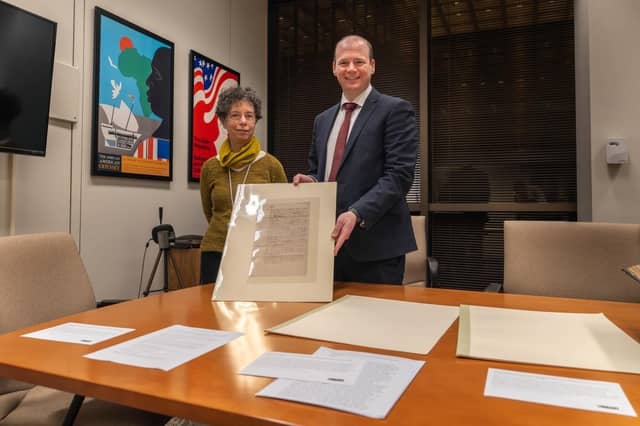
The history of the Scots Irish was told in America this month by, above all, the communities minister Gordon Lyons. The picture on this page shows him viewing original documents at the Library of Congress in DC that highlight the deep historical links between the United States and the place that is now Northern Ireland – documents that will be coming here later this year.
Among the exhibits are papers relating to Charles Thomson, originally from Co Londonderry and Secretary to the Continental Congress that formulated the Declaration of Independence, and Andrew Jackson, the seventh US President, who was born two years after his parents sailed west from Carrickfergus.
We will report more on these crucial links to Ulster in the run-up to America’s 250th birthday on July 4.
I will also write about Sinn Fein criticism of what Mr Lyons is doing.
Ben Lowry (@Benlowry2) is News Letter editor