
Ben Lowry: Donald Trump's election victory shows unionists that decline is not inevitable
It is hard where to begin writing after three intense weeks in the southwestern United States.
I could write about how America is a paradise but with profound problems, such as tragically crazed people walking the streets in Los Angeles and San Francisco – not just talking to themselves but shouting. We have homeless people too, but on nothing like the same scale re gravely mentally ill people on the streets.

I could write the US still being the world’s technological capital and the driverless cars that taxied me to places. This was the most hi-tech assisted trip I have ever made. I did almost everything on my smartphone: ordering Uber rides, meals, booking hotels, flights and paying for my coffees. I say that as someone who found setting up smartphones and downloading apps so tedious and at times complex that for years I didn’t even bother trying to grapple with methods of communication that I now find indispensable such as WhatsApp.
I could write about the weather, 20 Celsius to 26 C (70 to 80 Fahrenheit) daily with blue skies everywhere I went in California, Nevada and Arizona. But in high summer these places are becoming dangerously hot (Phoenix Arizona had 70 days this year over 110F, with regular July highs of 118F, approaching 50C).
I could talk about infrastructure and resulting productivity in the US that puts it far ahead of Northern Ireland (where barely a politician seems to consider that NI might only need one major hub airport, linked to by motorways, as a minor counterpoint to Dublin instead of our all-things-to-all-men three airports, including now permanent subsidies for City of Derry).
I could write about how much of the older America that I remember with such happiness as a young child in the 1970s is still there. And how much of it is gone.
I could expand on how being in America reminds you of its phenomenal ongoing and enduring entrepreneurial spirit, yet how even America is falling prone to work-shyness and a culture in which managers are afraid to manage.
And I could write about how this trip reminded me of the enduring, but subconscious and almost forgotten, cultural links and similarities between Ulster Protestants and the Scots Irish – both the good side of its individualistic Protestant spirit and the increasingly evident dependent, bad side.
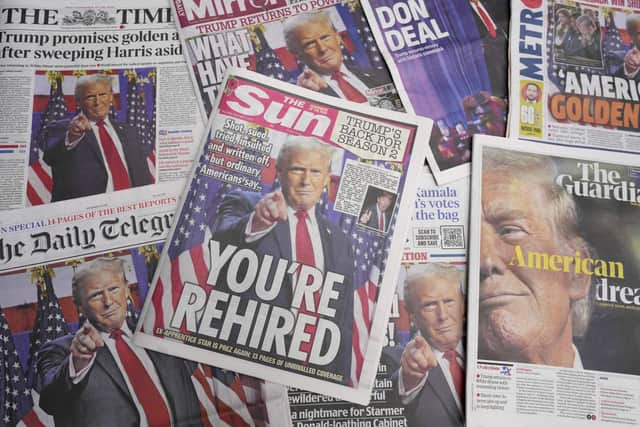
I could examine multiple aspects of the return of Donald Trump, who as I said in columns on Monday past and on Saturday October 19 was favourite to win this contest, even when Kamala Harris was ahead.
About how foolish the Democrats were to endorse a diversity hire for president – chosen as a woman of colour – when the party needed to connect with an anxious and shrinking white, middle America that deeply resents so-called ‘positive discrimination’.
About the staggering hypocrisy of Mr Trump who was implying fraud against him in the election campaign but now says not a word about cheating, a man whose refusal to concede the last election contrasts with the grace of Mrs Harris in defeat.
But in the space I have left in this column I want to draw open some lessons unionists can draw from Mr Trump’s win.
The first is that unionists can be more assertive, and less apologetic, without aping Trump’s unique style.
We are not in the same situation as Mr Trump in that a 50%+ unionist share of the NI vote is now hard to imagine. And we have a system of mandatory coalition about which the NI unelected elites are only concerned insofar as unionists might ever block things, never about the disastrous fact that a party committed to the destruction of NI has to be in power at all times. A party that is never properly challenged by successive UK governments.
But being nice is not working. It is making unionists seem weak. Being nasty won’t work either, but confident critiques can be built of of things that we might not be able to stop, such as the increasingly sectarian use of Irish.
We should also to know when displays of controlled outrage might be effective. I can think of no more obvious topic than the IRA still enjoying legacy largely on its own terms. Could you imagine America accepting for five seconds Islamist extremists and their helpers being allowed to drag through US police and military through the courts at US taxpayer expense for their far tougher response Muslim terror than our own fair-to-the-point-of-lily-livered Troubles response to the IRA?
We could consider how the woke extremism that is so embedded in the liberal consensus at Stormont and the NGOs has been rejected by American voters. There were signs of its rejection in NI in the Westminster election too when a noticeable chunk of voters edged away from Alliance in East Belfast and North Down, and the unionist overall vote pulled back ahead of nationalists.
We might reflect on how Trump’s jump in support among Hispanics and blacks shows that decline is not inevitable, no matter how many times the BBC publicises the republican ‘new Ireland’ project. New Ireland? I’ll take the old one thank you, which would not have indulged the increasingly mainstream Ooh ah up the Ra chants.
Meanwhile, Ireland has again placed itself on the far side of a cultural divide to America on global affairs, above all Israel. Unionists, like much of the UK establishment, are closer to Washington’s thinking post the October 7 mass murder of Jews by Hamas.
Unionists can, alone as seems likely, argue against the cultural problems with out-of-control immigration and multiple hotels being used to house the influx at a time of public services shortages.
Unionists have to be careful how this is done as not to alienate groups potentially sympathetic to unionism. But they will win respect for being firm if they are also friendly.
In my reports from Trump rallies, I tried to convey how he has a certain charm that lets him get away with outrageous rhetoric. I still don’t like him. But he has zoned in on fraught issues where naive liberals have failed badly.
• My report from Arizona p14-15