
Ben Lowry: Even if we defend the nuclear attack at Nagasaki, 80 years ago today, we must not shy from its pure horror
It is 80 years today since a nuclear bomb was dropped on the Japanese city of Nagasaki, effectively ending World War II.
(Click here to read Ben Lowry on the pop music writer Barry McIlheney)
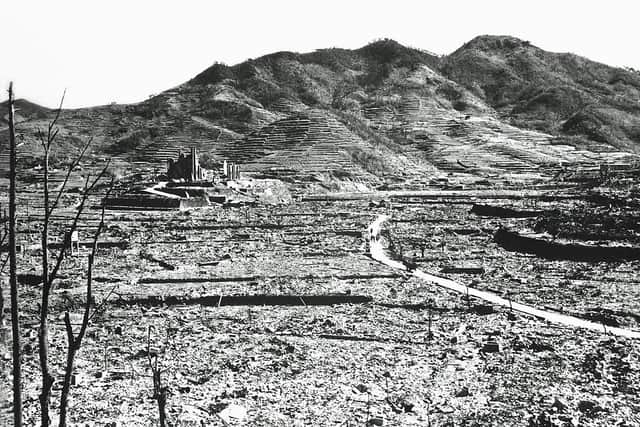

This week there have been commemorations and discussions around the world about that attack, and the one days earlier at Hiroshima. On page 18, Roamer reflects on those “indescribably” dark days.
I wanted to write about it here, and almost didn’t, thinking that there is not much a Northern Ireland journalist can add to this welter of words and reflection. But to add my small thoughts to the debate I want to reflect on my deep unease about those two bombings, despite being very much a ‘hawk’ on defence matters. It has become ever clearer to me as I get older that strong and civilised states must also be strong in their defence of their societies and their cultures, or one day – sooner rather than later – bad people will take advantage of their weakness and destroy them.
The arguments in favour of the bombings are very sound ones, yet I dislike the way that many supporters of the west, and of America, (and I am a fervent supporter of both) just shrug their shoulders and say that the bombings were necessary. On the whole I think they were justified, certainly one of them was, but that we must not let ourselves duck the horror of their outcome.
There are only five photographs of the aftermath of the Hiroshima attack that were taken on the day of the blast, two of which show battered and confused and seriously injured survivors, seeming to stumble around together in the aftermath. They are not in fact the most shocking pictures from Hiroshima – there are more distressing images taken later of examples of burn injuries – but it does not take much imagination to envisage all the children and elderly people and so on who suffered slow and agonising deaths after the nuclear blasts.
There is no doubt that Germany and Japan were responsible for World War Two – none. There is no question that British leaders who wanted to surrender to Hitler were wrong and that Churchill was right to continue to hold out (he came within a whisker of losing that internal UK government argument). There is no question that massive warfare was needed to stop the Axis powers.
It is further true to note that the emergence of a nuclear bomb was something Germany and Japan were working on, and it was important for America to win the race against them and to give evidence of that victory.
Even so I worry very much about the precedent of using nuclear bombs. The Hiroshima and Nagasaki bombs essentially kept the peace for 80 years, but memories fade and the risk of nuclear conflict now is rising again. Current bombs, however, are vastly more destructive even that the horrifically powerful devices used twice in August 1945. It would only take scores of them to be detonated to create a nuclear winter that could end mankind.
If the rise of Al Qaeda and Isis and Hamas has taught us anything it is that there are powerful groups of fanatics who are utterly unhinged. Never forget that the Twin Towers in New York held 25,000 people per tower when full, 50,000 total. If the planes had struck later in the day and lower down the skyscrapers, that kind of number of civilians would have died. Anyone who would merrily massacre that number of civilians, as the deranged 911 attackers did, would not baulk at killing hundreds of thousands of people if they could.
In World War Two it was Germany that led the way with air attacks on cities as early as 1940, hitting Coventry late that year causing mass civilian deaths. My late dad, who died three years ago in his 90s, wrote to this newspaper with his clear memories of the 1941 Belfast blitz, in which almost 1,000 people died in a few nights (a quarter of the 30-year Troubles death tally). It was Japan that air attacked the US fleet in late 1941. Retaliation was essential, and Churchill’s decision to raid Berlin during the Battle of Britain arguably saved the UK from defeat.
Even so, the justified later allied attacks on Dresden and Tokyo were tragic. It is hard to contemplate the people incinerated and their terrifying, agonising ends – a horror of which we will never know.
My biggest unease is about the Nagasaki attack. Did it need to happen a mere three days later? Could it not have been dropped on empty countryside near Tokyo as a terrifying warning? There is not space in this column to consider those points. Suffice to say America did ponder multiple options. Also the Japanese high command were not prepared to surrender after Hiroshima alone.
All I say in summary is this: I fear that those bombings, whatever their justification, were not the last word in nuclear conflict.