
Ben Lowry: Hallett pandemic report is now the latest feeble finding on the scandal of the IRA Bobby Storey funeral mass covid breach
By far the greatest scandal during lockdown in Northern Ireland was the flagrant IRA funeral breach of the covid restrictions in June 2020.
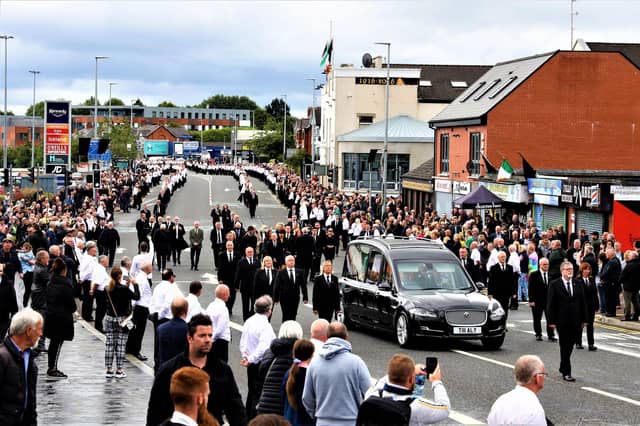

The first two volumes of the public inquiry report into the pandemic by Baroness Hallett devote a handful of paragraphs into that disgraceful incident by Sinn Fein. It is the latest in a number of limp reports into that funeral of the IRA leader Bobby Storey
To remind anyone who might somehow have forgotten the context of the calculated breach of the covid rules that day, the most sanctimonious of all the Stormont parties in the four months prior to the funeral had been Sinn Fein.
The massive funeral was a grievous insult to the thousands of relatives of people who had died and who had to accept covid limits that meant barely any people could be present at the send-off of their loved one. Almost everyone played by the rules, except republicans and a few others. An early such breach was the funeral of the ex Sinn Fein councillor Francie McNally on April 8, 2020 in Tyrone.
However, the Bobby Storey terrorist funeral in late June, which brought thousands of people on to the streets of west Belfast, was by far the worst such breach. Sinn Fein’s central role in the mass gathering was an act of profound hypocrisy from a party that had been so sanctimonious about covid, and which had been scathing about the Conservative government in Westminster’s response to the pandemic (John O’Dowd described the Tories as a “shire of b***ards” who were “using everyone ... [in a] twisted medical experiment”).
Sinn Fein, led in NI by the deputy first minister Michelle O’Neill, wanted the earliest and longest lockdowns. In mid March 2020 Ms O’Neill suddenly performed a u-turn to call for immediate school closures to combat coronavirus. But this came less than 24 hours after Sinn Fein had backed the Stormont executive’s decision to delay a shutdown. The party simply wanted to follow the Republic of Ireland, for the obvious reasons that it is obsessed with achieving all-Ireland political approaches to pretty much all public matters. Thus it discarded the already clear evidence that children were at barely any risk from covid.
An anglophobia that had come to the surface in nationalist Ireland after the 2016 Brexit referendum was also apparent during covid, during which commentators in the Republic praised Ireland’s own supposedly rigorous response to the pandemic with that of the UK. With hindsight, neither country had significantly different outcomes. I was among those commentators who said that any all island approach had to be weighed against the fact that Britain remains a scientific superpower (evident in the UK’s central role in developing vaccines, which were – I say – the key route out of the disaster of lockdowns).
But any disagreements over the need for an all island response to covid were as of nothing compared to the Storey funeral. Yet the various investigations into it resulted in feeble findings. Prosecutors said the law was all too complicated, even for those pro-lockdown Sinn Fein politicians who helped make it. A Her Majesty’s Inspectorate of Constabulary (HMIC) report agreed with that. Prosecutors also said that the PSNI facilitation of the funeral helped make prosecutions impossible. Police say that they had to engage with organisers, for safety reasons. HMIC agreed with that too.
Belfast City Council’s report into the use the takeover of Roselawn for an IRA funeral found that republicans did not put pressure on the council to close the crematorium. We must assume it just happened.
This newspaper and Stephen Nolan at the BBC tried to keep the focus on a funeral that much of the media had initially played down, as did Stormont MLAs – until the public uproar. Now Baroness Hallett has weighed in on the funeral.
She has past experience of investigations relating to the IRA, having found that Tony Blair’s secret scheme for IRA fugitives was flawed but not unlawful. The barrister Austen Morgan’s excellent book (Tony Blair and the IRA: The 'On The Runs' Scandal) looked at matters he felt her inquiry overlooked.
By my count, seven paragraphs of Baroness Hallett’s volume I and II findings on Stormont’s handling of covid mention the Storey funeral. Her overall conclusion, vis a vis the province has been reported as being – in effect – that the DUP and Sinn Fein were equally to blame for divisions that hampered their handling of covid. The BBC View on Thursday night put to SF’s Philip McGuigan the finding that Ms O’Neill’s “initial refusal to apologise for [the funeral], contributed to tensions” at Stormont.
You see? SF are flagrantly hypocritical and at the heart of the IRA funeral breach, but both sides are to blame for the tensions.
The report says that confused regulations meant “enforcement was practically impossible … as seen ... during the controversy over the size of crowds at the funeral of Bobby Storey”.
You see? Again, there is everyone’s fault. There is no agency on the part of the thousands of people who turned up for Storey, let alone the republicans whom the police helped to organise it. Had those who attended not noticed the advice everyone else followed?
The report says that Ms O’Neill expressed her regret at having attended the funeral in her evidence to the inquiry, without emphasising that this was years later. It notes that Arlene Foster then declined to take part in joint press conferences (I would say rightly in light of such shameful hypocrisy). The report says that the end of the joint conference “undermined” the bid to explain rules to the public.
It does, finally, say that O’Neill “must bear responsibility” for “for her failure to apologise earlier”. But when it then says it is “highly regrettable that joint press conferences were suspended” it then blames both her and Mrs (now Baroness Foster) for failing to resolve their disagreement. It then cites some of the aforementioned feeble reports into the Storey funeral, which in effect found that no-one was to blame, as if to endorse that finding – that the real problem was the confused regulations rather than a calculated mass breach facilitated by the authorities for an IRA leader.