
Ben Lowry: I believe that British and Irish leaders ducked my query on London having capitulated to Dublin's hypocritical legacy legal action because they cannot deny it
Almost a decade ago I wrote an article describing the handling of legacy as one of the biggest scandals in the UK since World War Two.
I made that comment in the first half of 2017 because the imbalance against UK state forces in legacy investigations was becoming ever apparent.
This was in the years after the Stormont House Agreement in 2014 was established to forge a way forward on legacy.
At the News Letter we had been closely covering two things: first the deluge in investigations against the security forces who prevented civil war in IRA-led violence. We had also been reporting on expert voices who explained why the Stormont House proposals would also turn against the UK state forces, yet it was an agreement that was supposed to bring balance to how legacy was investigated.

Aware that it would sound like hyperbole to say that legacy was one of the biggest scandals since 1945, I wrote why I really thought it was that serious: the Troubles was one of the biggest political and social challenges the UK faced after 1945. London was thrown into dealing with chaos in the late 1960s, and after some stumbles Labour and Tory governments saw off terror with patience over three decades.
Back in 2017, I wrote: “Now, almost unbelievably, the apparatus of the state appears to have turned in against that record of the state, despite that past success.”
The deal struck between London and Dublin yesterday is a significant return to the failures of Stormont House.
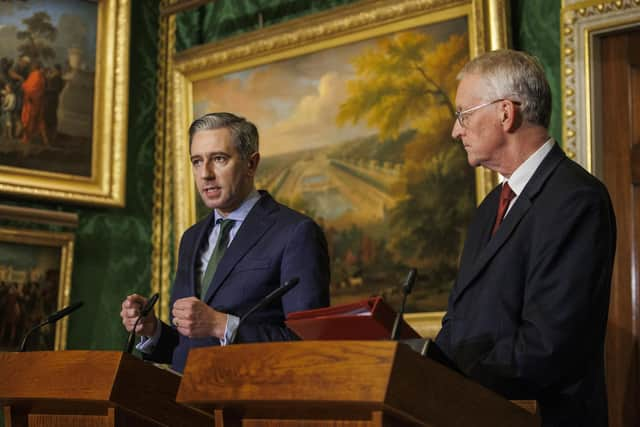
There is a lot to say about the agreement that was unveiled yesterday in Hillsborough Castle by Hilary Benn and Simon Harris, and a lot yet to absorb about it.
Among the many alarming elements is that supposed protections that are being offered to veterans of the Troubles are not afforded to former members of that excellent, but maligned, former police force, the Royal Ulster Constabulary. On the contrary, ex police office might have their cases sent back to the police ombudsman, which critics believe has produced so many reports of at best dubious merit, amid a deluge of complaints against the RUC (also amid an Irish nationalist hunt for collusion with loyalists, that plainly did not happen to anything like the scale that is repeatedly alleged).
A fortnight ago I wrote about why I thought the UK was surrendering to an Irish state that is suing it. Little that I saw yesterday made me change my view. Rather than recap on the points made in that article, let me summarise here how Hilary Benn and the Irish deputy prime minister Simon Harris responded when I put that point to them at Hillsborough Castle yesterday afternoon. The web version of this article will include a video of my question and their responses and you can judge for yourself, but I would say that they did not answer my question at all.
I noted that we had just had confirmation that Ireland was getting joint control of legacy now, despite taking a legal action at Strasbourg on legacy against the UK, a legal action which Mr Benn had not so far as I was aware even criticised, let alone threatened retaliatory action. I put it to Mr Benn that many people will think he had appeased this Irish action, amid all this gushing talk about good UK-Ireland relations.
I also put to him our story of earlier this week, based on a paper by the think tank Policy Exchange, that he had supported a fuller amnesty when he was a cabinet minister in Tony Blair's government (he had not answered our query about that this week). Yet when the last Conservative government proposed a lesser conditional amnesty, he was totally opposed to it, despite the fact Ireland was suing the UK for this proposal. An Ireland, I pointed out, whose former justice minister no less (Michael McDowell) had said operated a de facto amnesty for the IRA.
I then put to Mr Harris yesterday that he had sounded very high minded yesterday at the Hillsborough announcement, saying that Ireland had reluctantly sued the UK but been forced to do so. What about the fact that they took such an action in the context of their own de facto amnesty for the IRA?
Finally, I mentioned that there was, after all these years, still no process in the latest legacy deal to address, for example, the fact that for 30 years, 103 out of 110 extradition requests by the UK were refused by Ireland, as a result of which – many of our readers would believe – hundreds of Protestants along the border were massacred.
To list the answers the two politicians gave me would take about another 1,000 words but it only takes a few minutes to listen to their answers in the video that will accompany this article online.
Hilary Benn said that I had mentioned the past but that “at some point we have to move beyond the pain and the suffering and the events of the past, and fashion a way of dealing with this problem, which is exactly what this document does”.
He also said that “on the interstate case, of course, it's a matter for the Irish government, but I'm quite confident that the arrangements that I intend to put in place will make the body that we are going to reform human rights compliant”.
He said that he did not accept my characterisation of his stance on the 2005 Blair amnesty plan which “was eventually withdrawn because it had no support in Northern Ireland”.Mr Harris also spoke in general terms in his answer and said that Ireland “would welcome any complaints in relation to any or any unresolved criminal activity”.
I then pointed out that ex IRA speak freely about their terrorism in his jurisdiction (I was thinking of the late Father Ryan and others). I was then cut off and the press event moved on.
But I believe their answers were so poor because they know the UK has buckled to the hypocritical Irish legal action.