
Ben Lowry: I watched Donald Trump in Nevada and was reminded why he might win this presidential election
If you want to understand why Donald Trump is favourite to win back the presidency 10 days from now, being at his rally in Nevada would have helped explained it.
I was at the packed event in Las Vegas on Thursday night, arranged at five days' notice, as the former president criss-crosses the seven 'swing states'.
These are the states out of the 50 in the US that could either be won by Mr Trump, the Republican Party nominee, or his Democratic Party rival for the job, Vice-President Kamala Harris. America has a state-by-state winner-takes-all electoral college, in which if you win a state even by one vote you take all the electoral college 'votes' (ie college electors) for that state, based on the state's representation at the Houses of Congress in Washington DC.
The system means that a candidate can win more overall votes across the US but still lose in the electoral college. This happens because if you win a huge state like California (where I have been for most of the past week, beside Nevada) by a massive majority, you get all the electoral college votes for that state but no more based on the scale of your victory. VP-Harris is set to do just that in the biggest US state.

But if you win lots of smaller states by narrower margins, such as Nevada, as Mr Trump might well do, then you can pick up lots of electoral college electors even though the contribution to your overall vote is smaller than it is in big states like California and New York.
This is why the Republican President George W Bush Jr won the presidency in 2000 despite getting fewer votes than the then Democrat Vice President Al Gore. Hillary Clinton also lost with more votes against Donald Trump in 2016.
The situation is complicated by the way in which each state has two senators in the larger of the two Houses of Congress, the senate, regardless of the state's population, and has a typically larger number of congressmen, members of the House of Representatives, based on population. Thus smaller, rural states like Nevada have disproportionate influence.
For decades now this has been working to the advantage of the Republican Party, because these small rural states tend to have white populations, which are voting ever more Republican. As someone who has lived in both America and the UK, I have written for years about how the US is becoming like Northern Ireland, with white people rallying round one tradition, the Republican Party, just as Protestants in NI mostly vote unionist, Catholics mostly nationalist.
The position across America, though, is still more complex than that. While a trend has been developing in which 70% of white males might soon be voting Republican (already that percentage of non college educated men), this has been greatly complicated by ex-President Trump.
In these last weeks of the campaign, he has been gaining ground among both Hispanic men and African Americans (the latter are still 85%+ Democrat). He is also helping to create a gender divide, in which women are increasingly drawn to Ms Harris, such is the belief among many female voters that Mr Trump is flagrantly sexist.
Nevada, like Arizona beside it, is a border state where Mr Trump is hoping to capitalise on two factors.
First, the dissatisfaction with immigration and the flood of illegal aliens along the land border with Mexico to the south, that runs eastward from the Pacific Ocean in California, then through Nevada, Arizona, New Mexico and Texas.
Second, he is hoping to pick up Hispanic voters themselves, many of whom once arrived in the US as illegal migrants but have since found paths to American citizenship.
There was evidence of Mr Trump's success on both counts on Thursday night.
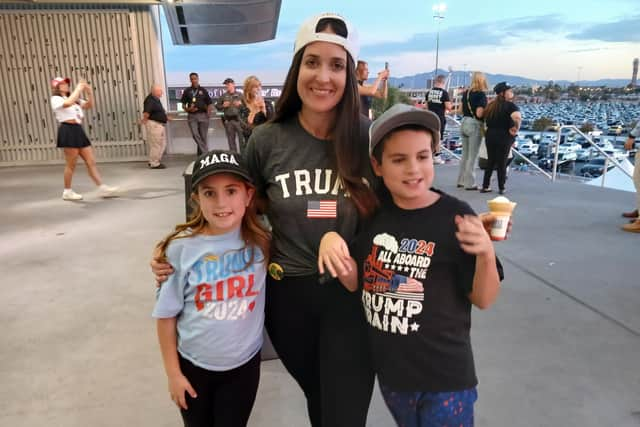
It was very racially mixed, with a high percentage of Hispanic voters in the audience. America has long traded on the idea that someone who becomes a loyal American is welcome to enjoy the American dream. Mr Trump was welcomed on stage by speakers including his one-time rivals for the Republican nomination, Vivek Ramaswamy, of Indian descent, and Senator Marco Rubio, of Cuban descent. They spoke of just that: how they were immigrants who had been able to achieve the dream. Jaime Lamb, from Boulder, Nevada, not far from Las Vegas, was among those in attendance with her daughter Gia, eight, and Crewe, nine. Gia said: “He [Trump] loves the US!” Her mum told the News Letter: “Yes, Maga! [The Trump slogan: 'Make America Great Again'].”
Then Ms Lamb cited immigration as her chief policy concern: “We love his policies, please help us at the border!"
The rally was extraordinary. I have not been to anything like it, even though I reported from a Trump rally in the then swing state of North Carolina in 2016.
He has improved with age. I do not write that as a fan of Donald Trump – on the contrary I have been scathing about his character – but it is nonsense to compare his ageing to that of Joe Biden. Mr Biden was suffering noticeable cognitive decline in the 2020 election. By last year, when he visited Belfast, his dementia was already painfully apparent. This year it was fully exposed in a debate against Mr Trump.
The latter has phenomenal energy. He spoke effortlessly, and largely coherently, for an hour and a half. He got rapturous applause when he vowed to keep taxes low, to jail people who burn the US flag, to stop trans men competing in women's sport, and when he accused Biden and Harris of having ruined the country. He tells falsehoods with panache.
At a political event at Stanford University days ago, an elderly fellow in their prestigious Hoover Institute told me the former president was a political genius.
That was evident on Thursday night. The crowd was almost hysterical in its love of this man who, despite being a self-made billionaire (largely so – but his father was rich), has an intuitive understanding of blue-collar concerns that most political elites do not.
On the issue of failing to control immigration alone, the latter have failed spectacularly on both sides of the Atlantic. In America, there is a politician who is capitalising on that more than any other.
Last week I mentioned how Ms Harris did not seem to me to be far enough ahead to win. The polls have since narrowed, in Trump's favour.
I will write more on my US trip in the coming fortnight.
Ben Lowry (@BenLowry2) is News Letter editor