
Ben Lowry: In Northern Ireland we share the financial fantasy of Rachel Reeves that we can have good public services without paying tax for it
Northern Ireland can seem to me to be a microcosm for wider problems in the western world.
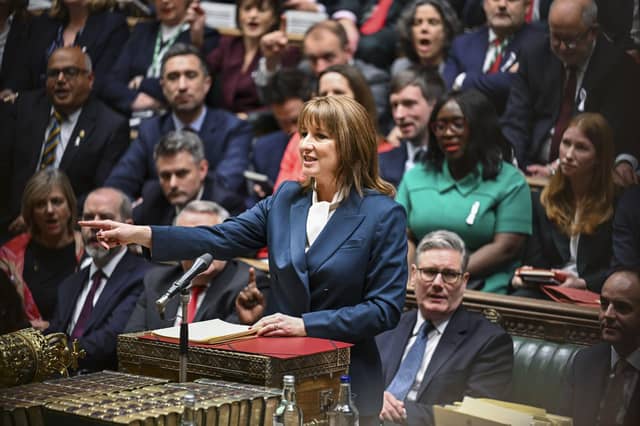

I was reminded of this this week after the Labour Party’s almost fantasy budget in Westminster, in which the government is trying to pretend that everyone can live well and no-one has to pay except a fabled and demonised wealthy class. Such thinking has been around at Stormont for a long time.
This province is a great place to live with an inventive population – I am optimistic about our future. But in the same way that rich and successful families can, in a small number of generations, descend into financial and social problems, so too can an a successful place like NI.
Before partition Ulster was the industrial and commercial and scientific powerhouse on the island. I have had a glimpse into some of the history to that, having serialised the earliest Belfast News Letters from the 1730s, where you see reports on the agricultural revolution, the fledgling linen trade and the expanding Belfast port. Those newspapers depict a thriving civilisation roughly midway between the 1609 plantation and the industrial heyday of the late 1800s.
That creative Ulster spirit has never entirely gone away but has become dulled by our dependency on subsidies from London. It was the great liberal American president, JF Kennedy, who said: ‘ask not what your country can do for you, ask what you can do for your country’. At the risk of romanticising the past, I think that the north of Ireland – a time just before Northern Ireland – was a place that was keen to serve its country, for example of the brave volunteers in the Great War.
We are now incomparably richer than then, very averse to risk and almost totally ungrateful towards the UK. Unionist politicians join with nationalists in implying that we are insufficiently funded by Westminster. There are different ways of measuring this, but it is beyond dispute that we are lavishly funded by the rest of the UK (being net recipients of public funds).
There is a huge high welfare bill in Northern Ireland and little political desire to tackle it. This was apparent a decade ago, when I was writing about the massively disproportionate number of people in NI on then Disability Living Allowance. Now even more people depend on benefits. The Troubles is often cited as a reason for this dependency but in doing so we greatly exaggerate the number of people who were badly traumatised in the violence.
In fact the Troubles helps explain why London smothered the province with money: two weeks ago, on the anniversary of the Anglo Irish Agreement, I wrote about how successive UK governments normalised Northern Ireland after the worst years of the Troubles, in the early 1970s. Reginald Maudling, the home secretary as the Troubles approached their height, was criticised for saying that it would not be possible to defeat terrorism but that it might be possible to achieve an “acceptable level” of violence.
This is largely what happened: in the five years from 1972 to 76 inclusive, almost 1,600 people died, and average of just over 300 per year. But in no year after that did even half that number die (1979 was next worst with 121 dead). In every year except 1972, more people died on Northern Ireland’s roads.
This is not to minimise the terrible suffering of the Troubles, but to explain how pumping money into NI worked. It helped to marginalise the violent extremists.
Now there is almost no gratitude towards funding from London. The only people who seem to realise that our resentful demands for more funding might alienate middle England, which is a net tax contributor, are Irish nationalists, who are quietly delighted at their success in depicting the UK as presiding over a badly-funded mess in NI.
We won’t reform NHS provision here, as recommended by numerous experts over a quarter of a century, we won’t pay for water so our infrastructure is failing, we reduced the age of free transport at a time of rising life expectancy, we gave free prescriptions to people like me who can afford them. We won’t even countenance asking any public sector workers to do more in return for generous pay rises and pensions. We are a mini reflection of the world of the Chancellor Rachel Reeves. Promise better services, keep individual income taxes down, and pretend that a wealthy person elsewhere is not paying their share.
This will all end in tears.