
Ben Lowry: Mike Nesbitt has faced the thankless task of political leadership in Northern Ireland
Mike Nesbitt will turn 70 next year. Of all the political challenges that he faces, I had not thought of that particular one – age.
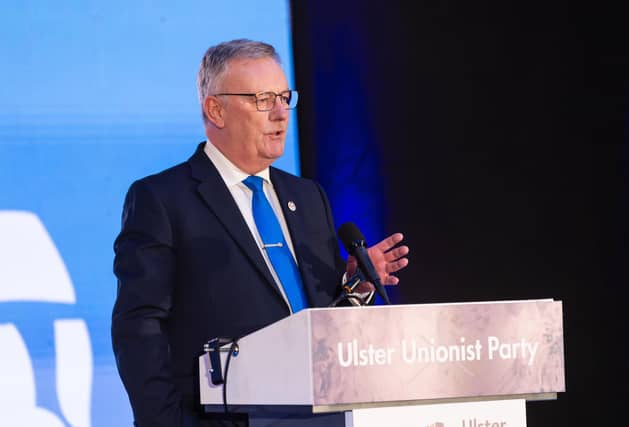

He strikes me as a man who is considerably younger than that Biblical milestone of three-score-years-and-ten.
Mr Nesbitt, explaining his decision to stand down as leader of the Ulster Unionist Party, said that if he was to go on to another full Stormont term, he would be participating in a political mandate that runs to 2032, when he will be 75 – “that’s a commitment to full-time politics I just do not feel I can make,” he said.
And who can blame him?
Very few people work full-time in a job as far as 70, never mind 75 – and let alone in a job as immensely pressured as a political leader.
Heading a political party such as the UUP is particularly challenging, because it has become one of the smaller of the main Stormont parties (after having been by far the biggest political party for most of the history of Northern Ireland).
Many times on these pages and in broadcasts I have pointed out how hard it is to find political leaders now. The reasons for this scarcity are simple – people of ability do not want to go into politics. They get abuse. They earn far less money than they would if they were working in the professions. And they have to reveal their personal views, which people are loathe to do in any western society, let alone one as divided as Northern Ireland.
As we can see every day, major nations such as the USA, the UK and France all struggle to find competent political leaders. If this is a challenge in countries with populations of 70 million plus (or, in the case of America, 300 million plus) then it is inevitably going to be all the harder in NI, where we have two million people, and where we have an array of different parties.
These points are worth emphasising again and again. We complain bitterly about bad government, yet will not accept politicians who take difficult decisions on financial or other matters. Ridiculously, there was not one Stormont MLA out of 90 (as far as I am aware) who opposed the public sector strikes when Stormont was down prior to 2024. Or, if I am wrong about that and there was in fact the odd MLA who opposed those strikes, then they were very quiet about it. I know this because in some broadcasts I was the only voice who made the case against such industrial action.
Mike Nesbitt came forward into politics, and not only took on the tricky job of leading a unionist party at a time when there are three such parties, he took on the health portfolio – one of the toughest jobs in politics, made all the more so by the disgraceful, cross-party political cowardice over NHS policy. The various parties simply will not implement the sorts of reforms that experts have been urging them to implement for 25 years, which means closing some units.
This failure is at the very heart of the health crisis – not that you would know it from the BBC’s breathless reports on the symptoms of the crisis, such as waiting lists. It is all pretty simple – if we fail to rationalise health provision by having a smaller number of world-class hospital sites, the crisis will go on and on and on. Mr Nesbitt also tried to provide a liberal unionist option for voters. Unionism has needed that option for decades, yet has not had it. The situation is made all the more tricky by the fact that while there are many moderate unionists who hover between Alliance, Greens and unionism, unionists have become more hardline. And who is surprised, in the face of perpetual taunting from nationalists that the UK’s days are numbered?
Or in the face of sectarian conduct on things such as the Irish language – think of Belfast’s disgraceful policy on Gaelic signs, which are being imposed in areas where up to 85% of residents do not want them.
Last year we ran an essay from David Burnside, the former Ulster Unionist MP, calling for a single unionist party. We will on these pages, in 2026, continue to cover the debate about unionist co-operation. The demand for one unionist party is not an unreasonable one at a time in which the unionist vote is shrinking.
At the same time, we need to be mindful of the fact that such a unionist monolith will deter the most liberal of the potential unionist voters. While it is not feasible for unionism to have three main parties in the longer term, we should not lose sight of the fact that giving unionist voters a wide choice of options is probably one reason why the combined unionist vote pulled back ahead of the combined nationalist vote in last year’s general election.