
Ben Lowry: Only in the soft UK would we get this contemptible Clonoe ruling against SAS and RUC heroes for stopping a heavily armed IRA terrorist murder gang
If SAS men are put in the dock for killing a fanatical IRA murder gang, my first instinct is to say that it will be the final scandal in legacy.
If they, and possibly RUC officers who investigated the special forces shootings at Clonoe in 1992, are put through a criminal trial it will be the final proof of the lunacy of this process, in which investigations into the past have turned entirely against the UK state.
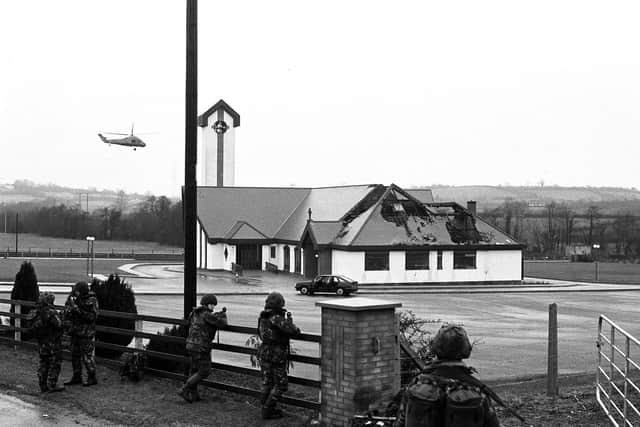

Except that such terminology is wrong. It is unlikely to be the ‘final’ outrage if that shameful outcome comes to pass, after another appalling legacy legal ruling by Mr Justice Humphreys (shortly after his extraordinary order to a government that the murder of Sean Brown get special investigative treatment when hundreds of Troubles victims lack anything even approaching truth and justice).
If the SAS and RUC are put on trial, it is far more likely to be just the start in such prosecutions.
The judge says that the SAS used undue force at Clonoe. Well said Gavin Robinson that such a ridiculous assessment “beggars belief”. I would go further than the DUP leader and say that only in Britain would our security forces, whose response to three decades of IRA was terrorism was so soft (with IRA terrorists largely being free to carry out their long campaign of murder and bombings) be subject to such a finding.
What were the SAS supposed to do at Clonoe? Take the risk of asking a heavily armed terrorist attack gang of up to 10 men to stand politely for arrest? There is an onus on the judge to give a clear indication of what the SAS should have done in light of his finding of unjustified lethal force.
This case not only illustrates the absurd standards to which past actions by state forces are being held, with no appreciation of the context in which they were operating, it is happening in an age in which the populations in every western nation on earth fully expects Islamic terrorists to be shot dead during their attacks. It is immediately understood that the public must be protected from terrorists.
The contemptible Clonoe ruling also highlights the success of nationalist Ireland in changing the parameters of the debate on legacy (and I write nationalist Ireland there consciously – they are now essentially at one on legacy, with the old nationalist wing that was scathing about IRA terrorism either now gone or, more likely, afraid now to speak up clearly against the IRA violence about which their predecessors were so scathing).
Here is an example of the subconscious acceptance of new parameters: some years ago I got concerned by how unionists were, as an example of their failure to grasp how serious things were on legacy, beginning to emphasise the fact that the security forces were responsible for only 10% of the Troubles dead. But this is potentially very misleading – it suggests that 10% of illegal killings were by state forces.
As I hoped was obvious, this was to inadvertently adopt a republican interpretation of the statistics – that all of those state killings were illegal. In fact defenders of the state such as unionist politicians should be pointing out that such killings were overwhelmingly legal – albeit tragic when they involved civilian deaths.
And even killings that were, potentially, wrongful – perhaps by a tired and anxious and poorly trained young soldier in a dangerous and chaotic situation – were almost always of an utterly different moral culpability than a pre-meditated action of a paramilitary who had decided that a particular person was going to be killed.
To illustrate my point about the republican distortions, I pointed out that they did not even accept that the SAS stopping the East Tyrone Brigade IRA mass murder gang at Loughgall in 1987 was legitimate. This gang had been responsible for scores of murders along the border – the Rev David Clements has written several times on these pages about how his father Billy was one such victim of the Loughgall gang, when he was murdered in 1985. Rev Clements writes powerfully about this again, opposite.
Now we are into topsy turvy moral and legal territory that even these most obviously legitimate state killings of hardened and lethal killers, at Clonoe and Loughgall, are going to be judged, decades later, to have been illegal, quite possibly leading to criminal proceedings.
This utter madness has been brewing for a very long time.
It has been clear for years that inquests were going to be at the heart of the legacy imbalance – for example I wrote in 2017 that they would play a “starring role” in the legacy scandal. But they are even worse than I was anticipating – they are now in effect major public inquiries at great expense. In this case there were 21 KCs.
I was talking to a very experienced lawyer who had a role in one such inquest and was shaken by the process, and what it had become, as was I when I attended some of the massive Ballymurphy inquiry (called an inquest).
Hilary Benn has restored these utterly lopsided probes into killings in which there are allegations against state forces, and he has also restored civil actions, which are almost all anti state. My colleague Adam Kula will be revealing some data on the scale of the anti state claims in Monday’s News Letter.
A final point on this that I have made repeatedly but must be made again. Hilary Benn, the Irish government in its sickening legal action against the UK on legacy, the BBC and even the lord chief justice Ms Keegan have all cited the fact that the main Stormont parties “are all opposed” to the last government’s Legacy Act (amnesty).
When will one of the unionist parties finally stand up and say that their opposition to the legacy amnesty was not a shared position with Sinn Fein, but rather an expression of their utter contempt for the idea that the IRA would be let off the hook?
Which, incidentally, it was already clear the IRA would be even before the Legacy Act. Because the SAS might be in the dock soon, but no IRA leader will ever be.
• Ben Lowry (@Benlowry2) is News Letter editor