
Ben Lowry: Some of Donald Trump's election fraud claims were nonsense but in Northern Ireland we know that Voter ID can indeed cut some types of cheating
The tycoon Elon Musk on Sunday sent out an election graphic on his social media platform X at the weekend about the presidential race in America.
The inventor, who is Donald Trump’s new best friend, posted the image – that you can see to the right – from a TV programme, and which showed that all of the 19 states won by Kamala Harris (Mr Trump won 31) reject laws that require voters to have voter ID before they can vote in an election.
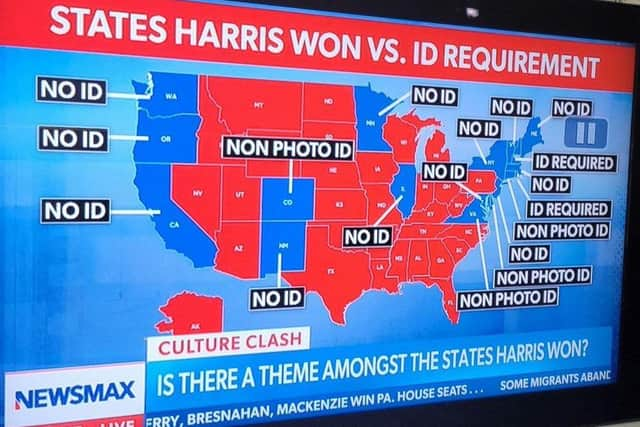

He then wrote a sarcastic comment beside the image: ‘Must be a coincidence.’
Mr Musk’s point was to imply that there was voter fraud that works in favour of Ms Harris’s Democratic Party and against the Republican Party of Mr Trump. His message gave weight to the notion that Mr Trump was cheated out of the 2020 election, which led to the then president never accepting the result, whipping up a mob that then stormed America’s parliament in Washington DC, and saw him snubbing the inauguration of Joe Biden in late January 2021.
Mr Trump was hinting at a return of such fraud as the US went to the polls last week. But there has not been a squeak about such misconduct since he handsomely won the race to the White House last week.
And, as seemed clear seven days ago, he is going to win the overall vote tally of all ballots cast by Americans across 50 states – the ‘popular vote’.
It means that he can claim a mandate he was unable to claim in 2016, when he lost the popular vote to his then Democratic Party challenger, Hillary Clinton, but defeated here on the electoral college, which is made up the state by state results.
He was all the less able to claim a mandate in 2020 when he both lost the popular vote to the then Democrat candidate Joe Biden, and lost the electoral college too.
I have spoken to Trump sympathisers here in the UK who believe he has a point about that alleged theft in 2020. But I think that they are confusing two matters.
There are, in effect, two separate sets of claims, one of which is nonsense, and one of which has elements of truth.
The nonsense is the claims, even conspiracy theories, of things like outright fraud such as tampering with voter machines or ballots by Democratic Party officials to change the election outcome. In a country the size of the US, in which 150 million or so people vote, it is impossible to prevent all instances of cheating, but there is no good evidence of extensive such fraud.
The other, much more plausible, claim that it is easier to impersonate someone in states that do not require voters to show photo proof of their identity. Republicans such as Elon Musk are pointing out that it is Democratic Party strongholds that reject voter ID rules.
Here in Northern Ireland we know how voter ID mandates can reduce fraud because republicans were notorious in their ‘vote early, vote often’ cheating during the Troubles, leading to voter ID being introduced in the province in the 1980s. This was initially just a requirement for voters to produce paper ID such as a medical card before they would be issued with a ballot, but 21 years ago it became a requirement for photo ID.
The Democrats have been hostile to voter ID laws because they say – not unreasonably – that poorer voters are less likely to have photo ID and so a vulnerable part of the population are most likely to be refused a vote. The party previously opposed an ID requirements but are now more open to the idea of paper ID, such as showing a home bill to show proof of residency.
In 2010 I wrote about the perils of unionists having a ‘unity’ candidate in the Westminster election for Fermanagh and South Tyrone. Such a candidate might merely encourage nationalists to find their own ‘unity’ candidate. I mentioned the 1981 by-election in that onstituency when the IRA prisoner Bobby Sands stood to be MP and won by 30,493 votes to 29,046 for Harry West of the Ulster Unionists on an 87 per cent turnout. This was at a time of ongoing IRA violence. When Mr Sands died, causing a by-election, the UUP got roughly the same vote, this time 29,048, Sands’ election agent Owen Carron took the seat, with an increased republican vote of 31,278. The overall turnout in the constituency edged up to 89 per cent, with all the extra votes nationalist.
Liam Clarke, the outstanding late political commentator, who had recently then been a columnist for this paper, sent me a note agreeing with my core point, but saying that I had failed to mention the republican voter fraud, which he said was well known to have been in the thousands.
There are almost never claims of such personation now that we have voter ID in NI.
Some US states have ‘strict’ voter ID laws, requiring things such as passports or driving licences, some non strict ones which allow wider types of photo ID, some strict paper ID laws, some non strict.
Republicans such as Musk also think that the Democrats want to allow mass illegal immigration, then retrospective citizenship for such illegal entrants into the US, so that the Democrats will reap their votes. Very poor people tend to vote for the party (although Mr Trump just improved his share of the Hispanic vote).
This claim, like that relating to voter ID, is not without foundation. There are indeed some radical Democrats who would happily open the borders. But the claims of major other types of fraud carried out by election officials who are hostile to the Republican Party have not just been shown to be wrong by Mr Trump’s decisive win, there was never good evidence for them.
And so Mr Trump has undermined trust in the stunning American democracy before dropping all such claims the moment he wins decisively.
Joe Biden won decisively four years ago. George Bush won decisively in 2004 when Democrats, rightly upset by the dubious way in which George Bush defeated Al Gore in 2000 (I think that if there had been a precise accounting of all ballots cast in Florida that year, Mr Gore would have clinched it) wrongly claimed irregularities.
But Voter ID is another matter, and there are sound reasons for wanting such requirements.