
Ben Lowry: The collapse of the civil action against Gerry Adams will make the legacy imbalance against the UK state and its security forces even worse
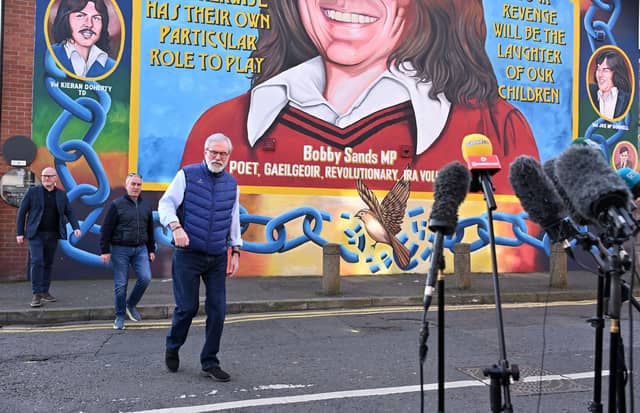

On Monday I was at the Gerry Adams trial in London, ahead of flying out to Washington DC for St Patrick’s Day (see below in the print edition).
Mr Adams would be mentioned in the US capital by the former Ulster Unionist leader Mike Nesbitt MLA, who contrasted 1994, when he was reporting out there, with this year. In 1994, unionists were furious that Mr Adams had been granted a visa by Bill Clinton and boycotted Washington. This year, republicans were boycotting DC, and Mr Nesbitt pointed out how this reversal of the snubs cleared the way for unionists.
The courtroom in the Adams case, number 16, at the Royal Courts of Justice was extraordinarily tight and intimate. Mr Adams sat two rows in front of me, in the front bench, beside his lawyer on one side and his long-term aide Richard McAuley on the other. Each row sat about 10 people.
There were three further rows behind, in one of which I sat, with a maximum of 40 people in all four rows. These included other lawyers, curious bystanders, IRA victims, and to my right the Sinn Fein MP John Finucane, and at the end of the bench, right behind Mr McAuley and beside the court door, a man who seemed to be an assistant to Mr Adams, handing him a glass of water, or perhaps a security guard.
The witness on Monday morning was the veteran reporter John Ware. Among the many things that he said during his testimony was that he had worked on programmes in the 1980s and later that looked into Mr Adams and his role in the republican movement. He said that the former Sinn Fein president had been in many respects an admirable figure, helping to end the violence, but that the public record should note that he had been in the IRA.
I could only see the back and side of Mr Adams’ head as he sat just ahead and listened intently to Mr Ware. I have observed Mr Adams in public many times, and – as have we all – on TV countless times and only recall him getting agitated, bordering on angry, in one debate. Normally he comes across as unperturbable, and so it was on Monday as he observed proceedings, a day before he gave testimony. Mr Adams at times had his bearded chin in his hands as he looked left towards Mr Ware in the witness box, explaining the people he had talked to about Mr Adams for his documentaries.
The court had room for only four court reporters, most of the rest of the press being in a spillover room, from where they sent a message that they could not at times hear Mr Ware, who was asked to speak into the microphone. Later his microphone was changed.
Mr Justice Swift at times asked Mr Adams’ barrister to explain things better, such as some of his references to legacy Troubles cases to which he referred in which there is alleged collusion.
The case against Mr Adams collapsed yesterday, as we report. Setting aside the details of the case, which others have followed more closely than I have done, it all reaffirms something that some of us commentators have been saying now for more than a decade. The entire legacy process is inherently biased in favour of getting justice or at least truth for the loved ones of that 10% of Troubles dead, those who were killed by state forces, or a larger number of loyalist killings in which there are allegations of collusion.
The most obvious reason for this imbalance, which is an immense scandal, is the obvious one – that the state kept detailed records, and terrorist organisations did not. But there is an even bigger reason for the imbalance: the republican movement has energy for chasing the past that no other groups of people do. Victims of republican terror, who are 60% of the dead, have nothing like the same energy. In many cases they do not want the past reopened at all, which is understandable. Republicans themselves have armies of sympathisers in the political, media, legal and academic worlds, as well as influential friends in Dublin, Washington and elsewhere.
Truly disgraceful sums of taxpayer funds are being spent on a small number of legacy cases – those whose advocates shout the loudest.
Civil actions, which Labour have reopened, are almost all against UK state forces. That will be so even more now.
Legacy is an easy process for the IRA. Until the UK government makes it uncomfortable for them, via unilateral public inquiries into republicans, the imbalance will continue. But as I reported last week, Labour will not challenge this even when Ireland is suing it. The Tories tried to shut things down, which isn’t the worst outcome, yet refused to make things hard for an Irish republican movement that is destroying UK reputation.
• Ben Lowry (@Benlowry2) is News Letter editor