
Ben Lowry: The IRA Kingsmill massacre reflected the isolation and vulnerability of border Protestants
The service to commemorate the Kingsmill massacre was held in Bessbrook last Sunday, but the actual anniversary was marked at the scene of the attack on Monday.
I was at the 11am short service, conducted by the Rev Graham Middleton and lasting around 15 minutes, 50 years to the day after the IRA atrocity.
It is a lonely rural part of south Armagh, with one of those twisting, undulating lanes that you find all over Ulster. In the near 20 years that I have been at this newspaper, we have reported many times on the 1976 killing of 10 Protestant workmen, but this was the first time that I had been to the precise place that it happened.
Three things struck me about the location, where there is now a memorial to the dead:
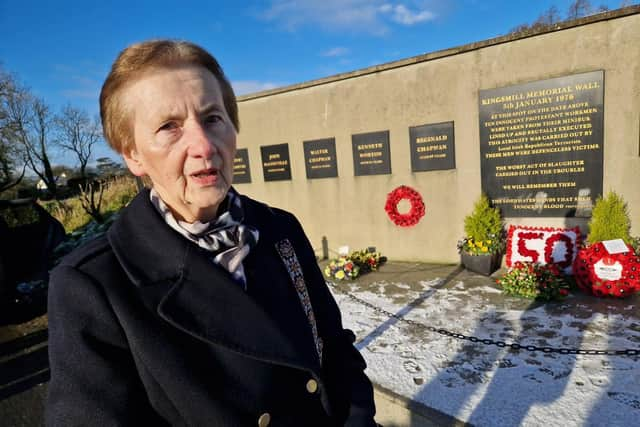

The first was the contrast between Monday morning and the time when the shootings took place: it was at the same point in the calendar, January 5, but this week’s roadside commemoration was held on a stunning wintry sunny day, with frost and light snow on the fields and the countryside at its most beautiful. The killings took place in the chilling pitch darkness of the early evening.
The second thing that struck me was that the site, on the Kingsmill Road between Glenanne and Bessbrook, was the perfect place to carry out such a heinous crime, undetected. It is so lightly populated that few people would hear anything, and the likelihood of a passing car was minimal. The minibus, carrying 11 Protestant and one Catholic workmen, was stopped by a men in combat uniform, wrongly thought to be army. Then 11 gunmen emerged from the hedges, in a highly calculated ambush.
The third thing that struck me was that the area seemed like a sample of those many border parts of Northern Ireland I have visited, in which Protestants are a small minority who were deeply vulnerable to IRA attackers who typically fled across the border. Even in 1976, Protestants were a tiny population in rural south Armagh, and those numbers have dropped further still, due to the success of such republican intimidation – literal terror, in that they made it too terrifying to live there.
On Monday, when there were perhaps 50 present for the service, I asked afterwards if there were any people who had lived right beside the scene. I found only two, probably because there are so few residents of any religion in the vicinity, and Protestants even less so.
Joey Cartmill, whose father Thomas was a first cousin of one of the men who was killed, Robert Freeburn, lived across fields to the south of the attack scene. He was 14 at the time, and remembers hearing it – “it is just like yesterday”.
“It was like someone hammering nails into a tin,” he told me. “Then it stopped and there was a second go again.”
Joey was left at home with a sibling while his parents left about half an hour later to find out more news.
Jennifer Jordan lived even closer to the scene, 300 metres to the northwest, near to Kingsmill Presbyterian church (while it has a church, Kingsmill is so small you could not even call it a hamlet). Then aged in her 20s, Jennifer heard nothing that night, but learned the following morning of the massacre.
"It was an isolated community. It was quite a horrific thing to have happened, because these 10 men were innocent men, and they weren’t in any security forces.”
This internet version of this article has the video of Joey and Jennifer speaking about their limited memories of that terrible night, half a century ago.
It is ironic that Ms Jordan mentions the fact that the massacre victims were not in the security forces, because her own father was murdered four years later, almost to the day – in January 1980 – at their home nearby. Samuel F Lundy had been in the UDR but, then aged 62, he was retired.
Three IRA men shot the lorry driver as he returned from work. The then Ulster Unionist MP Harold McCusker said the killing was part of a campaign to “intimidate or eradicate a small community”. The IRA said he should have let them know he had left the security forces.
We have long covered the way in which the legacy plans for Northern Ireland, which have exhaustively examined killings by the police and army, have no process for looking at the killings of hundreds of Protestants along the border, by republicans who fled into the Republic.
• Ben Lowry (@BenLowry2) was News Letter editor