
Ben Lowry: The links between 1690, the Twelfth and the early US
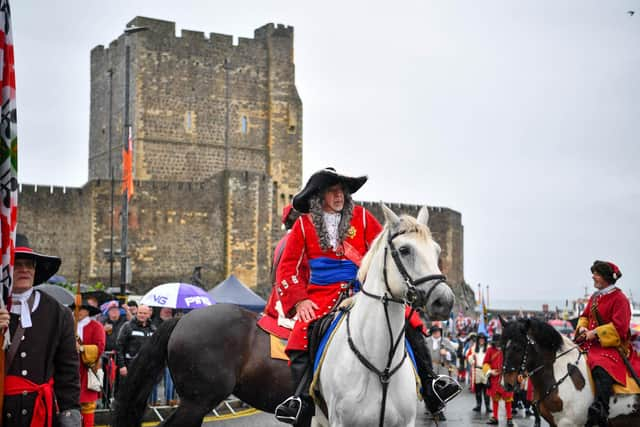
Many people’s eyes will glaze over when they hear that today is the 335th anniversary of the Battle of the Boyne.
I too would once have been bored by such a statistic about a war centuries in the past. But I mention here three coming anniversaries and explain why they now mean something to me.

• Next year is the 250th anniversary of the United States
• In little more than a decade it will be the 300th anniversary of the Belfast News Letter
• A few years after that will be the 350th of the Battle of the Boyne
Working on this newspaper, the world’s oldest, has made me highly conscious of those dates.
Consider the Battle of the Boyne, then the American war of independence, 85 years later. There is no newspaper to report the former, and yet there are extensive paper reports, not least in this title, of the latter. There was a media revolution between the two wars. A newspaper, which seems old-fashioned to a young person today, was a thing of genius then, bringing together news of events into a single publication.
Consider a vivid description, recounted in the late Jonathan Bardon’s ‘A History of Ulster’, of King William landing near Carrick in 1690, ahead of the battle south of Dundalk. William is said to have greeted his general, Schomberg, ‘coolly’. A crowd of locals watched the arrival, then began ‘huzzahing’ (like hooray today).
This description has long stuck with me. First, you wince in sympathy with Schomberg, who had so annoyed the king with his lack of military progress that the monarch had travelled over personally to see off the army of the Catholic claimant to the throne, James II (whom William had deposed only two years before).
Second, you think how breathtaking it was for the locals to see a king in person. They never saw film of such people. They never even saw photographs of them (photographs were still 150 years into the future). They rarely saw drawings of a king or queen, or even read about them because most people were illiterate and there were no newspapers.
A London-based king was thus almost a fairytale figure, whom someone in Carrick or their ancestors would not have seen. Yet suddenly this king was standing there. You can imagine then the stunned pause before they realised they should be cheering.
But, I later wondered, how do we know of this moment of William’s arrival, if there were no journalists to record it? We know because his chaplain kept a diary.
My point is that newspapers, which began to proliferate in the early 1700s, the decades after the Battle of the Boyne, were the first big step towards the world of today, in which we know almost all major events in the world.
I often think that a young man who fought at the Boyne, aged 18, would have been 65 if still alive when the News Letter was launched in 1737. I don’t doubt that some veterans were among our first readers.
And, having serialised the earliest surviving News Letters (from 1738 and 39, which are stunning artefacts – now digitally available thanks to a government-funded project) I savour each milestone for this newspaper on the way to our 300th (we turn 288 in September).
We were reporting when a free press was slowly emerging, and a modern democracy too. The first prime minister, Robert Walpole, was in Downing Street at the time of our first papers.
The Battle of the Boyne is significant in all this. Protestants tended to believe in limited, not absolute, monarchy – particularly after the restoration of the monarchy in 1660, in the aftermath of Cromwell, the man behind the beheading of King Charles I. The last monarch largely able to do as he pleased, without much parliamentary obstacle, was Henry VIII in the 1500s.
So the early News Letters reported on the emerging world on both sides of the Atlantic in the wake of 1690.
Which brings me to America. We were not the first in Europe to report the 1776 Declaration of Independence, as a charming myth once held. But we are one of the only daily newspapers in the world today that was around to report it.
I have been on holiday this week, before reporting today’s Twelfth, re-reading the US vice president JD Vance’s blunt account of the lives of the modern Scots Irish in America – Ulster folk, in other words. I will write more about these historic links in the run-up to next year’s 250th (semi quin-centennial!) of July 4 1776.