
Ben Lowry: The petition of concern is now vital to stop nationalist domination at Stormont
There was an intriguing development this week on the petition of concern – one that suggests that even moderate unionists see the risk to reforming Stormont.
(To read Ben Lowry on the longest day of the year, click on this link here)
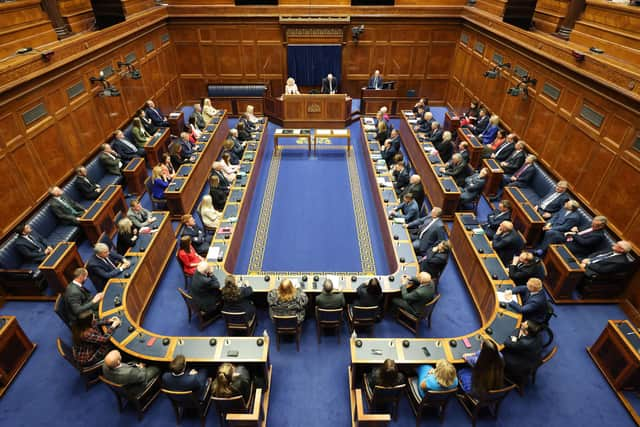

That risk is growing and the motive behind it is simple – now that unionists are in a minority, there is a near consensus among non unionists to remove minority protections.
This was highlighted by a dispute over plans to increase the minimum age of criminal responsibility (MACR) from 10 to 14 (12 or 16 is also proposed). Most unionists oppose any increase at all, most non unionists support an increase.
You could call it part of a deep, centuries-old philosophical divide in which unionists are more sceptical about human nature, and believe that people, including older children, are responsible for their actions, and in which non unionists – particularly Irish nationalists – believe that there are often excuses for wrongdoing, such as the circumstances in which the offender lives or is brought up (due to poverty etc).
Differing outlooks on criminal justice are of course more complicated than I can summarise in this space today, but they are part of the increasingly stark culture wars in Northern Ireland. The people who want MACR increased dismiss arguments such as the fact that children are capable of very wicked acts, as famously shown when two 10-year-old boys, Robert Thompson and Jon Venables, abducted, tortured, and murdered a two-year-old boy, James Patrick Bulger, in Liverpool in 1993.
As an example of the wildly differing attitudes to the age at which children should be prosecuted, we recently asked Stormont’s children’s commissioner if he stood by his position that no child under 16 should be prosecuted for crimes like rape after there was a national outcry over children being spared jail for raping two girls in England. He said that he did still believe that, and he avoided our questions about the vulnerability of girls to sex crimes (Click here to read our report on the commissioner’s stance).
The Ulster Unionist Party leader Jon Burrows, a former senior policeman, has strongly opposed any increase in MACR at all. The DUP and TUV agree with him but for days he seemed to be isolated within his Stormont parliamentary party. Only he and the UUP deputy leader Diana Armstrong seemed prepared to back a unionist petition of concern to block the increase. That would not have been enough to activate the petition.
Mr Burrows was not, it seemed, able to get any of the other six UUP MLAs to support him. This seemed to confirm that he was isolated at Stormont. However, in the end two MLAs did sign the petition – Robbie Butler and Alan Chambers.
This was surprising because they are sometimes said to be among the UUP MLAs who have poor relations with Mr Burrows – Mr Butler had been talked of as a contender for the UUP leadership that Mr Burrows won, and Mr Chambers has been talked of as facing possible de-selection by the UUP in North Down, where he is an MLA.
As I understand it, no deal was struck between Mr Burrows and Mr Butler and Mr Chambers. The party leader made clear to his colleagues that he and Ms Armstrong were signing the petition and left them to their own decision. In the end Mr Butler and Mr Chambers signed up. Both have to deal with anti social behaviour by young people in their constituencies.
This is significant not only because of the matter in debate, the criminal age of responsibility, but also because of the growing importance of the petition of concern. Liberal unionists once embraced the idea of Stormont reform but now see that it will lead to nationalist dominance.
Sinn Fein, the SDLP and Alliance now form almost a super majority in Stormont, and they certainly form a super (ie overwhelming) majority in councils across Northern Ireland. Unionists now believe that Alliance side with nationalists in four issues out of five.
The petition of concern is now one of the most important mechanisms in thwarting a situation in which unionists are outvoted on almost all major policy areas. No such one sidedness would be tolerated by nationalists or their supporters in Dublin and overseas.
Without the petition of concern, power sharing at Stormont would be an illusion in terms of legislation.
Reform of Stormont would be disastrous for unionists, as political supporters of reform at Westminster and in the Dail well know. They didn’t support reform when unionists were in a majority as recently as 2017.
Ben Lowry (@Benlowry2) is News Letter editor