
Ben Lowry: The UK is surrendering on legacy to an Ireland that harboured terrorists yet has had the sheer nerve to sue Britain
This week the interaction between the UK government and the Republic of Ireland one edged towards its inevitable – and disgraceful – conclusion.
We report in today’s newspaper the comments by the Northern Ireland secretary, Hilary Benn, and the Irish deputy prime minister, Simon Harris, on what seems set to be a coming deal on legacy.
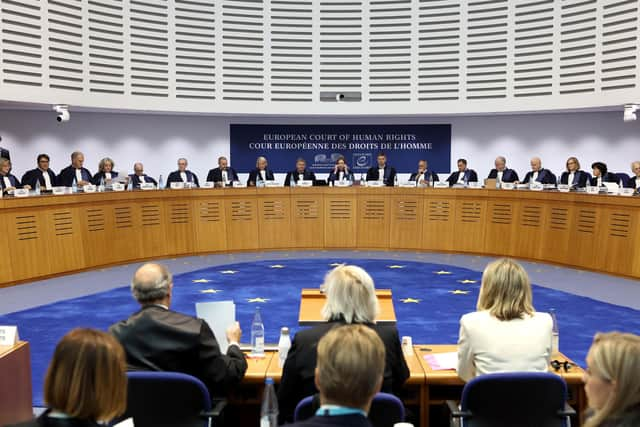

In summary, Ireland’s outrageous and hypocritical legal action against the UK on legacy will be rewarded, when any self respecting British government would have defended its security forces and hit back in kind against Dublin once it launched its case in Strasbourg. It is only to be hoped that one day, perhaps in a couple of years, a Reform or Conservative government will finally begin to push back against Irish hypocrisy.
Any cross-border agreement on legacy will be the culmination of an appalling saga, in which successive UK governments have shown weakness towards Ireland, and in which unionists have inadvertently help emboldened Irish leaders.
It is almost comical to think that Ireland’s case against the UK, which it took to the European Court of Human Rights in 2023, is about to be appeased when politicians across Europe are coming to see that the convention that underpins that court needs to be scrapped or radically reformed (because it is, for example, stopping nations controlling their borders).
Dublin was opposed to the conditional Troubles amnesty proposed by the then Tory government. This was hypocritical for two reasons – first because Ireland has operated an undeclared but stark amnesty for the IRA since its first ceasefire, and second because Ireland has ducked all its responsibilities on legacy. It was so obvious that this case should have been met with immediate retaliatory action by London. I suggested as a starter a public inquiry into Irish extradition refusals over 30 years, and all the people massacred on the border as a result of that sectarian policy. Instead, the last government was cool towards Ireland and wrote to it in complaint etc, but did little.
Meanwhile, unionists actually parroted the Irish justification for its legal action, allowing Dublin to say that all the NI parties opposed the legacy legislation that would have ushered in the amnesty. Now, far too late, some unionists are making clear that they have no shared position on legacy with Sinn Fein.
The handling of legacy is a long and complicated saga, and yet in a sense it is easy to understand. Regular readers of this newspaper will have read many or our reports and comment articles on what is happening. In 2018, we ran a major Stop the Legacy Scandal series of essays in which the emerging frustration among sections of the population erupted on the pro terrorist way in the fallout from the Troubles was being examined. For more than a decade, legacy investigations have been overwhelmingly focused on the state forces that prevented civil war during the long years of IRA-led terrorism.
This has come in the form of hundreds of police ombudsman probes, amid a nationalist ‘hunt for collusion’, also in the form of public inquiries into Bloody Sunday and soon to be into the killing of Pat Finucane (one single Troubles killing out of more than 3,500 that has had millions of pounds spent on it, while there is next to no investigation of the IRA, and its many helpers). Then also de facto public inquiries, supposedly inquests but in fact vast and expensive forums, eg into the Ballymurphy killings by soldiers (at a time when the security forces were facing near anarchy). Then there are more than 100 smaller, but still extensive, inquests, almost all of which have been into that small minority of Troubles deaths caused by the security forces. Then there are the civil actions, almost all funded at great cost by UK taxpayers, almost all into state forces.
It is wearying writing all this. I have written it so many times before. It is so obvious. Yet the overall response to it has been so limp.
The stark facts of the Troubles are so clear that a reasonably smart child in the early years of secondary school should be aware of it, yet almost none are. Republican terrorists were to the fore in pushing Northern Ireland to the brink of civil war, and continued in their murder and mayhem until, in the 1990s, the IRA finally realised that their various different types of terror– latterly including trying to murder civil servants – were not going to work. I was one of those who supported the Belfast Agreement that emerged from that realisation. But we did not know how craven the UK would be towards the IRA and its political associates.
In our 2018 series of essays, churchmen, victims of terror, academics, lawyers, politicians, ex RUC, ex military (including two generals), intelligence operatives, and others detailed their experiences of the violent years, and how it has latterly been investigated to demonise the UK and its forces. The disastrous 2014 Stormont House Agreement on legacy, which our various reports over the years showed would merely worsen the anti state imbalance, finally withered on the vane. Yet yesterday Mr Benn, the local representative of a Labour government that has had to retreat from its own naivete and weakness in other areas such as immigration, was talking about a new approach to legacy based on Stormont House.
Sir Declan Morgan is the distinguished head of the new legacy body based in Belfast. There was a real chance that his organisation would begin to get truth for those who have not had it, particularly not since terrorist murders have avoided scrutiny after the Historical Inquiries Team (HET) closed in 2014.
Now Labour might be about to reward to Ireland with a commissioner on that legacy body. It might also grant Dublin its demand of a public inquiry into the murder of Sean Brown (despite the fact that London is appealing a Belfast court order to hold such a probe). The loyalist murder of Mr Brown was vile yet thousands of republican murders were as bad, and have had no scrutiny, let alone an inquiry.
One encouraging element this week is that the DUP, UUP and TUV expressed contempt for Mr Benn’s signal of a deal with Dublin. There is yet time to turn the tide on legacy.
• Ben Lowry (@BenLowry2) is News Letter editor