
Ben Lowry: Thess Irish Dail results are yet another electoral blow to the claim that an all Ireland is inevitable
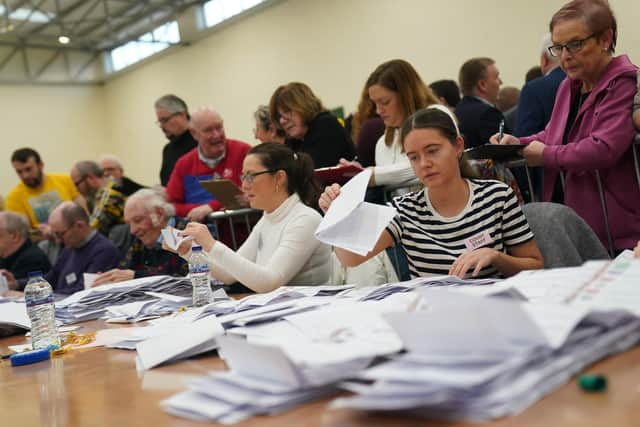
If you listened or watched or read some of the punditry yesterday, you would think that Sinn Fein had a reasonable Irish election results weekend.
You would think that they didn’t quite achieve what they wanted in the Irish general election, like the other two big parties, but that they had otherwise performed fairly well. But this would be, at best, a misleading interpretation of what has happened.

In the 2020 Irish general election, Sinn Fein finally made the breakthrough in the Dail that had been predicted for almost 20 years, when it had 37 TDs elected. Its previous best result was 23 TDs.
Sinn Fein got the largest share of the first preference vote of any party in that election and it was widely assumed that they would be the biggest party by far in the next general election, which has now been held. But in fact the republican party has now been the only one of the big three Irish parties to suffer a significant fall in its share of the total votes cast across Ireland last Friday, down 5.5% on its 2020 total.
Voting got under way on Saturday morning, when an exit poll published after polls closed the night before suggested that Sinn Fein would narrowly get the highest share of first-preference votes, 21.1%, ahead of Fine Gael and Fianna Fail at 21% and 19.5% respectively. In one respect that would have been a very disappointing result for Sinn Fein, in light of the high expectations the party had in 2020 after it won a hefty quarter of the vote across Ireland, and outpolled both Fianna Fail and Fine Gael, who won 22.2% of the first preference votes and 20.9% respectively. But it would have been satisfying for them to have beaten both FF and FG, even if only fractionally.
But this year’s exit poll was wrong – Sinn Fein did worse than estimated. Only 2% worse, but a decisive enough margin to be embarrassing, in that it has now fallen behind both Fianna Fail and Fine Gael in vote share, the parties it has for years demanded stand aside. By lunchtime yesterday all 43 constituencies in the Republic had tallied first preference votes. Totals were:
Fianna Fail 481,417 1st preference votes, 21.9%
Fine Gael 458,134 votes, 20.8%
Sinn Fein 418,627 votes, 19.0%
Independents 13.6%
Social Democrats 106,028 votes, 4.8%
Labour 102,457 votes, 4.7%
Aontú 86,134 votes, 3.9%
Independent Ireland 78,276 votes, 3.6%
Green 66,911 votes, 3.0%
People Before Profit-Solidarity 62,481 votes, 2.8%
Of the three main parties, Fianna Fail and Fine Gael have barely moved in terms of vote share since 2020, dropping between them a mere 0.4%, thus meaning that Sinn Fein has had easily the biggest fall. The Greens, who formed part of the outgoing coalition government, also fell sharply, to 3.0% of the vote, down from 7.1%.
The last constituency to provide its first preference vote totals was Cavan-Monaghan at around midday yesterday, a Sinn Fein stronghold where the party last time got almost 40% of first preference votes. This time SF only got 32.8% of the vote there, but it was still a large enough vote total to edge up the party’s nationwide first preference figure from what had been 18.6% of the total Irish vote when all other seats were counted to a final total of 19.0%.
In the February 2020 general election, Sinn Fein topped the poll but the proportional vote system meant that, after transfers, it ended up with 37 seats, a seat behind Fianna Fail, who had 38 and two ahead of Fine Gael on 35. Those latter two parties, political foes since the Irish civil war of 1922, joined forces in 2020 to keep Sinn Fein out of government.
They might be able to do so again. The exact distribution of the 174 seats in this coming Irish parliament will not be known today, due to the multiple counts in Single Transferable Vote (STV) elections, the method also used for Stormont elections. Given its vote share, however, Sinn Fein is not even guaranteed to emerge with as large a share of TDs as it did in 2020, let alone higher. However, it is set to get as many TDs in absolute number (as opposed to proportionate share of TDs), which was 37 last time, because the Dail seat numbers are up by 14 from 160. The party can get that same number of seats on a lower vote share. It needs to get 40 to have an equivalent share to 2020 (40 out of 174 is the same share as 37 out of 160).
Another factor helping SF is that they would have probably won 40 seats in 2020 if they had run more candidates, so their baseline this year ought to be higher than 37. As of this morning (10am), Sinn Fein has 36 seats, well behind Fianna Fail (43) and level with Fine Gael (36). The elimination of traditional Aontú candidates benefits Sinn Fein in transfers.
The final outcome for the party will be watched with great interest by unionists here, who are repeatedly being urged by Sinn Fein to “join the conversation” about a ‘New Ireland’ amid what republicans say is an unstoppable momentum towards a border poll. But SF had bad council and European elections earlier this year, when it moved the Fermanagh and South MP Michelle Gildernew to an MEP constituency across the border, which she failed to win.
The party has in this general election performed markedly better than it was expected to do only weeks ago, amidst the scandal over its handling of the departure of one of its Stormont press officers, Michael McMonagle, and after the sudden resignation of the former Lord Mayor of Belfast and Irish senator Niall Ó Donnghaile.
Sinn Fein has clearly lost some support for its perceived pro immigrant stance to a new movement called Independent Ireland, which wants tighter border controls, and which got 3.6% of the vote. But it seemed in the early autumn that SF might be much worse hit in this election than it has in the end been.
Sinn Fein can also say that its last general election in 2020 was a breakthrough, creating a new ‘Big Three’ of political parties in the Republic, and that it has preserved that new position near the top. But governing parties in Europe and North America have been losing badly in recent elections, such as the Tories in the UK, yet Sinn Fein has utterly failed to capitalise on anti incumbency mood.
In the 2022 Stormont election, nationalists won more MLAs than unionists for the first time. In the 2023 council elections, they got more votes for the first time. There was a media fanfare for both milestones. Then, in July this year, when unionists pulled 3% clear of nationalists again in the UK general election, it was barely mentioned outside of these pages.
That is not a result that suggest a ‘new Ireland’ is inevitable. And nor is this southern Irish election setback for the biggest advocates of an all island state, Sinn Fein.
• Ben Lowry (@BenLowry2) is News Letter editor