
Cillian McGrattan: Irish nationalists think that they and Palestinians are the only real victims
The tagline for Robert Harris’s first novel is What if Hitler had won? Here in Northern Ireland, republicans didn’t win the conflict, but they are winning the peace.
The more you read through Harris’s brilliant novel, the more you realise it’s not really about what would’ve happened if, say, Britain had collapsed under V2s (or V3s) and reached an accommodation with the Nazis; it’s about how the Nazis might have gotten away with it.

By ‘it’ I mean the double erasure: The physical eradication of European Jewry coupled with the erasure of that eradication – the destruction of every trace that Jews ever existed.
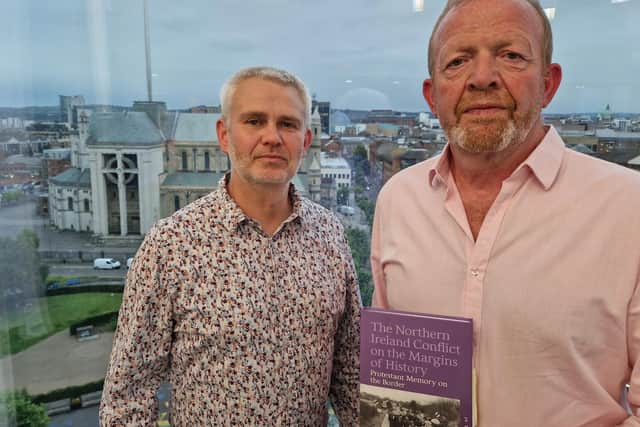
Harris’s novel has been informative to my reflections on the book I wrote with Ken Funston, which the News Letter covered in the summer. His novel suggests that you don’t need an erasure of history when you can have one in the mind. It helps us understand how Irish nationalist appreciation of unionist trauma is declining.
Whereas John Hume once read out the names of IRA victims at the SDLP annual general meetings, now the party’s recent leader carries the coffin of a terrorist, while its leader Claire Hanna MP talks of a non-existent ‘genocide’ while the party seems to ignore the stated aim of Hamas to have more October 7s.
Many Irish nationalists seemingly believe if it’s not Jews doing the killing, it’s not news. It is difficult to find such concentrated outrage among nationalists for any other conflict.
Might it be that Jews are a proxy for Protestants? A line can be drawn from nationalist support for Palestinians to its whataboutery concerning the conflict at home – the IRA weren’t really responsible for 60% of the deaths, goes the ‘collusion’ narrative because the UK state directed many killings.
Professor Liam Kennedy, who graciously launched our book, coined the term MOPE-ism for this type of nationalist thinking: that they are The Most Oppressed People Ever. Events such as the Hamas attack on Israel blunt their argument because the MOPE-syndrome means they need to minimise Jewish or Ulster Protestant claims to victimhood and injustice.
The logic applies to both Israel and Unionism, and it runs as follows:
a. Nationality must be defined geographically, albeit with several additional categories – culture, history, language. Religion is different – some of the heroes in the nationalist pantheon are Protestants we are often told
b. Israel, founded upon religion and not geography, is therefore illegitimate and so too is the Union, which isn’t founded upon geographical unity
c. Terrorism against Israel and unionism are abhorrent but understandable
Nationalists say it is free speech when they indulge a rap group who engage in IRA and Hamas dressing up and who seem tolerant of Islamic death cults that want to eradicate Jews ‘from the river to the sea’ and throw gays off rooftops. If the nationalist argument was truly about free speech, then it might be possible to debate the idea that killing homosexuals and eliminating Jews is despicable or that the celebration of sectarian killers in Northern Ireland isn’t something we should be doing when we’re facing into a longer peace process than the actual conflict.
The Robert Harris book suggests that memory doesn’t just reside in our minds or the things we commemorate; nor do we just forget things. There are non-places of memory (to paraphrase the French historian Pierre Nora – non lieux). There can be events and people we somehow choose to forget.
The eradication of Protestants from the border is one of those things. Drawing on the philosopher Jean-Paul Sartre (who argued that in the absence of confirming statements the US targeting of civilians in south-east Asia in the 1960s could be deduced from actions not words), we argue that ethnic cleansing took place de facto.
Acknowledgement of that would be a significant admission from nationalism. I won’t hold my breath.
The Harris novel deals in how the inability to face reality pushes people and ideologies towards unreality. Just as nationalists see Israel as illegitimate, they continue to see unionists as deluded – they are really Irish people.
Ken and my book goes into detail about how these things occur and are allowed to happen. As Harris points out: ‘We don’t really need to erase, facts can become uncomfortable; then they’re forgotten’.
‘The Northern Ireland Conflict on the Margins of History: Protestant Memory on the Border’ is a collaboration between Dr Ken Funston and Dr Cillian McGrattan