
Dr Philip McGarry: Calls for Troubles ‘forgiveness’ can be counter-productive
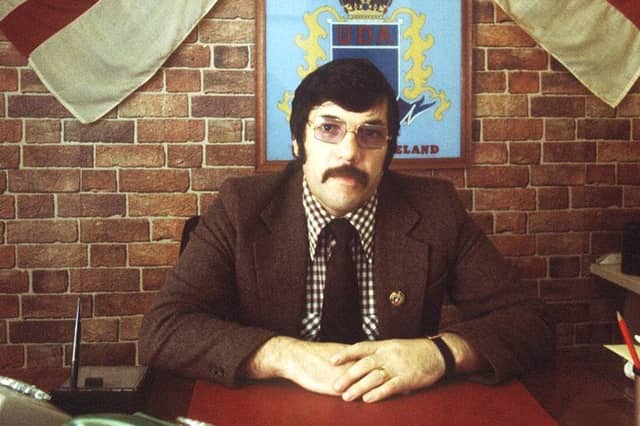

In a local newspaper’s report of the funeral of 85 year old Andy Tyrie, the minister who conducted the service is quoted as saying that the former UDA leader, in the last period of his life, believed that people should “always forgive and don’t be bitter”.
The minister added that “in our province there is a lot to be forgiven”.
It is understandable that a minister of religion will speak of "forgiveness”, but for society at large, in our local context of decades of unjustified and unjustifiable violence, the word has very limited meaning, and can be counter-productive.
As a practising psychiatrist for 40 years I have met countless people who have suffered terribly at the hands of their fellow citizens, but I never once suggested that they should consider "forgiving” someone who had deliberately done them a terrible wrong.

Firstly, forgiveness is a primarily religious construct, and my medical role is very different. My task is typically to help the person describe their emotions and cognitions about the event that has affected them, validate these (there is absolutely nothing wrong with hating people who have badly hurt you), and then work with them to manage their emotions, thoughts and behaviour.
The aim is to eventually arrive at a place where the individual, while not consciously blocking out or suppressing emotions about the past, is able to accept that it cannot be changed, and that life must go on and be lived and enjoyed as well as possible.
That is the only way to avoid “living in the past”, and becoming embittered.
Moving from the clinical to the societal/political, what is the word ‘forgiveness’ meant to imply? I recall a period after the Enniskillen bombing when naïve journalists almost routinely asked victims / relatives of terrorist violence whether they “forgave” the perpetrators. What a foolish (and hurtful) thing to ask!
In the religious context forgiveness implies that the past can effectively be wiped out. But in society at large it cannot.
Are the families of the approximately 1,000 victims of the UDA/UVF expected to “forgive” Andy Tyrie and other loyalist paramilitary leaders just because they have decided – in later life – that killing their neighbours is no longer a good thing?
And if the institutions of society at large also “forgive” them, does that not imply that the slaughter in which they engaged was both justifiable – in essence a trivial act which we should all just forget about?
Furthermore, there is a danger that the lesson for future generations in Ireland is that if you want to effect change you should consider setting up an armed organisation, and then intimidate and kill your fellow citizens as, in time, when you “generously” stop the killing, you can be seen as a “peacemaker” and a decent person!
Terrorism is by definition the use of a calibrated level of violence for a limited period of time to advance your political interests; it is usually an entirely rational and sometimes an effective project.
To "forgive” terrorists is effectively to endorse the use of violence as a perfectly acceptable option to use in a democracy (it isn’t!)
A further reason for not using the concept of forgiveness outside religion is that the large bulk of those who terrorised our community for over three decades show little to no true remorse for what they did.
Andy Tyrie never came out and said in public, repeatedly, that he deeply regretted the dreadful violence which he and his colleagues had brought to his fellow Ulstermen and women, that there was never the slightest justification for the killing, and that young people must never, ever act as he did, because what he had done was unconscionably wrong.
And even if he had said those things there is still no reason why the relatives of those he had had murdered should "forgive” him, as no words can undo the harm done.
The RTE broadcaster Joe Duffy, who has challenged a sometimes cosy consensus in the Republic of Ireland about the use of violence in the past, said: “We have to be much stronger in this country about rejecting violence; the bullets didn’t stop travelling.”
At the funeral of Garda cadet Gary Sheehan, shot dead by the IRA in Leitrim in 1983, Bishop Joseph Duffy said: “We have all sinned in glamourising the use of arms in Irish history. If we look more closely we see the gun as a tyranny, an instrument of division and hatred.”
Mr Tyrie’s family and friends are of course entitled to grieve for their loss. But the only credible moral lesson of his life for society is that the killing machine which he led was an iniquitous and poisonous outfit which unforgivably caused irreparable harm and human misery, which we must never allow to happen again.