
Esmond Birnie: A major world recession is not inevitable but a crash in the economy in 2025 or 2026 is becoming ever more likely - here's why
There is a joke about the economist who predicted 10 of the last five recessions. I am loathe to be a prophet of doom but there is enough evidence to suggest we should be very worried.

When you hear prominent bankers, whether from the Bank of England, Federal Reserve or JP Morgan, issuing storm warnings we should be concerned.
A major world recession is not inevitable but a crash in 2025 or 2026 is becoming ever more likely. Here are four reasons why.
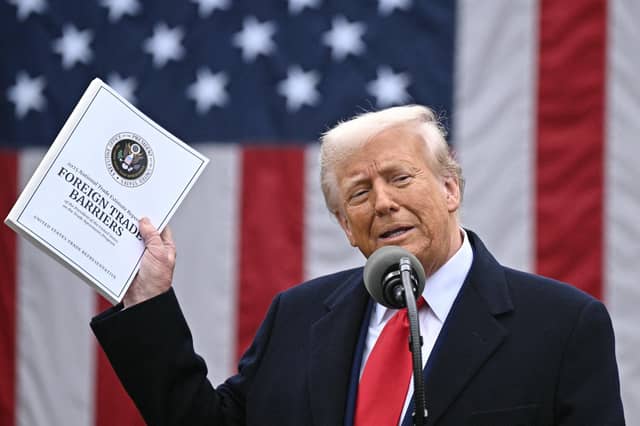
First, the Trump tariffs. The US has returned to the level of trade protectionism last seen in the 1930s. True, US consumers have so far proved resilient but this may be because US importers have decided not to pass on the impact of these taxes on goods coming into the US.
That cannot continue indefinitely and a “correction” in terms of the US growth rate is likely. When that does happen America will reduce its demand for products from the rest of the world including the UK. The ripples of economic downturn will spread.
Second, so much of recent economic growth in the US has been based on the AI (artificial intelligence) and tech sectors. Some commentators are expressing strong doubts about the extent to which AI will actually generate profits for those who have invested so massively in that sector.
This is beginning to look a bit like the British railway boom of the 1840s or the American one of the 1870s. A radically new technology inspired an investment mania which was followed by financial ruin for some.
What may be notable this time round is so-called “circular financing” whereby tech and AI companies have invested in each other and rely on mutual spending for the hoped for payback. This may not be sustainable to the extent that some very large companies are now in effect under-writing the demand for their own products.
Third, given the rivalry between the US and China, the world economy is now fragmenting. The US is, for example, restricting access to the advanced semiconductors produced by its companies and China has restricted usage of the rare earth minerals which it either mines or processes.
There are added costs to businesses as the world economy in effect breaks up into two compartments: one gravitating to America and the other to China. Like it or not, it is now impossible to separate economic policy from geopolitics and national defence.
As a medium sized economy the UK should at the very least be investing in improving its strategic resilience. This means recognising that the old Atlantic Alliance (Nato) is still of some value whilst also being clear sighted about the unreliability of the USA.
It also means recognising that China is indeed the world’s largest economy in volume terms but also a country whose government has ruthlessly aimed for dominance in strategic industries such as electric cars and solar energy.
China’s President Xi has also formed a “no limits” strategic partnership with Putin since the latter invaded the Ukraine in 2022. The recent evidence suggests the Labour government is trying to have its cake and eat it regarding the UK’s relationship with China but such an ambiguity is no longer viable.
Fourth, many countries including the UK, US and France are not in a fiscally strong position.
Given existing high levels of public debt and budget deficits, such governments are not in a position to spend themselves out of a recession in the way in which happened back in 2009 during the banking crisis or during Covid in 2020.
The world economy is beset by a range of structural weaknesses. Looking forward there are no easy answers and tough choices lie ahead.
Mention of the need to make hard decisions inevitably brings to mind the Northern Ireland Executive. The latter will, of course, have some role to play but we should always remember it has limited resources and policy levers.
If things get really bad in the world economy then from the point of view of the Northern Ireland Assembly it will be a bit like a rowing boat being hit by a tsunami.
Throughout the Western world we are probably looking at scenarios where some taxes will be higher and some of the levels of public spending which we have hitherto taken for granted cannot continue.
At the same time we will have to fund a higher level of defence spending and we may also have to pay to be more self-sufficient in terms of food supply and energy.
The old saying, “If it is too good to be to true, it is not true”, stands. Be very suspicious of financial or political snake oil salesmen (or women) who promise easy solutions to complex problems.
Simplistic, populist politics of the extremes failed during the Great Depression of the 1930s and they would fail again during any great recession of 2025 or 2026.
l Dr Esmond Birnie is senior economist at Ulster University Business School