
Esmond Birnie: Copying the Republic’s fuel price protests is a largely futile exercise - and could even cause harm
It was rather predictable that the fuel protests in the Republic of Ireland would spread to Northern Ireland.
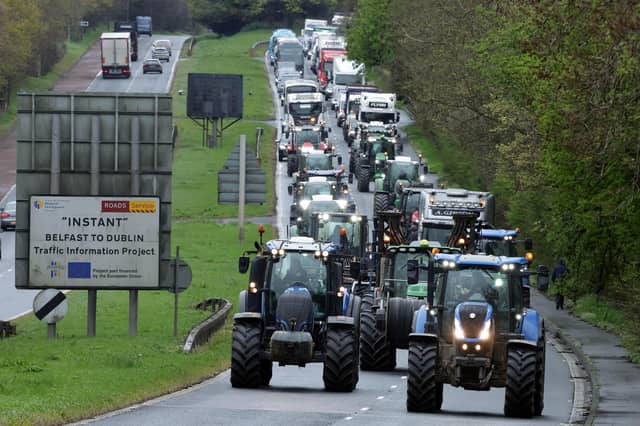

That people feel hurt or threatened by the rise in petrol, diesel and home heating oil prices is entirely understandable.
It is much less clear that protests in Northern Ireland will achieve much.
They could even cause self-inflicted harm.
One reality is that many of the notable (tax) policy levers such as VAT and excise duties are controlled by the UK government and not by the NI Assembly.
In the case of the Republic of Ireland it was feared that prolonged road blockages were going to lead to fuel shortages.
There is a deeper economic point.
The increase in oil and gas prices which has been a consequence of the US/Israel-Iran War looks like a long lasting effect rather than a blip.
This implies that for the UK economy, including the Northern Ireland region, there will be a lasting reduction in total output and income.
Either we buy less oil and gas or if we try to buy the same amount of oil and gas as before we will end up having to buy (and consume) less of something else.
The only long term (and probably partial and certainly hard to achieve) relief would come through becoming more energy efficient so we use less of these energy sources or through increasing domestic energy supplies.
These were the hard lessons of the 1970s oil shocks but now, alas, we have another generation of political and other leaders who have forgotten those lessons.
If, as protestors seem to want, the UK government responds to this situation by decreasing taxes on energy or by increasing subsidy on energy this will almost inevitably imply less resources are available to consume something else.
We could choose to do this. But we need to be clear and honest about what is being done - it will not be without cost.
Perhaps there are some low income groups and some sectors of the economy which deserve special protection in the face of escalating energy costs but efforts to provide such protection will almost certainly mean less for everyone else.
So, protestors are inevitably supporting one sort of distributional outcome and there may be other choices.
There could be the idea out there that somehow the UK government can find the resources to insulate everyone against higher energy charges by borrowing more.
After all, borrowing financed the furlough and other subsidies during Covid (2020-21) and then during the Russia-Ukraine oil and gas shock in 2022.
The problem, alas, is precisely that the UK government has already borrowed so much and now interest charges on that public debt are themselves a major charge on revenues.
There may be a case for saying that the UK government should “return” to consumers some or all of the windfall gains it is now making in terms of growing VAT receipts on fuel.
Beyond that, the case for tax reductions and/or large scale energy subsidies is far from self-evident.
There is no “magic” way to achieve relief from higher energy prices.
Road blockages cause social and economic harm whilst distracting from the unpleasant realities of the current position.
l Dr Esmond Birnie is senior economist at Ulster University Business School