
Esmond Birnie: For all its undoubted benefits, the Swiss cheese EU-UK deal has a lot of holes in it
It has been viewed as the great re-set of United Kingdom-EU relations after almost a decade of volatility since the June 2016 Brexit vote. At the same time, last week’s agreement contains so many missing figures and areas of work in progress that it might be called the Swiss Cheese agreement.

One thing we can be fairly certain of is that one of the main economic benefits from this deal for both the UK overall or Northern Ireland separately is in terms of impact on agriculture and food products, or at least that is true in the short to medium term.
Once implemented, the new arrangements should provide for free movement of food products from Great Britain to the Continent and in the reverse direction.
Significantly, from a Northern Ireland point of view, because the UK overall is to apply EU SPS (food and animal) standards this should remove almost all of the checks, ID and physical, on agricultural and food products moving across what has become the Irish Sea border (and, similarly, for plants).

This removal of frictions on the trade in food between GB and the EU will contribute most of the £9bn economic gain which the government projects by 2040.
Admittedly, as was inevitable, the European Commission has imposed a price for slightly less expensive food.
The UK, including Northern Ireland, is going to become a rule-taker with respect to EU food policies.
The UK may be able to “contribute” to the development of those rules but it is clear there will be no veto power. If any disputes emerge the UK will be subject to the oversight of the European Court of Justice.
Furthermore, the UK has promised to “dynamically align” to any future changes in EU food regulations.
Whether the UK will be able to use new food technologies like gene editing seems unclear.
Imagine some world-beating technology is coming along which might boost overall productivity in farming and food processing by 2% annually but EU rules ban this technology.
After a few years the output being lost because of the EU rules would be as large as the economic gain the government is attributing to this reset deal.
This point is about a hypothetical gain but it does indicate that a deal which relates to conditions at one point in time can also have large long run costs if it reduces the growth of the economy.
Farming is the apparent ‘winner’ but the obvious ‘loser’ is UK fishing. Continental fish fleets will continue to get access at relatively high quota to British waters until 2038.
Fishing is a relatively small economic sector representing about 0.04% of UK GDP (or slightly more in Northern Ireland, 0.06%). The UK government is promising a £360m subsidy for fishing and coastal areas (does that include Northern Ireland?) but presumably the workers would have preferred simply to catch more fish in UK waters.
Northern Ireland is already in a single electricity market arrangement with the Republic of Ireland. This week’s deal may foreshadow GB moving closer to the EU’s energy single market. It certainly provides for harmonisation of the UK and EU carbon emissions trading system.
In the absence of this arrangement the UK would have been paying £800m annually on goods exported to the EU and carbon taxing would have had scope to create big problems for Northern Ireland’s trade flows North-South and East-West.
Very importantly, whilst this deal has important implications for GB to Northern Ireland trading of food products it will do nothing to remove all the other Irish Sea border trade frictions relating to GB origin goods being brought into Northern Ireland: notably customs on inputs for Northern Ireland-based manufacturing.
It has been indicated that the deal could (mainly in terms of the reduced food checks) save firms in the Red Lane £12m annually in terms of reduced bureaucracy. We do not know what the cost of the level of frictions and checks which are still in place under the Windsor Framework is, but that figure is likely to be much bigger than £12m.
We do not know when this deal will come into force (given legislation, probably not for several years). Many details have to be worked out.
How many EU visitors will be allowed through the youth mobility scheme, what fees would EU students pay when the UK (re-)joins the EU’s Erasmus student programme, when will British air travellers be able to use EU e-gates and what is the “subscription fee” attached to the UK’s right to bid for the EU’s Euros 150bn rearmament fund?
Here in Northern Ireland over the years we have struggled with a “nothing is agreed until everything is agreed” approach but we might be quite surprised by an agreement which has many holes throughout its structure.
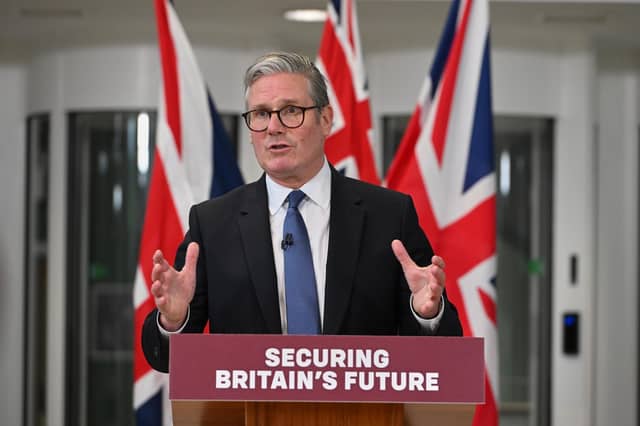
Prime Minister Starmer may feel that there is a national defence imperative to move closer to Europe in security terms. He has made certain gains in a short run sense but many of the long run consequences are uncertain.
He has managed a nod to both a global free trade post-Brexit Britain in terms of the agreements with the USA and China and now this turn towards the EU.
He will need great agility to maintain this position.
Dr Esmond Birnie is senior economist at Ulster University Business School