
Esmond Birnie: In normal politics, Stormont's repeated over-spends would be a badge of shame
The 19th Century German statesman Bismarck once said that law-making was like sausage-making.
The final product was more enjoyable if one did not know the process which had let to that product. The more we see of the budget-making process of the Northern Ireland Executive the less edifying it becomes.
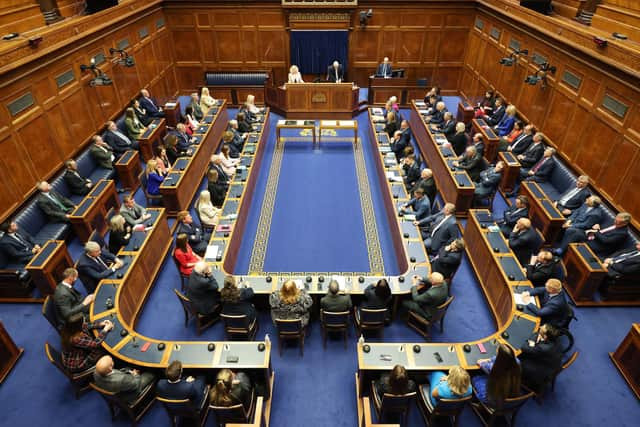

By this stage in December the executive should have produced an agreed draft budget for public consultation for the next financial year starting in April 2026. The fact that they have failed to do so is telling and worrying.
The Finance minister told the Stormont Finance Committee earlier in the month that we could be heading for an over-spend of about £390m in this financial year 2025-26. Normally, in the system of accountability for public finance over-spends are an absolute no-no. A badge of shame whether at the departmental level or, indeed, the level of the overall Stormont regional government relative to the UK government and the Treasury.
There is a danger that Belfast breaching the normal rules has become accepted as standard operating procedure. What makes this especially concerning is that we have been here before not that long ago. Whilst a previous executive collapsed during 2022-23 an over-spend of nearly £560m was allowed to develop.
The London Treasury did agree to write-off that ‘debt’ (conditional on the Executive raising £113m of revenues) as part of the terms for the restoration of devolution in January 2024. The Treasury may well now regret their generosity last time round and will certainly not be inclined to show Northern Ireland mercy in 2026.
Reliance on over-spend as a policy is dangerous because it shifts a problem into the future and fails to solve that problem. The Treasury is likely to rule that any monies over-spent by Stormont in this year will be deducted from Stormont’s funding block in the next year. We are heading for a fiscal groundhog day about a year from now whereby Stormont will once again be facing all sorts of financial embarrassments but with the added difficulty of the penalty deduction from its funding given it behaviour in December 2025.
Underlying a lot of these difficulties is the executive’s policy of pay parity. It is entirely understandable that teachers, police officers, nurses etc. want to have decent pay increases and ones which are in line with those happening in Great Britain. The executive, alas, is not being transparent with the public about the dilemmas inherent in trying to funding such parity. It is showing no signs of working towards a position which is sustainable in the long run.
In crude terms, the funding formula for the Northern Ireland public sector gives us our population share of any spending increase in England. The challenge is that NI’s public sector employment per head of the population is much higher than that in England. Even the recent 24% top-up to Northern Ireland’s funding under the Barnett Formula does not fully address this gap in terms of the sizes of the public sectors.
Additionally, Northern Ireland will always struggle to maintain pay parity given that rates of regional tax revenue collection fall far short of those in GB. Comparing our rates bills to council tax combined with Domestic Water charges in England, Scotland and Wales shows a gap of between £700 and £1000 per household.
The Pivotal Think Tank (Pivotal 8 December 2025, ‘Northern Ireland’s Multi-Year Budget’, Briefing) recently highlighted one of the consequences of Stormont’s attempts to maintain pay parity: money has to be diverted from other uses. In healthcare, for example, some of the funding previously allocated for waiting list reduction has been re-directed. This may or may not be a legitimate policy choice but it is something the executive should be transparent about.
It is sometimes too simplistic to compare balancing the government’s books to household budgeting but sometimes the comparisons are apt. During December we have had a lot of feel good announcements coming from the executive whereby most healthcare workers are to get pay awards and similarly teachers. And then, most recently, the major long run financial commitment to providing substantial subsidies to part cover childcare costs. All these are policy choices and to govern is to choose. What we are still waiting for is the explanation of how additional spending commitments are affordable given an already over-stretched budget. Is this rather like a household max-ing out on the credit cards ahead of Christmas and not worrying about the bills until the dark days of January?
In previous years large dollops of cash coming from the UK government through various spending packages have helped to get Stormont over the line and in most cases balance its books. This time round the UK government is in no position to provide further generosity.
There has been an opportunity, given the UK government’s three year Spending Review to go beyond agreeing a budget for one year and instead produce a multi-year one. It is now very unclear if such a three-year Budget is going to appear in mid/late January. Even if did the time available for consultation would now be curtailed. It has to be said there would be questions about the credibility of any spending plans stated for years two and three of such a budget given the repeated experience of over-spend by Stormont departments.
All this is more bleak midwinter than Merry Christmas but it is to be realistic. The executive needs to level with the public (and electorate). To make our budgets sustainable we need some combination of radical public sector reform alongside some revenue raising. Muddling along to the next election is no longer a real option.
• Dr Esmond Birnie is senior economist, Ulster University Business School