
Esmond Birnie: It is wrong of the chancellor Rachel Reeves to blame Brexit for our current economic woes in the UK
In 1947 the then Labour Chancellor of the Exchequer Hugh Dalton was walking to Parliament to give his Budget speech.
He made a few remarks to a journalist about what he was going to say. Some of what he said made it into the late editions of the newspapers. That premature disclosure of small part of his budget was enough to force Dalton’s resignation. Eighty years on Chancellor Reeves suffers from no such inhibitions or conventions. It might seem that every possible budget proposal has been leaked to the media and some, notably the proposal to increase income tax rates by 2 pence, appear to have been subject to a u-turn even before budget day. All this kite flying has itself been damaging to economic certainty and confidence.
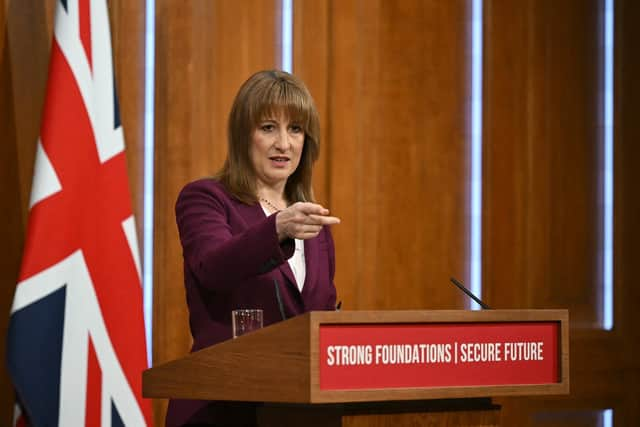

What seems very likely is that the chancellor will make heavy use of two arguments to justify the breach of the election commitment that there would be no tax increases on “working people” (that commitment having always been liable to a pretty elastic interpretation). Reeves will likely claim she has no choice but to repair the fiscal damage left by the previous (Conservative) government and that but for Brexit UK economic growth would have been so much higher and hence tax revenues would have been better than they now are.
Taking the first, for sure the UK economy was not in a brilliant position when Labour came to power in the summer of 2024. Growth rates were down on those of the 2000s or the 1990s or 1980s. The budget deficit was large and the level of public debt likewise. The major deceleration in economic growth rates actually happened as far back as around about 2007 at the end of Blair Labour and the start of Gordon Brown’s premiership. We could therefore argue about which political arty should be “blamed” for low economic growth. The debate is not straightforward. Similarly, the UK’s difficult fiscal position (deficits and debt) is to some extent the legacy of the two great shocks which happened to the economy: the banking crisis of 2007-8 and then covid in 2020-21. The first was during Labour’s watch and the second during the Conservatives.
Chancellor Reeves will no doubt complain about how she was dealt a bad hand. There may be some merit in that argument but the problem is that government policies since 2024 have contributed to the continued low growth of the UK economy. The early days of the Labour government involved commitments to increase public spending (including public sector pay) alongside the Employment Rights Bill which added costs to businesses (added to by a big increase in employer National Insurance Contributions). The government talked a good talk about its “growth mission” but its actions were inconsistent with that mission.
What about that hardly perennial, “it’s all the fault of Brexit”. This is not a new argument, during 2016-18 the media groaned under the weight of the various forecasts as to how much smaller the UK economy would be because of the implementation of the June 2016 referendum vote. Reeves has previously complained that Brexit “needlessly” added to business costs. She would probably concur with former prime minister John Major who termed Brexit an “act of collective folly”.
On Budget Day Reeves will likely make reference to the Office of Budget Responsibility’s (OBR) claim that over the long run Brexit will reduce the size of the UK economy by 4% compared to what it would otherwise have been. What is rarely recognised is that this is not a calculation which the OBR themselves made. Instead, they took the forecasts of Brexit’s impact made by 13 studies (academic, OECD, IMF, World Bank) during 2016-19 and they simply took the average result even though the studies differed widely in the methods and assumptions used. It looks like a case of comparing apples and pears. OBR’s average, the 4% figures, owes a lot to the fact that some of the studies assumed that there would be a very strong relationship from any reduction in UK-EU trade through to UK productivity. It is unclear how far such relationships really exist in advanced, industrial economies.
If Brexit had really been so damaging to the UK economy you would expect some of this to already be obvious when UK economic growth rates are compared to those of major European economies. As Dr Graham Gudgin (25 October 2025, “Always Blame Brexit”, Briefings for Britain) has pointed out during mid 2016 to mid 2025 UK economic growth exceeded that of France, Germany and Italy. Moreover, comparing the 2007-2016 period with the 2016-25 one, UK growth actually improved slightly.
The criticism of Brexit will continue in the budget and elsewhere. Perhaps someone will even blame it for the cold weather!
• Dr Birnie is an economist at Ulster University Business School