
Esmond Birnie: Kamala Harris and Donald Trump both present concerning negatives for world economy
From the point of view of the rest of the world, the economic downsides of a second Trump presidency include his potential business taxation policy.
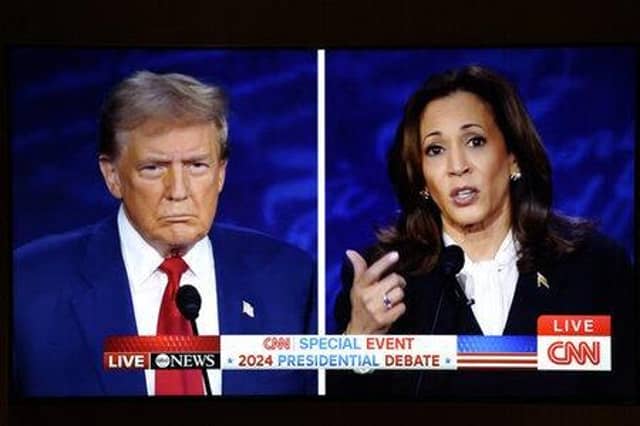

If Trump repeats the policy of his first term and cuts US corporation tax that would encourage US firms to invest at home rather than in the rest of the world (including Northern Ireland (NI).
Perhaps most importantly, there is the threat of his proposed general tariff, or tax, on most imports coming into the US. That would reduce UK/European exports to America (including those coming from NI - the US is our third biggest external market after GB and the Republic of Ireland).
To the extent that Trump does pull the US away from some overseas defence commitments that could imply the UK/Europe might have to themselves spend more on defence which would undoubtedly necessitate some tax increases.
In broader terms, the geopolitical has important implications for the global economy. If the foreign policy of a President Trump is highly volatile and does lurch to neo-isolationism that could encourage a power grab by at least one North Korea, China, Iran or Russia. The implications of that for the world economy would be immense.
Could there be any economic up-sides from a Trump presidency? Possibly a few. If UK defence spending has to increase that would create opportunities for some NI businesses such as Thales and Harland and Wolff. Given the developing Chinese super-predominance in some global markets such as electric cars and some rare earth minerals and components there are strong strategic industry arguments for Western economic protectionism in certain key sectors.
The Harris presidency threat to the rest of the world economy is largely in terms of the extent to which some of her tax/spending proposals such as debt write-offs to American students and tax credits to house purchasers would cause an already large US federal budget deficit to balloon still further.
It is currently 6% of US GDP. Larger US borrowing could imply higher interest rates around the world. Harris is likely to continue Biden’s Inflation Reduction Act massive subsidies to green industries.
Such subsidies give those industries a competitive advantage compared to their counterparts on this side of the Atlantic. Although there may be a rationale for some of those subsidies in terms of making a space for an American electric car sector to develop in the face of overwhelming competition from China.
Harris’s campaign speeches imply she thinks a major cause of the 2022 burst in inflation in the US was profiteering by grocery shops and other US businesses. If she really believes that that in turn implies a rather simplistic grasp of the causes of recent global inflation (what about quantitative easing or the shocks produced by the Russian invasion of the Ukraine?).
Also, there is the worrying possibility that she might resort to some sort of ill-advised policy response such as a 1970s era price control policy. Those policies did not work then and they won’t work in the 2020s.
Both of the candidates present some very concerning negatives from the point of view of the world economy but Trump probably more so.
Based on their campaign rhetoric neither candidate would score well in terms of economic literacy. Trump favours as many tariffs as possible despite the general consensus amongst most economists that free trade is usually the best policy (with possible exceptions for strategic industries).
Harris would probably inflate an already over-sized budget deficit and some of her rhetoric sounds like a re-run of 1970s price controls. Harris, however, unlike Trump is probably more likely to receive (and possibly accept) advice from the mainstream amongst US economists.
Former Republican Governor of California Arnold Schwarzenegger summed it up well by saying his party had lost its regard for the beauty of the free market whereas the Democrats were careless with deficit.
It is true that since 2020, the start of Biden’s presidency, the US economy has grown quite well and grown more rapidly than the other G7 economies. Notwithstanding the underlying strengths of the US economy it would however be naïve to assume that growth would continue if a host of silly policies were imposed over the next few years.
Of course, the US presidential result depends on the votes of US citizens today and not the views of the rest of the world. Non-economics issues also matter.
Harris is the exemplar of ‘woke’ and what the American’s call DEI (diversity-equality-inclusiveness). DEI policies taken to an extreme can themselves impose economic costs.
Those who think that in recent decades ‘progressive’ judges within the US Supreme Court engaged in political over-reach will value Trump’s previous Supreme Court appointments but any view of Trump as some sort of protector of traditional moral values looks very implausible.
Esmond Birnie is a senior economist at Ulster University Business School and also a member of the NI Fiscal Council