
Esmond Birnie: More April Fool than Liberation Day - Donald Trump's tariff onslaught
It is just as well the President is making his big reveal about tariff rates tomorrow.
One day earlier, today, and it would have looked like an April Fool.

This is really a huge blow to both the world economy which will also be a self-inflicted blow to the USA as well.
There are at least two reasons why we can be very confident that these tariffs will be very damaging: economic theory and the lessons of history. That is to say nothing about the moral argument against tariffs.

The mid 19th century free trade campaigner Richard Cobden may have exaggerated when he said, “Free trade is God’s diplomacy and there is no other certain way of uniting people in the bond of peace”, but he had a point. When countries trade well together they are less likely to fight wars. Trump’s tariffs are one aspect of how he is breaking up the 80 years old Western alliance.
Many economic forecasts have indicated the economic impact of the tariffs. If a 25% tariffs is applied against the UK then this could knock up to one per cent off UK output over the next year (estimates from the National Institute for Economic and Social Research and the Office for Budget Responsibility).
In the Irish Republic the Economic and Social Research Institute are estimating a hit of about 2 to 3.5% of Gross Domestic Product (GDP). The proportionally very large international business sector (especially American owned and in pharmaceuticals) makes the southern Irish economy particularly vulnerable to Trump policies.
Here in Northern Ireland my estimate is that the mix of direct and indirect effects could take up to 0.8% off our regional output.
The USA itself will not escape the harm. Tariffs are taxes which will raise prices and costs for US families and businesses. The Tax Foundation (an international think tank based in Washington DC) forecasts a direct impact of 0.4% of USA GDP but that loss would be multiplied several fold once indirect effects and retaliation kicks in.
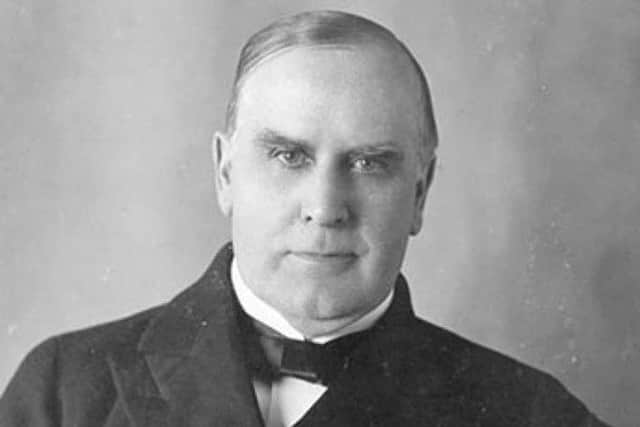
President Trump likes to think his America First approach chimes with history. This is true to the extent that for the first 80 or so years of its history, in the latter half of the 1800s and beginning of the 1900s, the Republican Party was strongly protectionist. In 1890, Republican Representative William McKinley, a particular hero of Trump’s, introduced a tariff bill. (Trump’s hero worship of McKinley, who became US president, has extended to renaming Alaskan Mount Denali Mount McKinley, McKinley’s Ulster-Scots ancestors came from Dervock in County Antrim.)
Trump should perhaps note that the McKinley tariff raised consumer prices and was deeply resented by the American public. The Democrats won the next presidential election.
There may been some argument for American tariffs in the early part of the 19th century to get US industry going in the face of British competition. By the 1890s the US was overtaking Britain and tariffs were no longer necessary to boost the American infant industries. A professor of economics at Dartmouth College in the US, Douglas Irwin, argues that in the late 19th century America was industrialising very rapidly in any case. The tariffs may, at best, only have accelerated that process whilst imposing sometimes excessive burdens on consumers.
Another episode in America’s history of tariffs is both instructive and frightening.
In 1930, one year after the onset of the Great Depression, two American politicians Senator Smoot and Representative Hawley introduced a bill to substantially escalate US tariffs. The then president, Hoover, had his doubts about the measure, and 1,000 economists presented a petition to plead that this act of economic self-harm be vetoed. Henry Ford, Elon Musk of his day, told Hoover it was an “economic stupidity”.
Nevertheless, the Smoot-Hawley tariff passed into law. By 1933 American trade had declined by two-thirds. Historians still argue about how far this piece of protectionism caused the Great Depression to be so deep and so persistent. It is overwhelmingly likely it played a role and it certainly poisoned the atmosphere in terms of international diplomacy. This made it harder for America, Britain, France etc. to work together to stop the rise of fascist or communist dictatorship.
The warnings for today should be obvious.
One final lesson from history for Donald Trump relates to the later career of McKinley.
McKinley was a conscientious and thoughtful public servant with a distinguished service record in the American Civil War. He was elected as president in 1897 and the US continued with its tariff policies. McKinley, sadly, was assassinated in 1901 but just one day before he was murdered he made a speech in which he said the age of tariffs was over and it was time for America to move towards free trade.
One might hope that President Trump will show similar wisdom although that appears unlikely.
Dr Esmond Birnie is senior economist, University of Ulster