
Esmond Birnie: Much is uncertain but it’s now decision time on Trump tariffs
Tomorrow, July 9, represents ‘D Day’ for the world economy in trade terms as President Trump’s 90-day pause on the reciprocal tariffs expires.
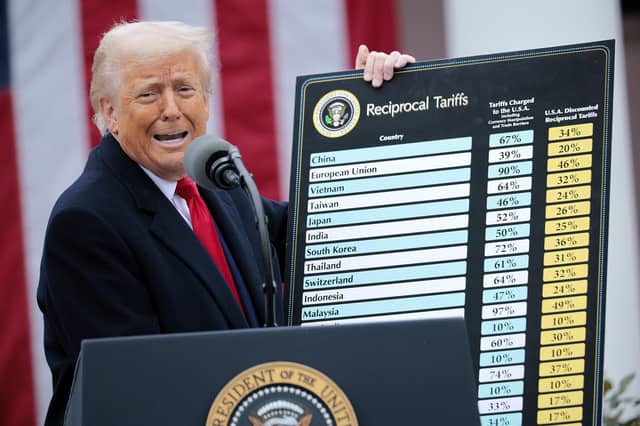

There is plenty of uncertainty but we could be looking at one of three scenarios, especially in terms of the crucially important US-EU trade relationship (there is also a fourth option - ‘defer’ - the president decrees another 60 or 90-day pause):
D Day - desirable day. Things revert to the pre-April status quo and a return to substantial free trade. In this scenario the European trade negotiators have been very successful in bargaining to achieve a degree of mutual free market access more or less returning the world to 2024. There is little indication this is about to happen.
D Day - default day. Whilst the trade negotiations have not been hugely successful there is at least some recognition that a high tariff trade war would produce no winners. US trade policy defaults to applying the 10% baseline tariff against the EU for most products (this would imply the EU would face a tariff broadly similar to that facing the UK). Less optimistically, the EU gets the original 20% tariff although with some exemptions.
D Day - devastation day. The president decides the talks have gone nowhere and reverts to the 50% tariff on the EU which he talked about in May. This would have very damaging effects all round. It is highly likely that the EU would retaliate against a 50% US tariff.
The world economy is now at its ‘just when you thought it was safe to go back into the water’ (Jaws 1975) moment. The ‘pause’” on President Trump’s reciprocal tariffs of April 2025 ends tomorrow. Some of the volatility of early April may come back again.
There might be an optimistic view that American and non-US trade negotiators have been beavering away very productively over the last three months and we are about to see a successful outcome. Free trade will come back and we can all go back to the status quo pre-November 2024. Alas, this very optimistic scenario is extremely unlikely to happen this week.
This is partly because whatever happens tomorrow and in the following months some scar damage has already been done to the world economy which is irreversible. Investors now know that US trade policy is capable of sudden and rather arbitrary movements. What happened in April 2025 could so easily happen again in the future. Investment has already been deferred and supply chains altered. All these changes cost money.
Even in the best case scenario global economy growth in 2025 and 2026 will be less than it would have been but for the Trump tariff changes. This also implies UK and Northern Ireland economic growth is going to be lower.
We know the outlines of UK-US trade rules given the agreement made back on May 8, albeit parts of that agreement await implementation. Most UK (including Northern Ireland) goods will be subject to a 10% tariff in the US. For the time being, pharmaceuticals continue to be exempt from that tariff.
Given the Starmer-Trump agreement, the first 100,000 of UK car exports to the US are subject to 10% rather than a 27.5% tariff. UK aircraft exports (and aircraft parts - important to NI) should be tariff-free. However, the proposed reduction in tariffs on metals (steel and aluminium) has yet to be implemented. For its part, the UK is allowing allowing tariff-free imports of 13,000 tons of US beef and 1.4 billion litres of ethanol (bio-fuel).
Subject to the important qualification that we still don’t know what tariff terms are going to apply to the EU post July 9, it looks possible that the UK, including NI, will be facing a lower US tariff than the EU does (a 20% so-called ‘reciprocal’ tariff was indicated for the EU).
Now what of the impact on NI of a 10% US tariff applying to most goods including manufactured products (although not pharma and aircraft parts)? Forecasting by the economic modellers Fraser of Allander for the Department for the Economy indicates a long run reduction in NI GDP (output) by 0.15%. That is the effect accumulated over a number of years and allowing for macroeconomic adjustments throughout the NI economy.
However, this forecasting exercise does not allow for: (1) the strong possibility that Northern Ireland will be caught up in EU retaliatory tariffs against the US (we would be obliged to do so since under the Windsor Framework we are still part of the EU single market and any compensation payment system under the HMRC’s duty rebate scheme is likely to be slow and ineffective) and (2) the general slowdown in the global economy given the trade uncertainty and disruption.
Given such additional impacts of Trump tariffs it is possible the overall loss in NI GDP would be more like 0.4% of GDP, a big proportion of what had been the previously anticipated economic growth rate in 2025.
As for the EU the outlook is rather unclear. It seems the EU initially offered the US a pretty widespread free trade agreement but this was something the Trump administration would not buy. So, tomorrow we may be returning to reciprocal tariff against the EU.
IF that happens then it is likely there will be retaliatory tariffs against the US. Very importantly, NI will be obliged to apply such tariffs on US products imported through our ports. A more benign scenario would be one in which the European trade negotiators have some success and manage to limit the general tariff on European goods to only 10%, i.e. the same as that applying to most UK products. However, a figure as high as 50% is possible.
Time will tell but suffice to say this is one of the most uncertain outlooks for the international economy for decades – and that uncertainty is imposing a very real economic cost on all of us. Such are the economic consequences of President Trump.
l Dr Esmond Birnie is senior economist at University of Ulster