
Esmond Birnie: Northern Ireland Executive’s commitment to public sector pay parity is as futile as King Canute’s legendary attempt to hold back the sea
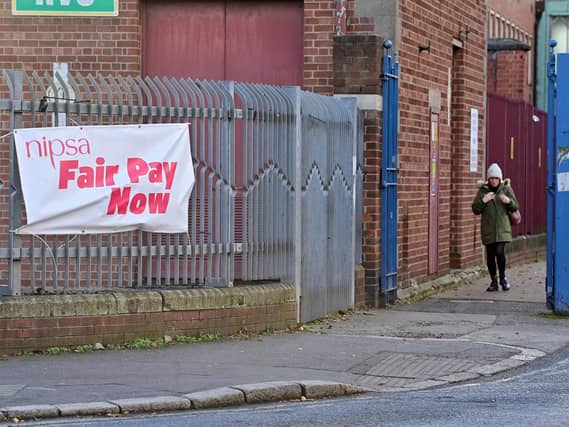
Rumours fly as to various public sector pay offers and threats of strike action. The more fundamental problem over the attempt to try to maintain public sector pay parity (e.g. for nurses and other health sector workers) between Northern Ireland and Great Britain is the point that public sector pay parity is becoming a mathematical impossibility.

That is, the numbers will not stack up unless the Northern Ireland Executive achieves certain other things which are either extremely difficult or very unpopular.
The mathematical point is this. If a certain group of public sector workers in England gets a pay increase that leads to public spending increasing by £Xbn in England.
Through the Barnett Formula, Northern Ireland gets its population share (Northern Ireland’s population as a percentage of England’s) of that additional funding of £Xbn.
Under the recent Interim Fiscal Framework, that Barnett payment is increased by a further 24% in Northern Ireland to reflect and estimate of “relative need”.
However, and here is the crucial point, as a percentage of population Northern Ireland’s public sector workforce is usually many percentage points bigger than that in England.
Per head of the population, Northern Ireland’s amount of public sector employment (number of workers) runs at about one and a half times the rate in England and the rate of employment in the National Health Service is about 40 per cent higher than England.
It follows, even with the 24% top-up, the Northern Ireland Block Grant for public funding usually does not get enough extra money to fully fund pay parity.
Hence I fear the Northern Ireland Executive’s oft repeated commitment to pay parity is as futile as King Canute’s legendary attempt to hold back the sea (though the Northern Ireland Executive may lack Canute’s humility, as in the story he recognised he could not control the tide and sea).
What would have to be done to fully fund parity?
l Ask for more money from HM Treasury. That has been the most often previously adopted strategy.
By all means ask, but there is little guarantee of success. Especially as recently the Treasury did grant that 24% top-up to reflect the estimate of higher need in Northern Ireland.
Given the context of an extremely tight UK Budget at the end of November and for years ahead, further generosity from the UK government is unlikely.
In previous years the Northern Ireland Executive has been able to live off the fat generated by the various financial packages which appear from time to time as part of the periodic restorations of devolution.
That is not a long term solution to paying for pay parity.
l Reduce Northern Ireland’s public sector workforce as a proportion of population.
It is easy to talk about “transformation” and increased efficiency and no doubt these things would be desirable. And, undoubtedly, waste does occur in the Northern Ireland public sector.
However, achieving such gains and squeezing out more output for less money has never proven easy to realise.
l Raise more tax revenue to support the Northern Ireland public sector.
There are some pretty obvious candidates such as the introduction of domestic water charges and lifting the caps on the rates paid by high end properties (and perhaps also remove some of the many rates reliefs which have expanded over the last few decades).
This outcome would of course require immense political courage. And it is the very thing which most of the NI Executive parties have tended to rule out time after time.
l In effect pay for the higher wages by accepting that Northern Ireland’s public sector will produce a lower quantity or quality of output.
From the point of view of the Northern Ireland public this is obviously a highly undesirable outcome but I suspect this has happened in the past and will continue to happen in the future as a consequence of trying to maintain parity and make ends meet.
The point of the Canute story is that there are certain things which even government cannot do.
They cannot readily frustrate the laws of nature. Similarly, notwithstanding the Northern Ireland Executive’s good intention regarding continued pay parity, that intention is likely to repeatedly hit a constraint imposed by mathematics.
In the absence of some rather fundamental reforms it looks like the Northern Ireland Executive will be locked into a Groundhog Day on the issue of public sector pay parity.
l Dr Esmond Birnie is senior economist at Ulster University Business School