
Esmond Birnie: Russia is testing Nato – it has to be given a firm response
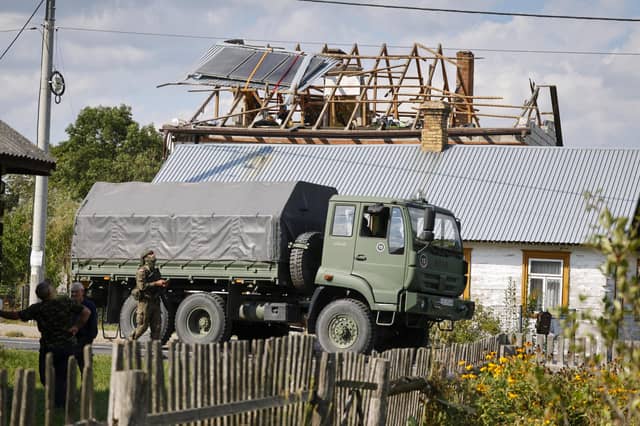
The attack on our ally Poland by 19 Russian drones on September 9-10 was very probably a deliberate test from Putin to see what level of Western/NATO response would be provoked.

It was followed by incursions into Romanian and Estonian air space. In the absence of a firm and substantial response, Putin’s pattern of escalation will continue.
In 2008 Russia invaded Georgia, in 2014 Crimea and the Donbas, in 2022 the rest of Ukraine and within the next 2-5 years Lithuania, Estonia, Poland? It seems very likely that the Russian president is exploiting the doubts which his American counterpart previously introduced as to whether NATO’s policy of collective security (“all for one and one for all”) still applies.
The fact that 19 drones entered Polish airspace suggests this was not a mistake. It may also be significant that these were so-called “decoy drones”, ones which do not carry bombs. Perhaps a carefully calibrated attempt to test NATO’s resolve whilst appearing relatively low key. As we saw, a crashing decoy drone can do a lot of damage. We should be thankful no lives were lost in Poland.
Almost 250 years ago the founding father of economics Adam Smith wrote “defence is much more important than opulence”. He recognised, as some modern governments do not seem to, that sometimes the higher priority of preserving national independence and freedom will require some sacrifices.
In the short run you may prosper by trading with your actual or potential enemy but the long run consequences of such naivety can be disastrous. It is exactly such a policy dilemma which faces the Western world at the moment.
Responding to Russian aggression and the connivance of other powers which claim non-aligned status will have a real economic cost but failure to do so makes it entirely possible that the 2020s will continue to track the dismal pattern set by the 1930s.
The challenge of framing an appropriate response to Russia’s drone strikes can be illustrated by considering the anatomy or supply chain of the drones which crashed in Poland.
They are a Russian spin-off from an Iranian design (the Shahed model). The Ukrainian government alleges that many of the Russian drones are based on kits supplied by the Chinese firm Skywalker.
Reuters and Bloomberg investigations indicate that many Russian drones use Chinese manufactured engines, electronics and cameras. At the same time, the RUSI (Royal United Services Institute) has done a painstaking analysis of the wreckage of Russian drones found in Ukraine and discovered a very high proportion of the microelectronics is actually of US, European and Taiwanese origin. Some very complex and illicit supply chains have been powering the Russian war machine.
There seem to be several lessons. The current level of economic and banking sanctions against Russia which were imposed after the February 2022 invasion of Ukraine is not working. There is leakage in terms of how far advanced Western electronics are still getting into Russia.
There must be a very severe response to any Western individuals or corporates who in effect continue to put money before lives by trading in technology with Russia.
Secondly, leaving to one side the cases of regimes such as that of Iran or North Korea which are pretty obviously in Putin’s camp, the Western response to Russian aggression will need to tackle those countries, notably China and India, which claim to be non-aligned in this conflict.
Even if it is strictly true that China has not supplied weapons as such to Russia it does look very likely Chinese components are an essential part of many Russian drones.
There is also the undoubted reality that Russia has been able to finance its war through exporting oil in large quantities to countries such as China and India. This prompts the difficult question whether to adopt President Trump’s proposal for “secondary sanctions” - that is a high rate of tariffs on those countries which continue to buy sizeable amounts of Russian goods such as oil and gas.
As a free-trade economist I have been highly critical of most of Trump’s tariff policies. However, I concede that on this occasion he could be right. Especially in the light of how Putin is now getting careless about the integrity of NATO territory there is a strong case for secondary sanctions. Unfortunately, it is entirely possible that by this stage Trump has lost interest in the policy.
To summarise, 24 years on from 9/11 it is no cliché to say we face a level of aggression which requires a proportional and very firm response.
That response would have at least two elements. First, try to shut down the continuing supply of Western technology (microelectronics) into Russia. Second, secondary sanctions against countries which are giving Putin tacit support.
There may even be a case for placing NATO anti-missile defences on the Polish border and firing those against any Russian drones which appear in the airspace of western Ukraine.
In moral terms and in terms of international law that seems highly legitimate”.
Dr Esmond Birnie is senior economist at Ulster University Business School