
Esmond Birnie: Translink’s problems - along with those of Northern Ireland Water - are a symptom of a dysfunctional NI Executive
Back in the Italy of the 1920s, the supporters of Fascist dictator Mussolini said one of his great achievements was getting the trains to run on time.
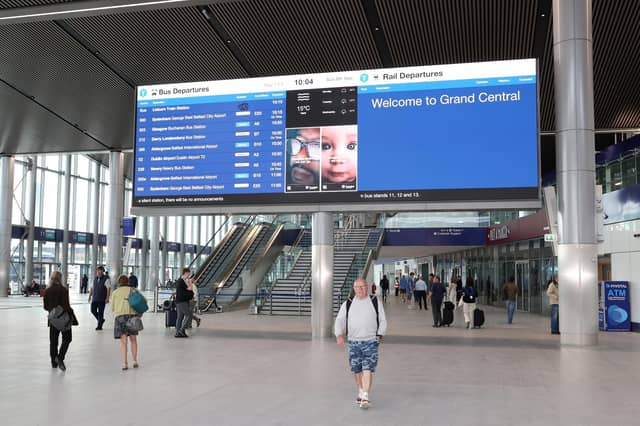

That was a far too generous assessment of Il Duce. Here in Northern Ireland in 2026 we now know that Translink’s train and bus services are about to be pared back to cut costs.
It is all too easy to assume this must be the fault of that public corporation. It is the policy approach of the infrastructure minister in particular and of the NI Executive in general which have forced Translink into this undesirable position.
Translink made a loss of £23m in 2025/26, up from the loss of £11.9m in 2024/25. We tend to think of Translink as a state body. It is in fact a public corporation which implies it is meant to act somewhat commercially: to balance its books and to raise most of its revenue through fares charged to customers.
Here’s the crucial point, whereas Translink have been facing large increases in costs (notably in terms of fuel but also in terms of National Insurance contributions for staff), infrastructure minister Liz Kimmins has vetoed any fare increases for the second year in a row. In fact, over the last nine years, executive ministers have blocked fare increases on five occasions.
Of course no one enjoys paying more for fares. But imagine what would happen if government tried via diktat to prevent petrol stations from charging more for fuel given the supply reduction coming from the Gulf. Or if government tried to ban increases in grocery prices in the face of rising costs at the global level. The result would be chaotic and even more harmful.
It is not as though Stormont has increased the operating subsidy paid to Translink to compensate for higher costs and/or the absence of fare increases. The transport company has in fact been forced to eat into its reserves.
That is obviously not a strategy which can be pursued indefinitely. Something had to give and outgoing Translink chief executive Chris Conway indicated that costs will be reduced by reductions in service provision.
Fundamentally what is going on here is an absence of taking responsibility on the part of the minister, or the executive more widely. The infrastructure minister may set the broad objectives for Translink but she is denying it the commercial freedom to meet those objectives.
She does not provide enough funding to meet those objectives. When Translink is forced to make some hard choices she tries to deny this has got anything to do with her.
Readers may recognise a familiar pattern. In a similar way, the infrastructure department is the parent department for Northern Ireland Water (NIW).
NIW is given lots of objectives and legally required standards but this begs the question, what happens when the level of subsidy given by the department falls short of that necessary to meet those outcomes?
One obvious way to square the circle would be to introduce domestic water charges (although making allowance to protect low income households). The infrastructure minister, and probably all her executive colleagues, remains adamantly opposed to such charges.
Turning back to Translink’s predicament - what could be done?
I would suggest looking again at the level of subsidy given, although given the current budgetary difficulties at Stormont finding extra money will be challenging.
Yes, the transport corporation should be given more commercial freedom to raise some fares. There is scope to cut costs through, for example, removing the 60+ Smart Pass concession (i.e. zero) fare.
This was an ill-advised “freebie” policy give away of the Robinson-McGuinness era.
Why should someone in the early 60s who is still in work and earning get free public transport? Why should Northern Ireland be able to afford free public transport for everyone in their early 60s when this policy is not being pursued in either England or the Republic of Ireland?
There may also be some scope to raise productivity. Translink’s accounts for 2024-25 indicate that in that year the number of staff employed increased slightly more than the number of passenger journeys. Admittedly, a crude measure of efficiency and productivity.
Public transport obviously matters a great deal in terms of the impact of mobility on the economy and people’s wellbeing as well as regional balance.
What I am arguing here is that Translink’s problems, along with those of NIW, are a symptom of something bigger. The Stormont Executive is not working properly.
So-called Arms Length Bodies (ALBs) such as Translink and NIW act as the agents which deliver for the executive ministers, but those ministers constrain what those ALBs are able to do.
When the ALBs are forced to make the hard choices, the executive ministers try to shield themselves by saying it has nothing to do with them.
That is becoming a less and less credible defence as is the claim being made by both Sinn Fein and the DUP that ultimately problems in public service delivery are caused by alleged under-funding by the UK government.
Dr Esmond Birnie is senior economist, Ulster University Business School