
Esmond Birnie: Trump may be a very effective populist but he is no friend of either the market economy or conservatism
One of the many worrying features about US trade and foreign policy is the extent to which policy is subject to violent shifts because of whims on the part of Donald Trump.
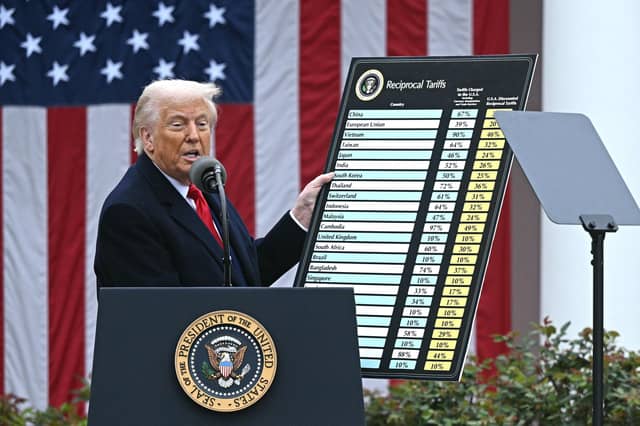

One example of this happened in the last fortnight. The premier of Canada’s Ontario Province, the Conservative Doug Ford, and other Canadians paid to place a TV ad across some US TV networks.
That ad consisted of parts of a 1987 speech by then US president Ronald Reagan on the case for free trade as opposed to tariffs.
Trump seemed to regard this as insolent behaviour. Enough to justify pausing US-Canada trade talks and placing another 10% on top of the previous 35% general tariff on Canadian sales to the US.
The main reason why Trump has reacted so ferociously to the Canadian ad was perhaps because that ad pointed to a significant truth.
It is Trump himself who is out of line with the mainstream of what was previously mainstream US Republicanism for about 50 years after 1950. That mainstream was pro free trade and valued working alongside North Atlantic allies, notably Canada, the UK and the rest of Nato.
Trump moved US trade and foreign policy into reverse gear by ending global free trade and by seriously damaging Nato.
The PM of Canada’s Ontario Province - and it should be noted he is a political conservative - has done us all a service by funding this ad which points out what has really been going on.
It is the case that the Canadian origin ad changed the order of Reagan’s remarks but it did not change Reagan’s essential message as originally given.
President Reagan argued that tariffs and trade protection lead to retaliation. Hence tariffs in the long run leave us all (including Americans as consumers) worse off.
This is essentially what most economists, including most American economists, have been saying for decades but it is always useful to hear that message coming from a mainstream politician.
It is certainly true that back in the 1980s Reagan did introduce a few tariffs on some Japanese manufactured goods but these were limited in scope.
There was nothing comparable to the broad and deep tariff wall which Trump is now building.
Reagan, as his own words confirm, was usually a free trader. It was during his administrations (1980-88) that much of the preparatory work was done in terms of the US’s economic relationship with both Canada and Mexico which would lead to the North American Free Trade Agreement of the mid-1990s.
Some have speculated that what Trump is worried about is how the ad might impact on the current Supreme Court case which is considering whether his tariffs are constitutional.
The wording of the US Constitution is very clear that taxes (and almost everyone accepts tariffs are a form of taxation) are a responsibility of Congress.
This is what is said in Article 1, Section 8, Clause 1 which grants to Congress the power, “to lay and collect taxes, duties, imposts and excises, to pay the debts and provide for the common defence and general welfare of the United States”.
That might seem pretty definitive. No doubt the president will continue to argue that as commander in chief he can take measures, including the imposition of tariffs, which will protect “strategic industries”, thereby promoting national defence.
The problem with that argument is that his tariffs have probably weakened America’s network of alliances with various parts of East Asia and Europe.
Moreover, US tariffs on steel imports mean that it will now probably cost more for US shipyards to build submarines for the US Navy (currently specialised British made steel is used in American submarines). That does not seem conducive to national defence.
And here’s another irony, hitherto it has usually been political conservatives who have been concerned about getting back to the original intent of the framers of the American Constitution but the application of tariffs by the president seems to cut across that original intent.
None of this is to suggest that Reagan was some sort of paragon of economic wisdom or governmental virtue.
That said, like most of the other post-1945 US Republican presidents (Eisenhower, Nixon and the Bushes), he could be robustly right wing whilst not indulging in the excesses of nativism regarding either trade or, indeed, immigration.
Trump places no such inhibitions on his politics.
Once again, Trump may be a very effective populist but he is no friend of either the market economy, see his apparently arbitrary interventions in the US semiconductor industry, or conservativism rightly understood.
The columnist Andrew Neil expressed it well: “Right wing populists like Trump have more in common with the Left than with true believers like Ronald Reagan or Margaret Thatcher.”
l Dr Esmond Birnie is senior economist at Ulster University Business School