
Esmond Birnie: UK government should exercise care for tax payers’ money in the case of Casement Park
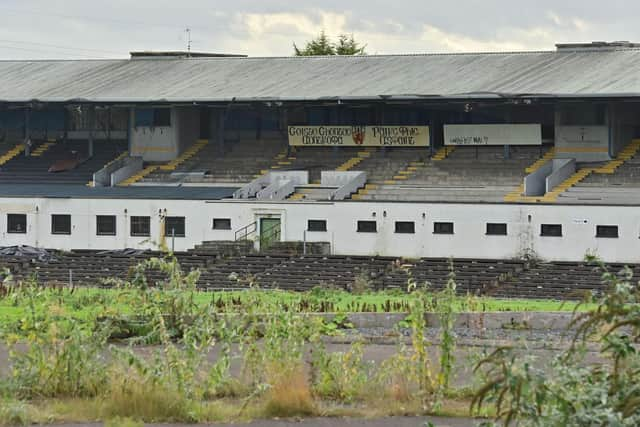
As we consider the potential re-build of Casement Park by 2027 in time to host the Euros football in 2028, which seems to be dependent on a hefty public subsidy (particularly from the UK government), what can be realistically said about the costs and benefits of that stadium?
Forecast building cost has already increased from about £70m to more than £300m. Further inflation is possible given uncertainty about global energy and commodity prices.

Northern Ireland (NI) has a woeful record in terms of failing to keep big infrastructure projects within budget.
It would be a very dangerous position from a cost control point of view if the UK government committed to pay whatever it took to get the building work over the line by 2027.
A comprehensive “cost-benefit analysis” would include an estimate of the negative impact on people living near Casement of having a much larger stadium next door to them along with crowds, litter, anti-social behaviour and light and noise pollution.
If Casement is re-built we could examine what could happen to house prices in the neighbourhood: any major decline in values perhaps capturing the “social cost” of living near to a large sports ground.
Admittedly, some of the UK and international (especially US) research on house price impact of stadia suggests the effect could be positive albeit this could be more about how building a stadium is sometimes associated with improvements in transport infrastructure and other urban development [Note 1].
It is also worth noting that the Euros, and an subsequent major events at Casement, would be associated with crowd control challenges implying that extra policing would be required.
This would certainly be another burden on the Northern Ireland (NI) public sector budget and probably should be added to the general economic cost of re-building Casement for the Euros.
As an illustration, a match in 2017 in Windsor Park, Celtic vs. Linfield, had a policing cost of about £100,000 [Note 2].
Attendance at that game was quite small (just over 6,000) so the cost of policing the Euros could be many times £100,000 per match.
Benefits of Casement: In terms of economic impact of Euros
There have been some attempts to justify a very large public subsidy for the re-build by arguing that very substantial economic benefits could follow from the Euros.
A consultancy report by Grant Thornton commissioned by the GAA [Note 3] arrived at a high figure of £106m in terms of the total tourism and spending which would occur in Belfast if we had the Euros in 2028.
That report does not appear to be in the public domain which means it is not possible to assess its assumptions.
I have therefore conducted the following assessment of the monetary benefits of Casement for the Euros.
In forecasting what could happen to total spending in NI and hence to the economic output (GDP) of the region it is very important to focus on the number of visitors who would come from outside of NI (i.e. from GB plus rest of world).
The reason for this is that it is very likely that any spend by NI based fans attending matches would probably largely “displace” spending which they would have made within NI in any case.
This concentration on “outsider” visitors is a standard assumption in cost-benefit analyses of the economic impact of sporting and cultural events.
Having assumed that all matches would have 100% ticket sales, we need to make three further and key assumptions to arrive at estimated result for increased spend within NI generated by the Euros:
What proportion of attendees at the matches would be from outside NI?
Over how many days/nights would those outsiders be present in NI? (Not a straightforward question as, depending on the timing of matches, it is possible that some visitors would fly in and out on the same day, also, we do not know if UEFA would assign Belfast four or five games.)
How much would they spend during each day in NI?
In an optimistic scenario we assume: 90% attendance is by outsiders over 5 days and spending of £311 per person per day [Note 4].
That spend per day figure is based on an inflation-upgraded estimate of the spend per day by visiting fans associated with the Chelsea-Villareal Super Cup match at Windsor Park in August 2021.
In a pessimistic scenario we assume 60% attendance is by outsiders over 4 days and spending of £108 per day.
This would imply in the optimistic scenario additional spending of £42m and in the pessimistic scenario £7.8m [Note 5].
Even these figures may exaggerate the extent to which there would be an additional gain to spending in NI and hence to NI GDP.
About 25,000 outsiders per night would exceed the number of hotel beds spaces in Greater Belfast (indeed, for NI as a whole).
Hotel occupancy rates would normally be relatively high in June-July when the Euros are held.
There is a very real danger that some “normal” tourism would actually be diverted away from NI whilst the Euros are going on.
Benefits of Casement: Over the long term through hosting other sporting events
It has, of course been, claimed that the point of investing in Casement is not just to have the one-off economic boost from the 2028 Euros but also in terms of increased spending through a host of other events in the future.
Both the GAA and Grant Thornton referenced this although did not go into detail.
The problem with such claims is that they are speculative whereas the Euros in 2028 is at least a known fixture.
We do know that once Casement was built and then converted to a part seat, part standing format for the GAA it would no longer be eligible to host any further Euros after 2028.
There are musical and cultural events but the problem here is that even a re-built Casement with a capacity in the low 30,000s would be small by UK and international terms.
For example, at the 2024 Taylor Swift concerts in Edinburgh (73,000 at Murrayfield) and Dublin (50,000 at the Aviva) there were much larger crowds. Bruce Springstein at Boucher Belfast attracted a crowd of 40,000.
Another long term imponderable is just how valuable Euros related TV coverage would be to NI on the world stage.
Previous sporting events in NI, notably the Open at Portrush in 2019 were claimed to have generated global TV coverage worth £37m for 5,400 hours of global TV coverage [Note 6].
The length of time of TV broadcasts associated with 5 football matches would be shorter than the length of the golf.
Also, the golf coverage was skewed more to the particularly important USA market.
Using that Open estimate of the value of TV coverage per hour and multiplying that up could imply an estimated value of Euros broadcasting of about £4.2m [Note 7].
It is hard to say just how many tourists might come to NI because of a “flash” picture of, say, Belfast City Hall or the Causeway before a match at Casement but surely most of the continental European TV audience would view the coverage coming from Belfast as just one of a number of venues across the UK and the Republic of Ireland.
Conclusions
There is of course an equity argument that the GAA should get a subsidy in line with that already given to rugby and football.
That smaller amount of money would enable a re-development of Casement but would not produce the scale necessary to host the Euros.
Given the scale of the public funding challenges facing NI and the limited forecast economic gains from the Euros the more modest approach seems appropriate.
In mid July 2024 the UK Government announced that it would not provide a loan guarantee to Harland and Wolff.
The grounds for this refusal was a substantial risk to the taxpayer. I have some sympathy for the Government’s position.
Unfortunately, in the case of Casement we are not talking about a “risk” we would be experiencing but rather an actual loss of about £200m of UK government public subsidy which would then not be available to spend on projects with a potentially much higher return”.
Note 1: For a suggested positive effect from football grounds in London through to house prices (based on research by Pure Commercial Finance) see Watford Observer 8 August 2019, “Living near a Premier League stadium increases the value of your property”, online. Other UK research suggests it depends on the sport, negative for rugby but positive or cricket. See Daily Mail 3 October 2020, “What’s the score? Property price winners and losers when it comes to living near stadiums- and cricket comes out on top”, online. The latter quoted estate agents in central Manchester as saying that 20% of clients viewed being close to football grounds as a negative with the remaining 80% being indifferent.
Note 2: Belfast Telegraph, 7 September 2017, “£100k for policing Linfield versus Celtic”, online.
Note 3: BBC 23 May 2024, “Hosting Euros “could bring more than £100m to Northern Ireland”, online. It is unclear how the consultants got such a large figure: did they assume all spending by fans (regardless of whether they come from NI or not) should be included, did they assume very high rates of daily spending by the fans?
Note 4: In 2021 at the Super Cup between Chelsea and Villareal 10,435 fans attended Windsor Park (Covid restricted) and spent £1.12m on accommodation plus £700,000 on other spend, i.e. £260 per person (assuming a one night stay on average and assuming 67% of the 10,435 fans were from outside NI): Belfast City Council 25 March 2022, “UEFA Conference League Fund 2023”, Strategic Resources and Policy Committee, online. We used the Office for National Statistics CPI index (June 2024 compared to August 2021) to upgrade the £260 in inflation terms, i.e. £260 X 134.1/112.1 (ONS, 17July 2024, “CPI INDEX 00: ALL ITEMS 2015=100).
In 2019 research for Visit Britain indicated foreign fans coming to the UK for football spent a total of £87 per day (Visit Britain, October 2019, “Football tourism in the UK”, online.). This was also upgraded using the ONS CPI index, i.e. £87 X 134.1/107.9.
Note 5: Optimistic scenario: 30,000 X 0.9 X 5 X 311 = £42m.
Pessimistic scenario 30,000 X 0.6 X 4 X 108 = £7.8m.
Note 6: “The 148th Open delivered £100m of economic benefit to Northern Ireland”, online.
Note 7: The source in Note 6 attributed a value of £37.3m to 5,400 global broadcast hours. That would imply a value per broadcast hour of about £7,000. We assume, very crudely, that 2 TV broadcasters in each of 30 European countries broadcast all five matches in NI at 2 hours per match, i.e. 2 X 30 X 5 X 2 =600 hours. 600 hours X £7,000= an estimated value of £4.2m.
Dr Esmond Birnie is senior economist at Ulster University Business School