
Esmond Birnie: Why Alliance MLA's amendment to ban smacking in Northern Ireland would be harmful legislation
It is sometimes claimed that one of the failures of the Northern Ireland assembly is the relatively small quantity of legislation it has produced. That said, if laws are bad laws it would be better to have no new legislation at all.
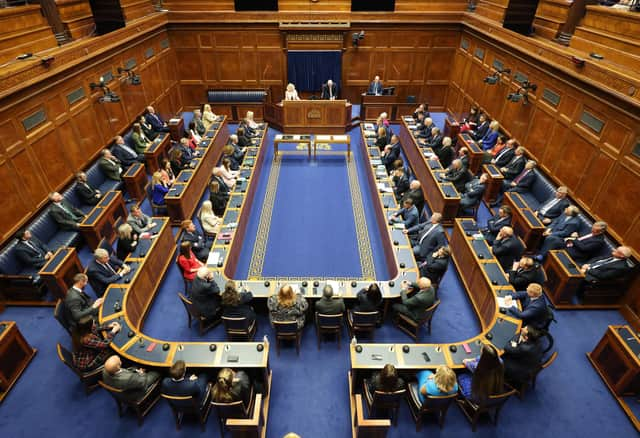
Alliance MLA Michelle Guy has put down an amendment to the justice minister’s Justice Bill. The assembly could be voting on her amendment within weeks. If it passes, NI will join Scotland and Wales, though not England, in removing the “reasonable punishment” defence. This has allowed parents to smack their children provided that such smacks produce nothing more than transient reddening of the skin. Guy’s amendment would remove what is in truth a rather narrow permission to smack. It raises profound questions about parent rights, child protection and competing demands for scarce funds for public services.

It is important to stress that the existing law in NI and England provides protection for children. It allows only the lightest of chastisement. In July 2018 in Torquay a stepfather was successful prosecuted for hitting his daughter in such a way that he left a hand-print on her.
Of course, MLAs who might be inclined to support this amendment will claim public opinion is on their side. In fact, a YouGov poll in 2021 showed that 80% of adults admitted that they had smacked their own children (the proportion who actually did so may be even higher). In an NI-specific poll by Parentkind in 2025, 40% of parents supported the legality of smacking against 38% who opposed it.

The leading charity NSPCC have funded adverts calling on the assembly to “make the law clear” by banning smacking. The change envisaged would actually create ambiguity. The authorities would have to decide whether prosecution of a parent passed a “public interest” test. And they would have to decide when the parent exerted some sort of physical force on a child (eg in terms of putting a child into a child car seat) was there an intention to punish. All this is highly subjective and contrasts with the current state of the law where the test is whether physical harm has been done to a child.
What we can all agree on is that a smacking ban is a major change. As such it should properly be the subject of legislation in its own right. Given the use of an amendment this law change would occur without a public consultation and without a proper costing of the public expenditure implication.
What is also missing in this campaign against smacking is any sober assessment of what has happened in Scotland and Wales since they introduced bans a few years ago (in 2020 and 2022, respectively). In 2024 the official body responsible for social services in Scotland, Social Work Scotland, admitted that implementation of the new law was posing “challenging issues”.
Official figures published by the Welsh government in 2025 demonstrated that in the Wales there had been a very significant jump of about three-quarters in the first two years of the law change in number of contacts to social services relating either wholly or partly to physical punishment. There are gaps in the Welsh data for both before and after the law change but this is the best official data we have on the effect of changing the law. We also know, again from the Welsh data, that in the first three years 130 parents, 125 and 110 were referred to a diversion scheme. This is an attempt to provide an out-of-court resolution but will nonetheless still be a traumatic experience and still constitutes a criminalisation of the parents.
At a time when funding for public services is short can it be wise to create a further, unnecessary call on such funding? The Welsh government estimated that the cost of implementing a smacking ban would be £7.9m over six years excluding social services. It is now possible to estimate that the additional annual cost in terms of social services would be £0.5m to £1.5m.
Public policy should, of course, be evidence based. The proponents of a smacking ban like to argue that there is a mass of sociological data which proves the harm done to children from even the lightest of smacks. In fact, many academic experts such as Professor Ellie Lee or Dr Ashley Frawley or Professor Robert Larzelere have argued that there is no such evidence base.
No doubt when this matter comes up for debate at Stormont we will be told that to ban is to be on the right side of history. In fact most countries either allow smacking or if they do have a ban it is a symbolic civil law provision with no criminal liabilities. Sweden did introduce an outright ban in 1979 but what followed was not sweetness and light. Child-on-child violence in Sweden escalated massively during 1984-2010.
Perhaps the main reason for voting to preserve our existing position is a desire to avoid criminalising innocent parents by the mix of police, legal and social services investigations which would inevitably be unleashed by a ban. We know there will be an escalation because the Welsh data for 2022-25 has provided proof. There would be unnecessary suffering in terms of damaged family life, lost jobs and implied financial hardships. All this because in the brave new world of the Guy amendment the lightest of smacks would lead to investigations which would then be recorded in Access NI checks.
l Dr Esmond Birnie, Senior Economist Ulster University Business School